
You Won't Believe What New Orleans' Dawn DeDeaux Unleashed at the Venice Biennale – Shocking Art That Could Change Everything!

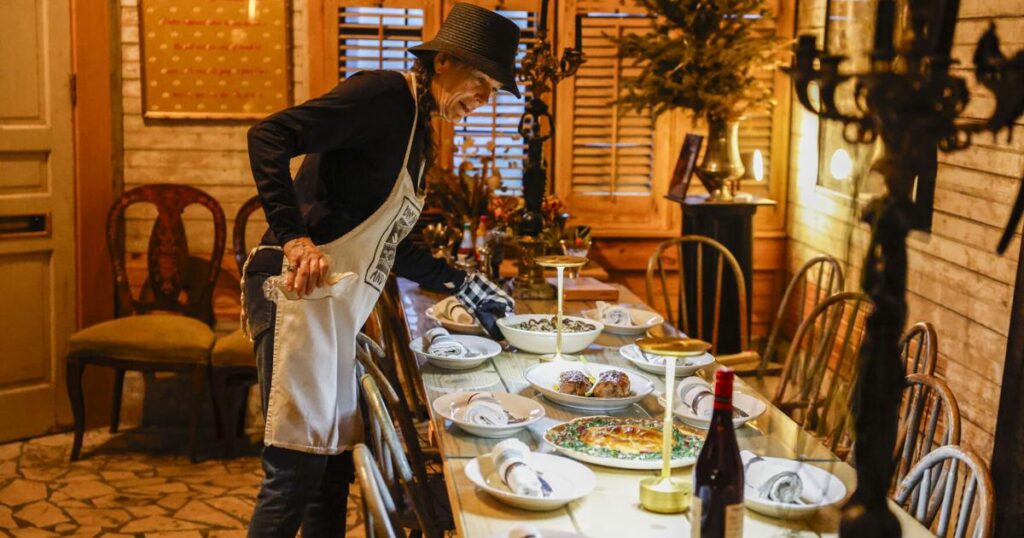
Three days before embarking on a journey to Italy for a landmark exhibition, New Orleans artist Dawn DeDeaux was bustling around her home, a transformed old po-boy shop in Gentilly. With forks in one hand and spoons in the other, she engaged in a light-hearted conversation with Susan Taylor, the director of the New Orleans Museum of Art, discussing the curious phenomenon of a potential black hole in the sea. This blend of personal and cosmic themes characterizes DeDeaux's work, which consistently probes the universe’s pressing questions through various artistic mediums including photography, video, and sculpture.
At 73, DeDeaux has cultivated a reputation for creating art that is not only grand in scale but also deeply human and intimate. Her works invite viewers into a carefully constructed world, allowing them to explore complex themes through a relational lens. “I can’t look at anything in a singular way,” she emphasizes. “It’s all relational.”
For years, DeDeaux has been pushing the boundaries of what art can mean and how it can be experienced. Her home, dubbed Camp Abundance, reflects this philosophy. With its mixture of antique and futuristic elements—from white columns inscribed with Milton's “Paradise Lost” to clear acrylic ladders—it is a space that challenges conventional ideas about art and environment. "If you give her a conventional environment and let her follow her instincts, it will inevitably be transformed into something marvelous,” noted Dan Cameron, a curator whose work has included the Prospect New Orleans triennial.
This May, DeDeaux will debut a new installation in the final room of the Arsenale at the Venice Biennale, one of the most prestigious contemporary art events in the world. This year, she will share the spotlight with 110 other artists in the central group show titled “In Minor Keys.” Fellow New Orleans artist Demond Melancon, known for his work in the Black Masking Indian tradition, will also represent the city at this significant exhibition.
Being selected for the Biennale is a monumental achievement that DeDeaux never foresaw. “It’s a chance for the world to discover what New Orleans knows and New York City ought to have learned by now,” Cameron remarked. “It’s now time for Dawn to get the recognition she deserves.”
The Journey of an Artist
Raised in New Orleans as the eldest of six children, DeDeaux faced significant family challenges, including the loss of two siblings in one year. This personal turmoil deepened her empathy and shaped her artistic vision. After moving into her grandmother’s house on Esplanade Avenue, she absorbed the changing cultural landscape around her—particularly the effects of White flight on her community. A bohemian artist renting a room upstairs introduced her to painting and the world of New York art galleries, planting the seeds for her future career.
Her artistic journey has been marked by explorations of racial divides, environmental issues, and a keen sense of justice. Following the devastation of Hurricane Katrina in 2005, she witnessed a transformative shift in her perspective on New Orleans. “We went from looking to our past to looking at the future,” she reflected, highlighting that the hurricane provided a unique vantage point for understanding the fragility of the land she calls home.
DeDeaux’s work often intertwines themes of beauty and calamity, as seen in her installations made from post-Katrina remnants. For instance, her creation of “Gulf to Galaxy” was sparked by a moment of beauty amid destruction, when she found herself standing amidst shattered glass in a shopping center, illuminated by sunlight. “I looked up and saw pelicans flying, and when I looked back down, the sun was hitting the glass, and I was in a field of diamonds,” she recalls. This duality of devastation and beauty is a recurring theme in her work, reflecting her belief that art can navigate complex emotional territories.
As she prepares for her Venice debut, DeDeaux is immersed in finalizing her installation, which will incorporate sculpture, sketches, found objects, and a new film piece. Just days before her departure, she experienced a breakthrough, completing the film’s script. “It just came out. Boom, boom, boom,” she shared with her friend Susan Taylor during a dinner party at Camp Abundance, where she prepared a feast of sweet figs, truffle risotto, and pork tenderloins for her guests.
DeDeaux's commitment to her craft is palpable, as is her enthusiasm for culinary artistry. "The table is where everything happens," she declares, emphasizing her love for hosting and sharing knowledge with others. As she engages her guests in conversations about history, art, and science, it becomes evident that her role transcends that of a mere artist; she is a community-builder, an educator, and a visionary.
In a world increasingly aware of its existential threats, DeDeaux’s work resonates deeply. She embodies the belief that there is power in speculation and creativity, especially during times of uncertainty. Her optimism is reflected in the name of her home, Camp Abundance, suggesting a space where ideas flourish, and connections are made. As she prepares for her journey to the Venice Biennale, DeDeaux remains a testament to the resilience and transformative power of art in the face of personal and communal challenges.
This $80K Cryptocurrency Could Skyrocket to $300K—Are You Ready to Miss Out?

This One Growth Stock Could Soar 100%—Are You Ready to Risk Missing Out?

The Shocking Truth About Men’s vs. Women’s Running Shoes: What I Discovered Will Change Your Game!
Shocking Discovery: How One University’s Model Could Predict Measles Outbreaks—Are You at Risk?
You Won't Believe How the Raiders' Shocking Win Changes Everything for High School Soccer!

You Won't Believe What Could Happen If We Hit Just 2 Degrees of Global Warming—The Shocking Consequences Revealed!
You might also like: