
You Won't Believe What Happened When China's Xpeng Robot Tried to Walk - Shocking Footage Inside!

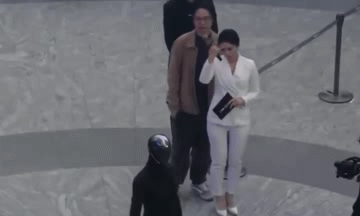
In an intriguing display of technology and the challenges still faced by humanoid robots, China's Xpeng introduced its robotic creation, named IRON, during a public event at a shopping mall on January 31. Standing at a height of 178 centimeters and weighing 70 kilograms, IRON is engineered to walk, speak, and interact with people in real-time. Its design incorporates a structure modeled on the human spine and muscular system, utilizing synthetic muscles to facilitate smoother, more natural movements.
During its debut, videos on Chinese social media captured the moment when IRON took a misstep while lifting its arm, resulting in a fall that drew audible gasps from the audience. Staff members quickly rushed to assist as the robot tumbled forward onto the ground. The event's host attempted to reassure the shocked crowd, stating that robots, much like humans, must "overcome setbacks on the way to a better future," as reported by Business Insider.
This incident, despite IRON having navigated the stage successfully several times prior, went viral over the weekend, becoming the top trending topic across various Chinese social media platforms, according to the South China Morning Post. The CEO of Xpeng, He Xiaopeng, reacted to the unforeseen hiccup on Weibo, likening it to how toddlers learn to walk. “After a fall, they will stand firm; the next step is to begin running, and to keep running,” he remarked.
The fall highlights significant challenges that humanoid robots still encounter in physical movement. While artificial intelligence has rapidly advanced in cognitive tasks, achieving fluid and stable physical embodiment remains a more complex hurdle. According to Zhang Qiang, the director of the academic committee of the Beijing Innovation Center of Humanoid Robotics, “It is quite difficult to find truly comprehensive data on human movement.” This suggests that while the field of robotics is evolving, there is still a long way to go before robots can match the natural grace and balance of humans.
IRON was previously noted for its strikingly light, catwalk-like gait, which had already attracted attention online. During a demonstration last November, He Xiaopeng even opened the robot's outer layer to confirm to viewers that no human was inside, dispelling skepticism about its lifelike movements.
The incident not only serves as a reminder of the challenges ahead for robotics but also illustrates the public's fascination with advancements in technology. As companies like Xpeng continue to push the boundaries of robotics, incidents like IRON's fall could serve as pivotal learning moments in the quest to create machines that can seamlessly integrate into human environments.
Spain's Shocking Move: Is Social Media for Under-16s Facing a Total Ban? Find Out What This Means!
Access Denied: The Shocking Truth About Your Privacy That Could Cost You Everything!

Government Shutdown Ends, But You Won't Believe What Trump Just Revealed in Shocking Meeting!

PepsiCo Just Slashed Snack Prices—Find Out Which Popular Items Are Shockingly Cheap Now!

Is Your Life at Stake? Discover How Political Decisions Are Costing Lives Everyday!

Dak Prescott's Shocking Turn in Pro Bowl: How He Led the NFC to a Stunning Flag Football Victory!
You might also like: