
Scientists Discover a Shocking New Way to Save Coral – You Won’t Believe the Results!

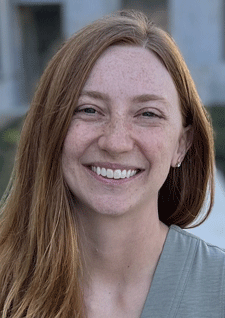
The Santa Barbara Maritime Museum (SBMM) is set to host the latest installment of its Maritime Distinguished Speaker Series, featuring a lecture by Marley Dewey, an assistant professor of bioengineering at the University of California, Santa Barbara. The event, titled “How Our Skeletons Can Save Our Reefs,” will take place at 7 p.m. on Thursday, May 21, at the museum. Those attending the event can join a pre-lecture reception specifically for SBMM members from 6:15-6:45 p.m.
Tickets for the lecture are available at no cost for Navigators Circle members, while SBMM members can purchase tickets for $10. The general public can attend for $20, and students and educators with valid identification can secure tickets for just $5. Reservations can be made online, via email at [email protected], or by calling 805-456-8750.
Coral reefs, which are vital marine ecosystems, are primarily formed by living animals that build calcium-based skeletons, offering support to diverse marine life, safeguarding coastlines, and providing sustenance and livelihoods for millions globally. However, these crucial habitats have faced significant threats, with a staggering decline of more than 50 percent since 1950 due to ocean warming and acidification. Traditional restoration efforts have struggled to adapt to this rapid loss, prompting scientists to seek innovative solutions.
Dr. Dewey’s groundbreaking research aims to apply advancements in biomaterials and tissue engineering—originally developed for human bone repair—to the restoration of coral reefs. Traditionally, coral skeletons have been used to help heal human bones, but her lab is reversing this approach. By utilizing lessons learned from bone repair technologies, Dewey is working on designing materials that can promote coral growth and rebuild damaged reef structures.
In her upcoming presentation, Dewey will delve into the scientific connections between human and coral skeletons, the evolution of biomaterials research, and the burgeoning field of coral tissue engineering. “This work has significant implications for coastal ecosystems worldwide, including those that influence ocean health and biodiversity along the California coast and within the Santa Barbara Channel,” the SBMM noted.
Dean Noble, executive director at SBMM, expressed excitement for hosting researchers like Dr. Dewey, emphasizing how her work showcases the intersection of innovation and science in tackling urgent oceanic challenges. “Her research reflects the kind of forward-thinking solutions that inspire hope and deepen our community’s connection to ocean stewardship,” Noble stated.
Lis Perry, SBMM’s director of education, highlighted the importance of the Maritime Distinguished Speaker Series in connecting the community with prominent voices in ocean science and conservation. “Dr. Dewey’s presentation underscores how interdisciplinary research can aid in protecting marine ecosystems and encourage the next generation of ocean advocates,” she added.
Marley Dewey’s academic background includes a Bachelor of Science degree in chemical engineering from the University of Maine, followed by a Ph.D. in materials science and engineering from the University of Illinois Urbana-Champaign. There, she was recognized as a National Science Foundation Graduate Research Fellow and received the Annual Innovation Award for Outstanding Ph.D. Thesis. Dewey also served as an NIH Clinical and Translational Science Fellow at the McGowan Institute for Regenerative Medicine at the University of Pittsburgh. Her research interests encompass developing biomaterials and nanoparticles for improved human bone repair, disease treatment, and the restoration of coral reef ecosystems.
“Corals and humans both rely on skeletons to provide structure and support,” Dewey explained. “By applying what we’ve learned from repairing human bone, we can develop new tools that may help coral reefs recover and strengthen in the face of environmental change.” This innovative approach not only underscores the scientific community's commitment to marine conservation but also fosters a deeper understanding of the interconnectedness of life on Earth.
You Won't Believe How Chef Robotics Turned Failure into a $10 Million Success—Find Out Their Secret!

Is House District 44 About to Explode? Two More Republicans Enter the Race—What This Means for You!
LACMA's Geffen Galleries Open on April 19—Will You Miss the Most Anticipated Art Reveal of the Year?

Is Your Health at Risk? Discover the Shocking Truth Behind Beyond Risk’s New $50M Funding Platform!

Why Williamson County's Commercial Real Estate Surged by 30%—Are You Missing Out?

S&P 500 Soars After Iran Drops a Shocking Truth About the Strait of Hormuz—What You Must Know!
You might also like: