
Kathy Hochul's Shocking 140 Vetoes: What Critical Bills Will You Never See?

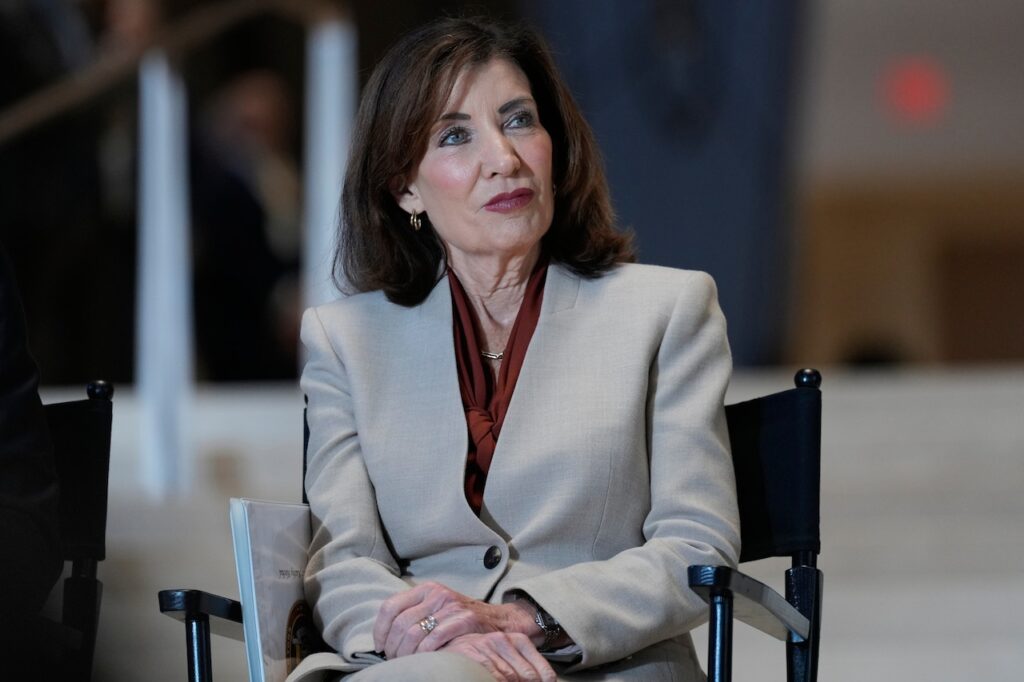
By Zachary Groz | New York Focus
This story originally appeared in New York Focus, a nonprofit news publication investigating power in New York. Sign up for their newsletter here.
For the first Christmas holiday since she took office in 2021, Governor Kathy Hochul will not be bringing a stack of unsigned bills with her. This year, she has already either signed or vetoed all but two of the 856 bills passed by the New York state legislature. One of those bills is the controversial Medical Aid in Dying Act, which she has promised to sign; the other, which would add two judicial districts in Western New York, remains undecided.
Hochul’s swift action can be attributed in part to her increased number of vetoes this year. The governor has rejected 140 bills, or more than 16 percent of those passed by the Senate and Assembly. In contrast, last year she vetoed fewer bills and opted for negotiation over outright rejection. The only time she issued more vetoes was in 2022 when a record 1,010 bills were passed, leading to 166 vetoes.
This year's vetoes have sparked debate among lawmakers and advocacy groups, ranging from expected decisions—like the repeated rejection of the Grieving Families Act—to surprising choices such as vetoing a bill meant to protect a corporate transparency law she previously championed. As reported by Chris Bragg, this decision may weaken the law just as it is set to take effect, potentially undermining efforts to combat corporate misconduct.
Critics have noted that Hochul also vetoed several transparency-related bills, including measures aimed at strengthening New York’s Freedom of Information Law. This has raised eyebrows, given her previous promise of a "new era of transparency" upon taking office. Good government advocates are perplexed by her rejection of these transparency measures, while celebrating her veto of other bills that would have imposed burdens on public transit and increased regulation without clear benefits.
Among the bills Hochul vetoed were proposals to expand retirement or disability benefits for various state and local employees. While she signed around 20 other bills extending specific benefits to public employees—including a corrections officer in Monroe County and a police officer in Port Chester—she continued to reject broader initiatives, including a proposal to speed up payments to the nonprofits that deliver essential social services across the state.
Hochul cited budget constraints as the reason for approximately half of her vetoes, claiming that many of the rejected bills would necessitate expenditures not accounted for in the state budget. This includes a bill proposing the creation of an independent office for utility customer representation in rate hike proceedings.
In total, Hochul vetoed or modified 228 bills this year, representing 27 percent of the total. This strategic use of her bill-signing authority surpasses that of any of her recent predecessors. However, while some may have expected pushback from lawmakers, the likelihood of overriding any of her vetoes—even for the 60 or so bills that passed unanimously—is slim. Albany's political dynamics suggest that lawmakers are gearing up for intense budget negotiations, with Hochul holding considerable influence.
Some notable bills that fell victim to Hochul's veto pen include:
The Impact of Corporate Transparency Legislation
Only two years ago, Hochul signed a significant bill mandating increased transparency for limited liability companies (LLCs) in New York, aimed at curbing white-collar crimes like money laundering and tenant mistreatment. However, she recently vetoed a bill that would have broadened this initiative, potentially undermining its effectiveness just as it is set to take effect on January 1. The decision came in response to federal regulations issued during the Trump administration, which limited disclosure requirements solely to foreign LLCs. In her veto message, Hochul emphasized that the updated state bill would impose requirements not mandated by federal law, much to the dismay of reform advocates.
John Kaehny, executive director of the government reform group Reinvent Albany, criticized the move, stating, “With this veto, she basically just destroyed” the transparency law she had previously championed.
Hochul also vetoed two bills aimed at reinforcing the Freedom of Information Law (FOIL), which allows the public to request government records. One bill sought to establish more stringent deadlines for fulfilling public records requests, while the other aimed to rectify recent court decisions that limited access to entire documents if parts of them were deemed unreleasable. These vetoes were met with disappointment by transparency advocates, who have consistently criticized Hochul for failing to uphold her commitment to transparency.
Furthermore, lawmakers have repeatedly attempted to establish a Utility Consumer Advocate office to give consumers a voice in energy rate discussions. For the fifth consecutive year, Hochul rejected this initiative, which would aim to balance the influence of utility companies over rate-setting processes. Bill Ferris, legislative representative for AARP New York, noted that the governor's stance seems to favor utility interests over consumer protections.
In addition to these controversies, Hochul vetoed a bill that would ban subscription fees for built-in car features, reflecting the growing trend among automakers to charge customers for functionalities often expected to be included in the purchase price. The veto was justified on the grounds that it could limit consumer choices and potentially increase vehicle costs.
Amid a backdrop of proposed legislation aimed at enhancing public transit safety, Hochul also opted to veto a bill mandating two-person crews for subway trains, arguing that single-operator trains are a safe alternative. This decision may allow for future changes in operational staffing, potentially leading to significant cost savings for the subway system.
Lastly, Hochul's resistance to streamlining contracts with nonprofits continues to draw criticism, as many organizations struggle with delayed payments from the state. A recent survey indicated that New York could owe over $650 million to nonprofits for services already rendered, a situation exacerbated by ongoing federal funding cuts.
These vetoes illustrate the complex landscape of policymaking in New York as Hochul navigates competing interests, budgetary constraints, and her commitment to reform. As the state heads into budget negotiations, the implications of these decisions will undoubtedly reverberate throughout New York's social and political arenas.
Why Tedros Adhanom Ghebreyesus Says Science Will Save Us—Are We Ignoring the Warning Signs?

Kotek's Bold Move: How One Decision Could Change Southern Oregon Forever!
You Won't Believe What Happened Behind Closed Doors—Legal Secrets No One Wants You to Know!

Unlock Hidden Wealth: This Little-Known Penny Stock Could Skyrocket 300% Overnight!

You Won't Believe the Shocking Events that Shaped Entertainment in 2025—Find Out What You Missed!

You Won't Believe Which 10 ‘House of the Week’ Features Shocked Readers in 2025! Are You Missing Out?
You might also like: