
Italy's Soccer Star Apologizes as Nation Faces SHOCKING Third World Cup Failure—What Happens Next?

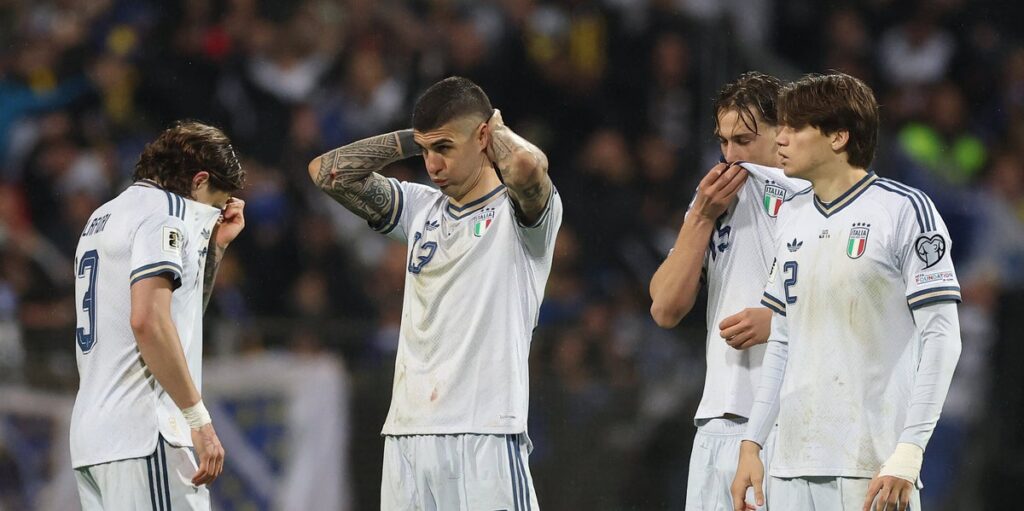
Italian football is currently experiencing a significant crisis, reaching its lowest point in nearly 40 years. This downturn has been exacerbated by a series of disappointing results at both the club and national levels, including the country's failure to qualify for the World Cup for the third consecutive time. The fallout from this has led to a mass exodus of players from Italian clubs, with no teams remaining in European competitions after the exits of Bologna and Fiorentina in the Europa League and Conference League, respectively.
For the first time since the 1986-87 season, Italian clubs have been completely shut out of the European semi-finals across all major continental tournaments. This stark reality follows Atalanta's departure in the round of 16 of the Champions League last month, marking a significant decline for Italian football.
Italian football, long seen as a bastion of talent and competitiveness, is grappling with an identity crisis as it reflects on what many are calling an 'annus horribilis'—a year of significant missteps. Inter Milan's participation in the 2025 Champions League final, where they were soundly defeated by Paris Saint-Germain, and Atalanta's victory in the 2024 Europa League seem like distant memories when contrasted with the current state of affairs.
In March, Italy suffered a collective shock after a heartbreaking 4-1 penalty shootout loss to Bosnia and Herzegovina in a World Cup qualifying playoff. This defeat led to the resignation of coach Gennaro Gattuso, along with the Italian Football Federation President Gabriele Gravina. Gravina admitted that the foundations of domestic football had crumbled and stated, "The crisis is deep, Italian football needs to be redesigned." His sentiments have echoed throughout the football community, with several prominent coaches voicing similar concerns.
Fabio Capello emphasized the severity of the situation, stating, "It is practically impossible to get worse than this; we have hit rock bottom." Meanwhile, Carlo Ancelotti, who now manages Brazil's national team, noted that Italy has strayed both on the pitch and financially. He pointed out, "We already lack talent in other areas of the pitch, but the excessive focus on tactics has distorted our characteristics, the ones on which we have always built our history." He also recognized the growing financial divide between Serie A and its European counterparts, stating, "The great foreign players no longer come to Italy." As lucrative TV rights and significant investments continue to flow into leagues abroad, Italy's appeal diminishes.
This crisis extends beyond the pitch. Reports indicate that Italy's infrastructure for hosting major events is lagging, raising concerns ahead of the country’s co-hosting of the 2032 UEFA European Championship alongside Turkey. Many stadium projects are reportedly behind schedule, and UEFA President Aleksander Ceferin has warned, "I hope the infrastructure will be ready. Otherwise, the tournament will not be played in Italy."
As the season draws to a close, Italian football faces a crucial period of restructuring. With both a new coach and FIGC president still to be determined following the departures of Gattuso and Gravina, speculation is rife. Napoli manager Antonio Conte and AC Milan boss Massimiliano Allegri are among the frontrunners to take over. However, a decision on the coaching position may not come until after the FIGC elections on June 22, leaving Italian football in a state of limbo.
In light of a season marked by systemic failures, there is increasing pressure for structural reform. The status quo is no longer tenable for a country whose football legacy was once celebrated worldwide. As Italy grapples with this crisis, the future of its footballing identity hangs in the balance, necessitating urgent and effective action to revive the sport that has always been a source of national pride.
You Won’t Believe What Shocking Revelations Defined Arts & Entertainment in 2025-26! Discover the Untold Truths!

This Shocking Vanguard ETF Just Split! Discover the 1 Stock You MUST Buy Before It's Too Late!

You Won’t Believe How One Investor Plans to Transform Zanzibar’s Food Supply and Real Estate – The Shocking Secrets Revealed!
Lions' Bold 2026 Draft Plan: Are They About to Shock Everyone by Trading Up to No. 13?

You Won’t Believe What Happened in Sports This Week: Shocking Upsets and Heart-Stopping Highlights!
Is College Football's Future at Risk? Discover Why One Seller Might Hold All the Power!
You might also like: