
Coral Reefs Are Disappearing Faster Than You Think—Find Out the Shocking Truth Before It's Too Late!

Coral reefs, often referred to as the "rainforests of the sea," play an essential role in protecting coastlines and supporting marine biodiversity. Recent studies highlight the alarming decline of coral reefs worldwide, raising concerns about their future and the consequences for both ecosystems and human communities.
A comprehensive study published in Nature Communications by Beck et al. in 2018 emphasizes that coral reefs provide vital flood protection, yielding an estimated global savings of $2 billion annually. This financial benefit underscores not just their ecological, but also their economic importance, particularly for coastal communities reliant on these natural barriers against storms and rising sea levels.
However, the health of these ecosystems is rapidly deteriorating. According to a 2021 study in One Earth by Eddy et al., there has been a significant decline in the capacity of coral reefs to provide essential ecosystem services. The authors note that the increasing frequency and severity of coral bleaching events, driven by climate change, have severely impacted coral health and resilience. The implications are dire: if current trends continue, many reefs could face irreversible damage by mid-century.
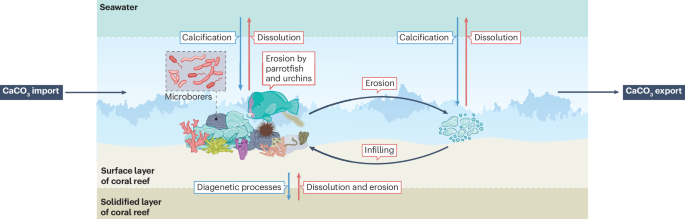
Acidification of ocean waters, a direct consequence of increased atmospheric CO2, further complicates the situation. Research by Cornwall et al. in Global Change Biology highlights how coralline algae, critical for reef architecture, struggle to thrive under acidic conditions, thereby undermining the entire reef structure. This presents a dual threat—while corals suffer from bleaching, their structural integrity is compromised as well.
Another pivotal study from Hughes et al. in Nature discussed the spatial and temporal patterns of mass coral bleaching. It revealed that certain regions, particularly in the Caribbean, are experiencing heightened vulnerability due to warming waters. The report emphasizes that without immediate action to curb greenhouse gas emissions, these regions may see a drastic shift from coral-dominated reefs to algal-dominated systems, fundamentally altering marine ecosystems.
The economic implications are profound, as coral reefs are not only natural barriers but also hotspots for tourism and fisheries. Woodhead et al. in Functional Ecology further assert that the loss of coral reefs could lead to a decline in fisheries, which many coastal communities depend on for their livelihoods. In fact, an estimated 500 million people rely on coral reefs for food and income worldwide, making their preservation critical for human well-being.
Efforts to mitigate these issues are gaining momentum. Scientists are exploring various restoration techniques, including coral gardening and selective breeding for heat-resistant corals. However, these approaches are still in their infancy. The ongoing debate, as highlighted in recent publications, focuses on whether such interventions can keep pace with the rapid environmental changes affecting coral reefs.
As global temperatures rise, the urgency to act cannot be overstated. Policies aimed at reducing carbon emissions and protecting marine environments are essential. The Intergovernmental Panel on Climate Change (IPCC) underscores that without significant and sustained reductions in greenhouse gas emissions, the future of coral reefs—and the myriad benefits they provide—remains perilously uncertain.
In conclusion, the fate of coral reefs is inextricably linked to the broader battle against climate change. As research continues to unveil the depth of the crisis, it is imperative that communities, governments, and individuals recognize the value of these ecosystems and take decisive actions to protect them. The time for awareness has passed; now is the time for action.
White House Insider Exposes Shocking Demand for Fed Researchers After Controversial Tariff Study!

Illinois Lawmakers SHOCKED by Governor's Budget Address: What They’re Hiding Could Affect YOU!

Is Your Vote at Risk? Shocking Details Emerge in WBTV's Live Sheriff Debate for 2026!

Moderna's Shocking FDA Win: Why This Vaccine Battle Could Change Everything for You!

White House and Democrats' SHOCKING $10 Billion ICE Standoff—What’s at Stake for YOU!

Harvard's Shocking Crypto Move: Is BlackRock About to Dominate Ethereum Staking ETFs?
You might also like: