
China’s Bold AI Move: Are They MOCKING the US in Their Viral New Campaign? Find Out Why!

BEIJING – China’s Communist government is evolving its approach to messaging, shifting from a rigid, dogmatic style to a more dynamic and engaging narrative. The state has effectively tamed the domestic internet through strict censorship, but now it's harnessing the capabilities of social media and artificial intelligence (AI) to shape its global story—often at the expense of the United States and its leadership.
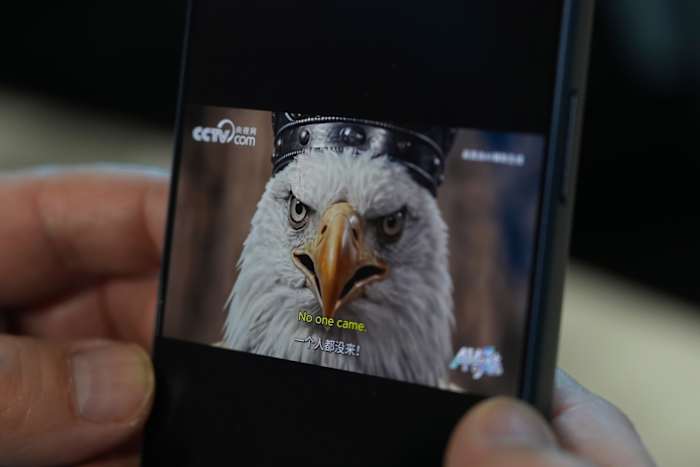
One striking example is a recent five-minute AI-generated animation that mimics classic martial arts films. This video presents an allegory for the war in Iran, featuring a white eagle dressed in military attire, symbolizing the U.S., unleashing an evil laugh as it commands an army to attack a group of black-cloaked Persian cats, representing Iranians. These cats vow to resist, particularly after losing their leader and facing the closure of a vital trading route.
The animation, rich with metaphors touching on injustice, revenge, and worldly wisdom, showcases a shift in Chinese state media's storytelling methods. This isn't an isolated incident; multiple AI-generated clips have surfaced recently, mocking the U.S. as a global bully—one even riffs on President Donald Trump's controversial plans to take over Greenland.
These efforts come in the wake of a long-standing push by Chinese President Xi Jinping to enhance the nation’s ability to project its narratives abroad and contest Western perceptions that Beijing often views as biased. Shi Anbin, a professor and director of the Israel Epstein Center for Global Media and Communications at Tsinghua University, notes that AI-generated "infotainment" is particularly effective in reaching younger audiences globally. “It is a new way for Chinese mainstream media to engage global Gen Z audiences and social media users to understand the Chinese standpoint on international affairs,” Shi stated.
The short film on the Iran war is arguably one of the most sophisticated products from China’s state media thus far. Released by the state broadcaster China Central Television, it quickly went viral domestically, earning praise from Chinese viewers for simplifying a complex geopolitical situation. An English-subtitled version found its way into international discussions, garnering over a million views within days of its release.
Andrew Chubb, a senior lecturer in the School of Global Affairs at Lancaster University, commented on the video’s impact, saying, “It’s hardly even like propaganda—it almost seems more like a historical fiction dramatization of the situation.” This marks a significant departure from China’s traditional messaging style, which was often characterized by dry, slogan-heavy narratives that failed to engage young people.
Recognizing that younger generations were turning away from their staid messaging, Chinese authorities have adapted their tactics. The Communist Party now employs a mix of humor and contemporary culture to communicate its messages. This includes using rap music, enlisting popular singers and actors to feature in patriotic films, and creating compelling narratives for anti-corruption television series.
State media are experimenting with innovative formats, utilizing short-form content and AI to capture attention. Wang Zichen, deputy secretary-general of the Beijing-based Center for China & Globalization, noted that “whatever one thinks about the format, the message itself clearly resonates with increasingly larger audiences.”
To reach a broader audience, China has invested significantly in constructing a vast “matrix” of social media accounts across platforms like X and Facebook, managed by diplomats, state media, influencers, and even bots. This network is adept at seizing moments to disseminate their messages. For instance, in February, the official Xinhua News Agency shared an AI-generated music video lampooning the U.S. threat to take over Greenland, featuring a bald eagle character in military garb declaring, “Anything I want, I’ll get it. One way or another, I’ll get it.”
In March, following Trump’s “Shield of the Americas” summit, Xinhua released another short video depicting a bald eagle caging small birds in the name of security, with the eagle asserting, “Sometimes, security comes with a little control.”
With the State Department warning that foreign messaging campaigns pose a direct threat to U.S. national security, the U.S. must grapple with the implications of this evolving information warfare. Recent cables indicate that these foreign campaigns, often propagated through digital platforms by state-controlled media, fuel hostility toward American interests.
As the global information landscape becomes increasingly competitive, the U.S. is faced with the challenge of countering foreign narratives. China's embrace of AI and social media to disseminate its viewpoints not only complicates this challenge but also highlights the importance of adapting messaging strategies to engage a younger, digitally-savvy audience in a world rife with misinformation and competing narratives.
Is Your Favorite Sweetener Harming You? Shocking Study Links Erythritol to HIGH Stroke Risk!

FBI's Shocking Signal Recovery: What They Found Will Leave You Speechless! Are You Safe?
Melania Trump's Jaw-Dropping Epstein Revelation That Left White House Aides Speechless! What Did She Say?

Apple's Shocking Q1 Triumph: How They Dominated the Smartphone Market Amid a 15% Shipping Plunge!

Detroit's Housing Market COLLAPSES: Prices Plunge 30%! Is Your Dream Home at Risk?

CVS Stock Dilemma: Are You Missing Out on a Hidden $79 Opportunity Amidst Shocking Earnings?
You might also like: