
You Won't Believe Why 30% of Young Adults are Ditching Smartphones for Flip Phones!

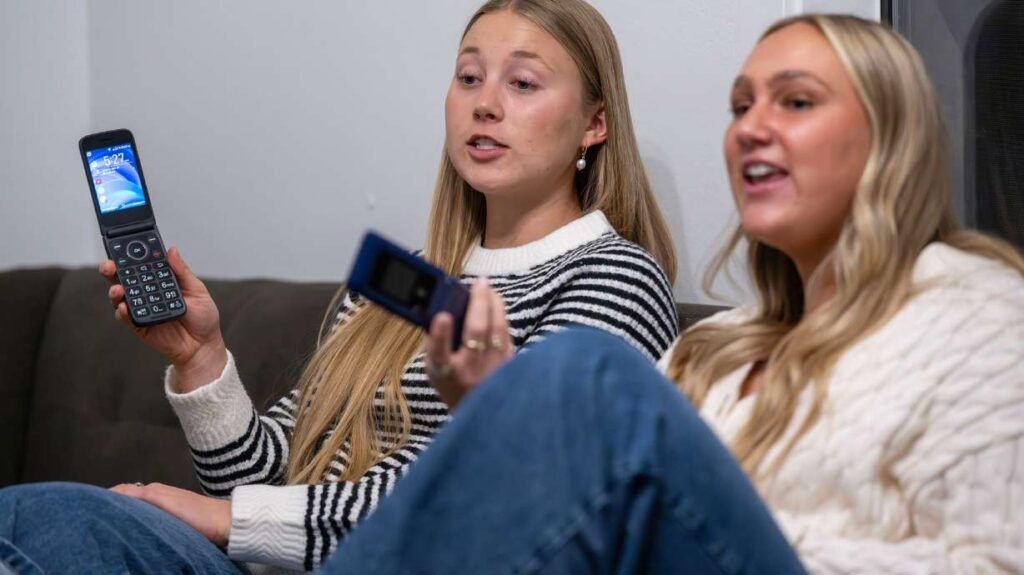
When a buzzing smartphone started to feel like a weight she couldn’t put down, Grace Freeman, a full-time seminary teacher, made a leap of faith: she bought a flip phone on a dare from her students. They laughed, insisting she would “never survive” without her iPhone. But Freeman was determined. “I just bought one right then,” she recalls. “I got it in December and I wanted to do it until the end of the year. And then after I finished like the first three weeks, I was like, I’m gonna do this till spring break. And then after spring break, I was like, I’m gonna do it till I can.”
Fast forward several months, and the plastic clamshell had replaced the glowing rectangle that clung to her palm for years. What surprised her most wasn’t what she lost but what she regained. “I lived life more presently,” Freeman said. “I stopped caring about unimportant things. I feel like I had less anxiety, I feel like I was less stressed about things. I feel like I was just overall, honestly happier.”
Freeman is not alone in her journey. From college apartments in Utah County to online communities worldwide, a growing number of youth and young adults are intentionally swapping smartphones for “dumb phones”—devices that call and text but don’t scroll through endless notifications.
A Trend with Numbers Behind It
While “dumb phones” still represent only a small slice of overall handset sales, recent data indicates rising interest, particularly among Gen Z and young millennials. The Canadian Broadcasting Corporation reported that sales of basic “feature phones” in Canada rose 25% between 2022 and 2023. Globally, companies producing minimalist phones, like Light Phone and Punkt, are witnessing increased demand from younger users wanting fewer apps and less distraction. The Washington Times noted that sales of “brick phones” among 18 to 24-year-olds surged by 148% from 2021 to 2024, characterizing this trend as a form of “dopamine diet” from constant notifications.
Simultaneously, parents, doctors, and policymakers are raising alarms about youth screen time and its effects on mental health. In Utah, health officials have identified lack of sleep, mental health struggles, and excessive screen time as major challenges facing young people. A 2025 Pew Research Center survey found that 44% of U.S. parents view social media as the most detrimental factor affecting teen mental health, with nearly half of teens acknowledging its mostly negative impact.
Such concerns have led to legislative changes, including Utah’s first-in-the-nation social media regulations for minors that require parental consent and restrict overnight use. Amid this backdrop, some young adults are not just discussing screen time reduction; they are altering the devices they use entirely.
Freeman is candid about her transformation post-switch. “I think that, and I say this boldly and confidently, that I genuinely believe that we are experiencing a third of what life could actually be because two-thirds of it, we’re wasting it on our phone.” She argues that even those with relatively low daily screen time may underestimate how much their smartphones influence their thoughts and attention. “Even if your screen time is less than three hours… the effects your phone has on your mind is diminishing the rest of your life,” she added.
Multiple studies support her claims, indicating that just the presence of a smartphone can reduce cognitive capacity. Freeman said her mental health shifted in ways she could physically feel. “I don’t even deeply struggle with anxiety or depression… but immediately when I had a flip phone, the amount of anxiety I lost was— I don’t even know if I could explain it,” she said.
Her teaching also improved. “I was a significantly better teacher with a flip phone,” Freeman explained. “If I check my phone as the teacher, everyone in my class thinks, ‘Oh, it’s acceptable for me to check the time’ — that’s also checking all my notifications.” She found that being disconnected made her more present and attentive in the classroom.
Although Freeman still needs her smartphone for certain tasks related to her work as a podcaster and influencer, she has repurposed her old iPhone into what she describes as “basically an iPod.” She leaves it at home, disconnected from cellular service, using it in short, scheduled bursts, stating, “It’s actually so unhealthy that your work has access to you 24/7 and you feel required to respond 24/7.”
However, the hardest trade-off was relational. Freeman noticed being left out of group texts and friends forgetting to include her in last-minute plans. She began recognizing the superficiality in some relationships. “What I started realizing is it’s not healthy to expect that we will be invited to everything… I realized, ‘Oh, that’s so superficial. If that is what was keeping us friends, what a joke.’”
As digital distractions increasingly invade our lives, Freeman’s experience serves as a reminder of the power of intentional disconnection. By trading her smartphone for a flip phone, she has unearthed a clearer perspective on her mental health, professional life, and the nature of her relationships. In a world where the need for connectivity often overshadows genuine interactions, perhaps it’s time to reconsider what makes us truly connected.
Miley Cyrus Drops Shocking News About Dolly Parton's Health—You Won't Believe What’s Happening!

Ethereum's Shocking Surge: Will ETH Hit $3,500 Soon? Here's What You MUST Know Now!

AI Surveillance Scandal: Shocking Proof This Startup Exploited 200 Workers to Spy on YOU!

Shocking Real Estate Trends: 25 Homes Sold This Week in Tompkins County – Don’t Miss the Surprises!

NYC's Top Doctor Warns: The Shocking Truth About the Hepatitis B Vaccine You MUST Know NOW!

Tonight's Warriors vs. Bulls Showdown: Can Curry Defy the Odds and Save Their Season?
You might also like: