
You Won’t Believe What Radiant’s Shocking $300 Million Nuclear Breakthrough Means for Your Future!

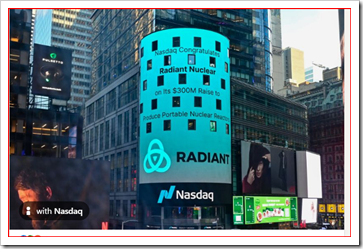
In the realm of nuclear innovation, several companies are making headlines with substantial funding rounds and groundbreaking advancements. Radiant Nuclear, a developer of portable nuclear microreactors, recently announced it has raised over $300 million in a new funding round—just six months after securing $165 million in its Series C financing. This influx of capital, spearheaded by Draper Associates and Boost VC, will primarily fuel the construction of its R-50 factory in Oak Ridge, Tennessee, aimed at mass-producing nuclear reactors designed for various applications, from defense to disaster response.
Radiant's CEO and founder Doug Bernauer emphasized the importance of this funding in achieving their timeline for their first reactor, the Kaleidos Demonstration Unit (KDU), which is set to start operations at Idaho National Laboratory’s Demonstration of Microreactor Experiments (DOME) facility next year. They have already signed contracts for 20 Kaleidos microreactors with Equinix, showcasing strong demand for their innovative technology.
Meanwhile, Last Energy, another player in the nuclear sector, successfully closed a $100 million Series C funding round led by the Astera Institute. Founder Bret Kugelmass stated that this financing would support their pilot reactor project and lay the groundwork for commercial deployment of their PWR-5 model. The company is actively preparing for a criticality demonstration in 2026 as part of the U.S. Department of Energy’s Reactor Pilot Program.
On an international scale, Samsung Heavy Industries received an ‘Approval in Principle’ from the American Bureau of Shipping for its floating nuclear power platform utilizing two SMART100 small modular reactors (SMRs). The floating design is seen as a significant innovation in nuclear energy, aimed at enhancing safety and scalability in maritime applications. The concept allows for flexibility in reactor type, paving the way for various SMR applications.
In Sweden, the nuclear startup Blykalla has raised $50 million, led by the advanced reactor company Oklo. This funding will accelerate the development of their lead-cooled reactor, named Sealer, targeting high-demand sectors such as data centers and industrial facilities. Blykalla is poised to enhance its testing programs and design efforts immediately, with ambitions to deploy advanced reactor technology globally.
Not to be overshadowed, ARC Clean Technology has announced the successful closing of its Series B financing round, which will support their commercialization efforts for the ARC-100, a 100 MWe advanced sodium-cooled fast reactor. They aim to deploy systems in the U.S. and Canada, collaborating with partners like Korea Hydro & Nuclear Power to expand their global footprint.
In a landmark move, China’s Linglong-1 is set to become the first land-based small modular reactor to begin operation in 2026. This indigenous design, part of the Generation III reactor category, will generate approximately 1 billion kWh of electricity annually, enough to power around 526,000 households.
In the U.S., Senator Jim Risch's International Nuclear Energy Act was signed into law, aimed at boosting the domestic nuclear energy industry’s competitiveness against international rivals like China and Russia. The provisions include initiatives to enhance U.S. civil nuclear exports, establish cooperative international relationships, and promote regulatory harmonization for nuclear ventures.
On a different note, French power company EDF is projecting a provisional cost estimate of $86 billion for six new-generation EPR2 nuclear reactors, with the first unit expected to be operational by 2038. This ambitious plan represents a significant investment in France’s nuclear infrastructure and signals a commitment to revitalize the nation’s energy strategy.
Overall, the dynamic landscape of nuclear technology is marked by significant investments and pioneering developments across the globe. As the demand for clean and reliable energy sources grows, these advancements in nuclear technology could play a pivotal role in addressing energy challenges and shaping the future of energy generation.
You Won't Believe the 5 Shocking RSV Trends of 2025 - #3 Will Leave You Speechless!

You Won't Believe What Phil Murphy Reveals About His Shocking NJ Governor Years!

Shocking Truth: Why 70% of Americans Are Ignoring Life-Saving Pneumococcal Vaccines! Are You Next?

Shocking Forecasts for Amazon & Microsoft: Will 2026 Bring Devastating Layoffs?
You Won’t Believe Why 70% of People Are Getting Access Denied—Discover the Shocking Truth!

Discover the 7 Shocking Snacks Dietitians Swear By to Crush Your Cravings—#3 Will STUN You!
You might also like: