
You Won't Believe What Happened When FDR Dressed as Julius Caesar at a Secret White House Party!

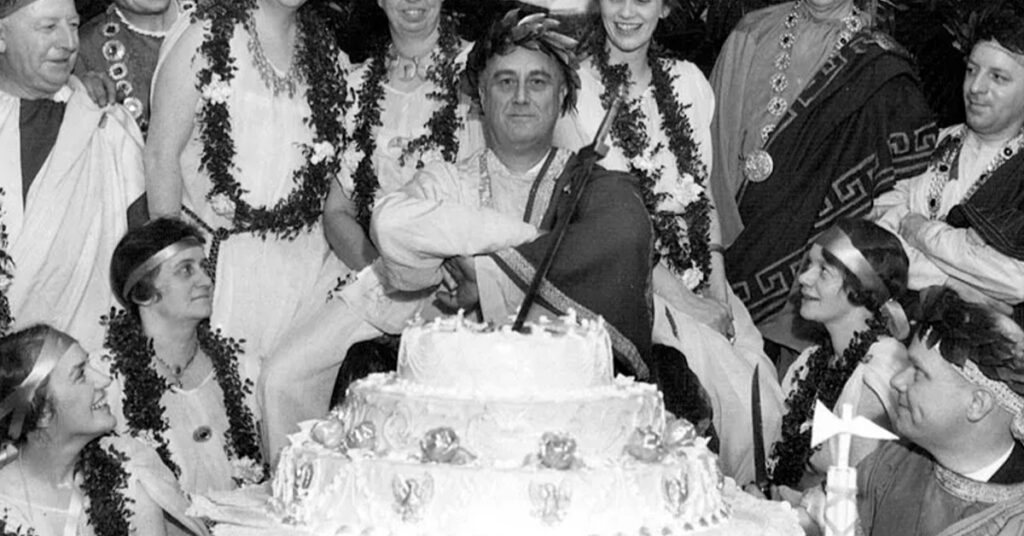
In the midst of the Great Depression and rising political tension, President Franklin D. Roosevelt found a unique way to lighten the national mood and cleverly poke fun at his critics. On January 30, 1934, the White House transformed into a lively, theatrical scene from ancient Rome as FDR celebrated his 52nd birthday with a private toga-themed party that would become legendary. At a time when uncertainty weighed heavily on the nation, Roosevelt used humor and spectacle to shift the narrative, showcasing his unshakeable confidence and sharp wit.
The celebration, hosted by President Roosevelt and First Lady Eleanor Roosevelt, was crafted under a spirited Roman theme by FDR’s close-knit group of friends and advisors, humorously dubbed the “Cuff Links Gang.” Roosevelt took center stage dressed as Julius Caesar, donning a toga, sash, and symbolic regalia, fully embracing the playful spirit of the night. Eleanor, ever supportive of her husband’s lighthearted ideas, appeared as the Delphic Oracle, adding an intriguing mystique to the evening. Guests, including cabinet members and staffers, arrived in togas and laurel wreaths, transforming the White House into a whimsical pageant of ancient Roman splendor.
Despite the politically charged atmosphere surrounding the New Deal, the tone of the evening was warm, humorous, and self-aware. Roosevelt’s critics had begun accusing him of steering the nation toward dictatorship, making exaggerated comparisons between his aggressive economic reforms and the authoritarian regimes rising abroad. Rather than respond with hostility or defensiveness, FDR chose satire. By portraying himself as Caesar and encouraging his inner circle to join in on the jest, he turned political criticism into a joke he could control, diffusing tension through wit and theatricality. This intimate moment revealed Roosevelt’s ability to navigate political storms with charm, confidence, and an unwavering sense of humor.
While the toga party was a private affair, it was also symbolic of a much more consequential national tradition that had begun to take shape on the same occasion. By 1934, Roosevelt’s birthday had evolved into a nationwide philanthropic movement aimed at combating a cause deeply personal to him: the battle against polio.
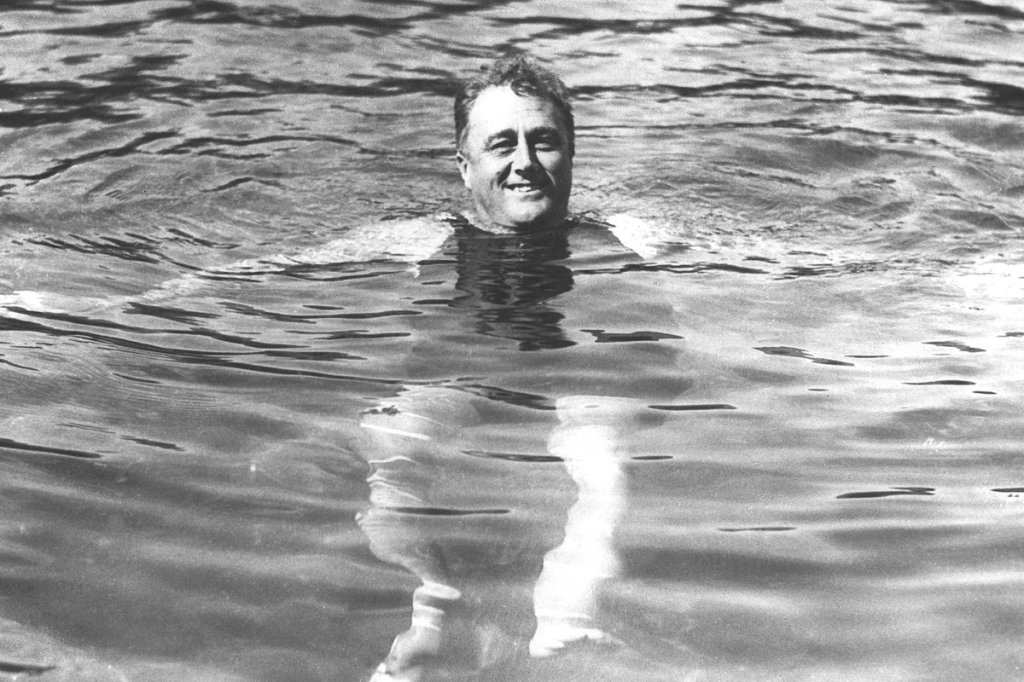
Across the United States, communities—from major cities to small rural towns—held elegant Birthday Balls in honor of the president’s birthday while raising funds for polio research and rehabilitation. These events served as acts of collective hope, allowing Americans to participate in something larger than themselves during a period of hardship. The funds raised from these gatherings flowed into the Georgia Warm Springs Foundation, established by Roosevelt in 1927 after his own struggle with polio. Warm Springs, a tranquil southern resort town, had become FDR’s refuge beginning in 1924, where he discovered not only physical relief in the water’s buoyancy and temperature but also emotional renewal among fellow patients.
Determined to create a sanctuary for others suffering from the disease, he purchased the property and expanded it into a pioneering rehabilitation center, blending physical therapy, hydrotherapy, and community support. Roosevelt’s deep involvement with the institute earned him the affectionate nickname “Doctor Roosevelt” among patients, underscoring his personal devotion to the cause.
The success of the Birthday Balls was immediate and extraordinary; in their first year alone, they generated over a million dollars, a remarkable achievement during the height of the Depression. This momentum helped lay the foundation for what would soon become the National Foundation for Infantile Paralysis, later known as the March of Dimes—an organization that would fund groundbreaking research leading to the development of the polio vaccine and provide support to countless families.
The 1934 toga party remains a striking reflection of Franklin D. Roosevelt’s unique leadership style, which blended humor, humility, and deep human connection. While privately disarming political critics with costume and comedy, he publicly harnessed the energy of his birthday to rally a nation toward a noble cause. His ability to transform personal challenges into national movements revealed a leader with both vision and heart.
This combination of theatrical wit, nationwide unity, and purposeful philanthropy turned Roosevelt’s 52nd birthday into a moment in history that still resonates today. It serves as a reminder that leadership is not solely measured by policy and power, but also by the capacity to inspire, uplift, and mobilize people for the greater good. A Caesar he may have appeared that evening, but it was the compassion and resolve of a servant leader that truly defined the day. In a playful historical twist, Roosevelt’s toga party now seems like the dignified ancestor of the modern fraternity toga party—one can only imagine FDR chuckling at the sight of college students in bedsheets reenacting scenes that look far more like Animal House than ancient Rome. Somewhere, Julius Caesar and John Belushi are likely sharing the same cosmic smile.
You Won't Believe What This Governor Discovered After Watching a Children's Film on Climate Change!
Why the Europe Snack Bar Market Could Skyrocket to $12 Billion by 2033—Are You Missing Out?

Is Google’s Shocking New Experiment About to Crush Your Favorite Search Portals? Find Out Now!

Shocking New Study Reveals: Pregnant Women Who Skip COVID Vaccines Face THIS 40% Higher Risk!

Could the Hawks Actually Trade Their Star Player? Shocking Plans for the Season Revealed!

Could the Bucks Land an All-NBA Star in This Year’s Draft? The Shocking Odds Will Leave You Speechless!
You might also like: