
You Won't Believe What Cursor's New Composer 2 Model Can Do for Your Coding Skills!

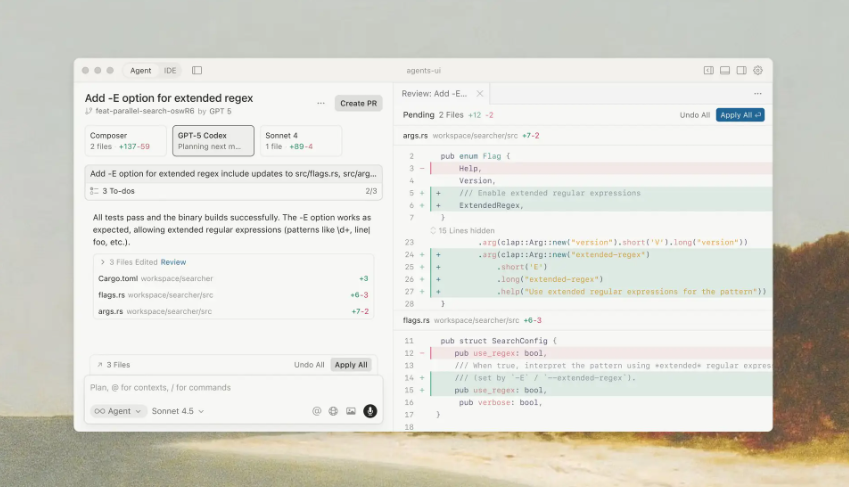
In a significant leap for programming technology, Cursor, a rapidly growing AI software company, has unveiled its new artificial intelligence model, Composer 2. The company claims that this innovative model can outperform Claude Opus 4.6 in numerous programming tasks, signifying a potential shift in coding capabilities for developers. With over 1 million daily active users of its popular AI code editor, Cursor, which operates under the name Anysphere Inc., has seen its valuation soar to an impressive $29.3 billion as of last November.
Composer 2 boasts the ability to handle prompts with an extensive limit of 200,000 tokens. This capability allows it to not only generate code but also to rectify bugs in existing software and effectively interact with a computer's command line interface. For developers looking to expand its functionalities, Composer 2 offers optional integrations with tools such as browsers and image generators.
To benchmark its performance, Cursor utilized an internal evaluation tool called CursorBench, designed to mirror challenges faced by its engineering team. The average challenge within this framework comprises around 352 lines of code distributed across 8 files. Composer 2 scored over 60% on this benchmark, placing it in third position, just behind GPT-5.4 configurations that leverage more hardware for enhanced output quality. Notably, it outperformed GPT 5.4’s low configuration and Claude Opus 4.6, as well as Anthropic PBC's model in the Terminal-Bench 2.0 benchmark, which assesses the capabilities of AI models in command line operations.
One of the distinguishing features of Composer 2 is its cost efficiency. The standard version is priced at $0.5 per million input tokens and $2.5 per million output tokens, with a premium version available for $1.5 per million input tokens and $7.5 per million output tokens. This financial model is partly attributed to the fact that Composer 2 was exclusively trained on coding datasets, unlike many frontier models that attempt to automate a broader range of tasks, resulting in a larger hardware footprint.
The development of Composer 2 also utilized an advanced machine learning technique known as self-summarization. This method helps streamline the coding tasks presented to the AI during training by condensing large volumes of data into manageable formats that fit within the model’s context window. This innovation not only enhances efficiency but also boosts the model’s overall performance.
As Cursor prepares to raise additional funding, the introduction of Composer 2 could likely spark increased investor interest. Reports suggest that this funding round may elevate the company’s valuation to approximately $50 billion. This anticipated growth reflects the burgeoning demand for AI technologies that can enhance and simplify programming tasks, positioning Cursor at the forefront of this competitive landscape.
The arrival of Composer 2 signals a promising advancement in AI-assisted coding, potentially transforming the way developers approach their work. As more companies look to integrate AI into their operations, tools like Composer 2 could become essential for enhancing productivity and streamlining coding processes in an increasingly digital world.
Mystery in the Marsh: Who Was the Unknown Man Found Dead in North Portland? Shocking Clues Revealed!

You Won’t Believe What Jimmy Darts Did to Transform Strangers' Lives Overnight!

Dolphins Fans Unveil 5 NFL Rule Changes That Could SHOCK the League Forever! Are You Ready?

N.Y. Health Centers Demand $300M—Will Your Community's Services Be Cut? Find Out!

Call the Midwife Star Reveals ADHD Diagnosis: You Won't Believe What Happened Next!

NFL Superstar Micah Parsons' Shocking March Madness Pick: Why Texas Tech Could Make History!
You might also like: