
You Won't Believe the Shocking Truth Behind Helen Keller's Life: Did Conspiracies Fool Us All?

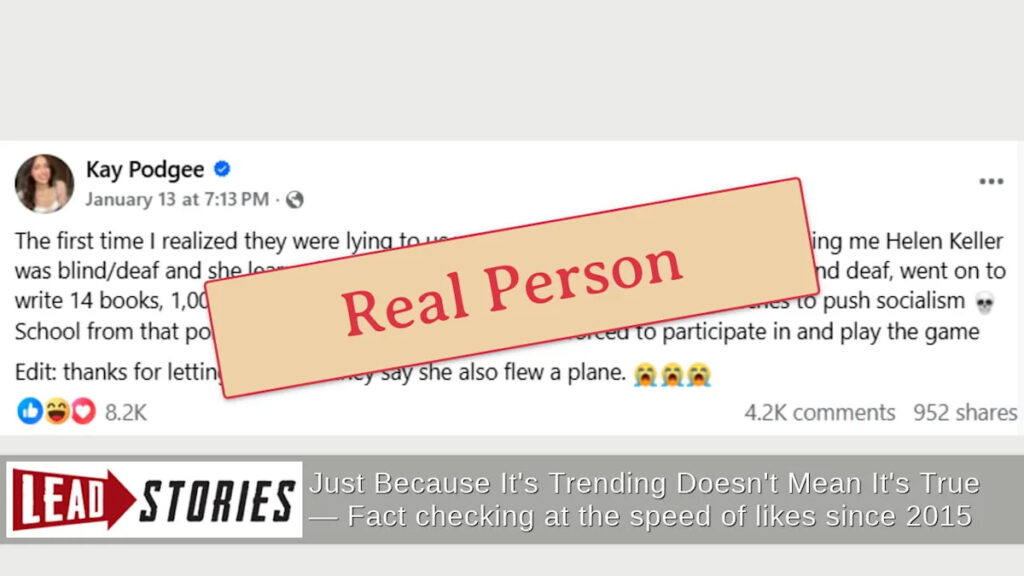
In recent years, a vague conspiracy theory has emerged questioning the authenticity of the life achievements of Helen Keller, an iconic figure in American history. Keller, who was deaf and blind from an illness in early childhood, is celebrated as an author and social activist. She communicated through an interpreter using a method known as finger-spelling, which involves spelling words into the palm of her hand. Despite the efforts of some to cast doubt on her remarkable accomplishments, the evidence of her life and work remains well-documented.
One focal point in these discussions is a 1919 silent film titled "Deliverance," which portrays Keller's life and includes a dramatic scene where she appears to ride in a biplane. Critics claim that such dramatizations undermine her genuine achievements. However, the film does not suggest that she was piloting the aircraft; it merely depicts her experience as a passenger. This overdramatization does not detract from her true accomplishments or the profound impact she had on society.
The conspirators often cite vague claims, such as the assertion that Keller's teacher, Anne Sullivan, was also disbelievably deaf and blind. This statement is false. Sullivan, who was blind but had her vision partially restored through surgery, is known for her own remarkable achievements and played a crucial role in Keller's education. Sullivan learned finger-spelling from Laura Bridgman, the first person with deafblindness to receive a formal education, during her time at the Perkins School for the Blind.
The conspiracy theories surrounding Keller often stem from social media posts that lack credible evidence. For instance, one claim suggests that medical records from 1902 to 1924 prove Keller had functional vision and hearing throughout her life. However, no such records exist, as searches within reputable databases, including the archives of the American Foundation for the Blind, have yielded no relevant results. These unfounded allegations only serve to perpetuate misinformation.
Another baseless claim posits that Keller was merely a "cash cow" for Sullivan, implying that her intellect was solely a product of Sullivan's guidance. This theory crumbles upon examining Keller's life after Sullivan's death in 1936. Keller continued her public engagements, aided by her new companion, Polly Thompson, who also used finger-spelling to communicate with her.
Thompson played a vital role in one of Keller's most memorable moments: piloting an airplane. During a flight from Rome to Paris in a Douglas Skymaster, Keller took control of the aircraft for 20 minutes, guided by Thompson's instructions. A newspaper account from "The Bulletin" in June 1946 described the scene, highlighting how Keller's sensitive touch on the controls amazed the crew. Keller herself remarked, "It was wonderful to feel the delicate movement of the aircraft through the controls."
Despite the skepticism surrounding Keller's legacy, credible documentation is available to affirm her contributions to society. The Library of Congress holds a searchable database that features 152 entries related to Keller, including books, essays, and correspondence, demonstrating her prolific output and influence.
In fact, the conspiracy theories questioning Keller's legitimacy have been thoroughly debunked by independent fact-checking organizations like Snopes, which published a detailed analysis on December 26, 2020. Additional insights have been shared by the Office of Science and Society at McGill University, focusing on misunderstandings about deafblindness, further clarifying the realities of Keller's life and achievements.
Helen Keller's story is one of resilience and dedication, breaking barriers and paving the way for advancements in the rights of individuals with disabilities. While conspiracy theories may attempt to undermine her legacy, the overwhelming evidence of her accomplishments stands strong, reminding us of her enduring impact on American society.
Why Wall Street is Panicking: Intel's Shocking Plunge and Gold Soars to NEW Heights!

You Won't Believe How Different These Results Are—Shocking Variations That Will Change Everything!

What 100 People Would Say to Their Parents—7 Shocking Truths That Will Break Your Heart!

White House's Bizarre 'Penguin' Message Sparks Outrage—Is Trump’s Greenland Dream in Danger?

Arkansas Governor Sarah Huckabee Sanders Issues Urgent State of Emergency: What You MUST Know Before the Storm Hits!

Trump’s Shocking Greenland Encounter: AI Reveals What Really Happened with the Penguins!
You might also like: