
You Won't Believe How Bush v. Gore Still Haunts Today's Elections—25 Years Later!

In the heart of Washington D.C., visitors to the Smithsonian can encounter artifacts that represent significant moments in American history. Among these is a seemingly innocuous item that played a critical role in shaping the future of the nation: the “butterfly ballot” used in Palm Beach County, Florida, during the contentious 2000 presidential election. This ballot not only stirred confusion among voters but also became the centerpiece of a Supreme Court decision that ultimately handed the presidency to George W. Bush.
The butterfly ballot's design was notoriously flawed. It presented candidates listed on either side of a vertical line of holes, requiring voters to punch through with a stylus to indicate their choice. However, the confusion stemmed from the fact that the names of the candidates—Bush and Al Gore—corresponded to non-adjacent holes, with Bush on the left corresponding to the first hole and Gore to the third. This layout led to misvotes, as at least 2,000 voters accidentally selected Pat Buchanan, the Reform Party candidate, believing they were voting for Gore. Florida was decided by just 537 votes, making this design error all the more consequential.
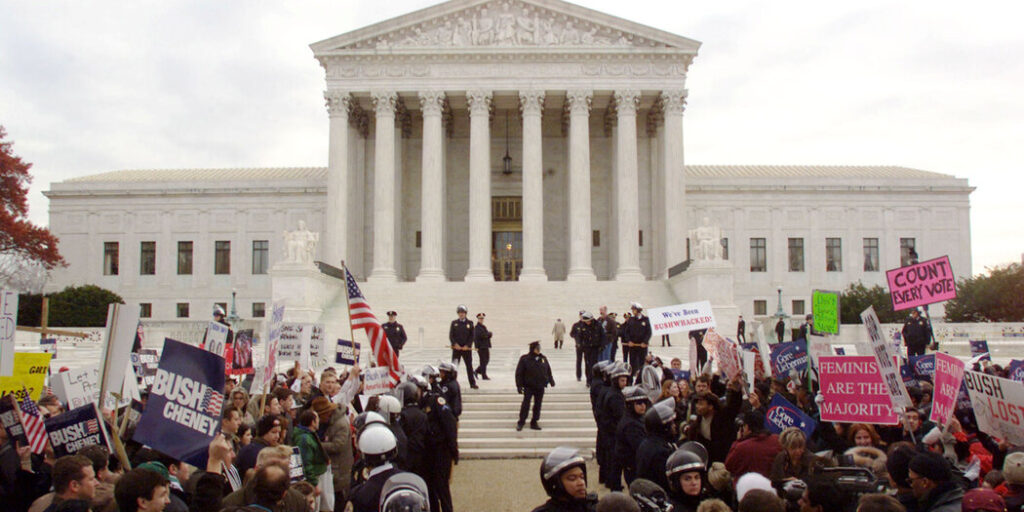
The Supreme Court's ruling in Bush v. Gore marked a pivotal moment in American judicial history. The Court's decision to halt the state’s recount of votes was based on concerns over the “timely resolution of the election.” This ruling not only changed the outcome but also altered the landscape of election law, creating a perception of partisanship within the Court. Notably, the ruling was decided by a narrow 5-4 margin, and two dissenting justices, including Justice Ruth Bader Ginsburg, argued that constitutional issues surrounding differing standards for determining voter intent warranted a continued recount.
At the time of the ruling, public trust in the Supreme Court had been relatively stable, with an approval rating of 62 percent just four months prior to the decision. However, that trust began to deteriorate as a partisan divide emerged, leading to a stark contrast in perceptions of the Court. By the time Bush took office, 80 percent of Republicans viewed the Court favorably, compared to only 62 percent of Democrats.
Over the ensuing two decades, this divide has continued to shift. Public favorability ratings have changed dramatically, with current statistics showing only 26 percent of Democrats and 71 percent of Republicans holding a favorable view of the Court. A June 2025 survey reported that just 20 percent of Americans view the Court as “politically neutral,” underscoring the growing skepticism surrounding its impartiality.
Despite the turmoil that surrounded the 2000 election, it did pave the way for some constructive reforms. The bipartisan Help America Vote Act emerged in response to the election crisis, establishing national standards for election administration, improving voting systems, and enhancing voter registration processes. More recently, after challenges to the results of the 2020 election, Congress passed the Electoral Count Reform Act, tightening loopholes in the law governing how presidential elections are certified.
Nevertheless, as American democracy continues to face challenges, the question lingers: if another razor-thin presidential election were to arise, how would the Supreme Court navigate the delicate balance of public perception? Justice John Paul Stevens, in his dissent during Bush v. Gore, warned that the real loser was the nation’s confidence in the judiciary as an impartial guardian of the rule of law. Twenty-five years later, that warning resonates, reminding Americans of the fragile nature of trust in their institutions.
As we look back on the events of 2000 and their lasting impact, it is clear that while the butterfly ballot may seem like a relic of a bygone era, its consequences are still shaping the political landscape today. The ongoing debates about voting rights, election integrity, and judicial impartiality signify that the lessons learned from that tumultuous election remain relevant and urgent for American citizens.
You Won’t Believe What’s at Stake in the Saint Louis vs. NC State Soccer Semifinal—Find Out Now!

Startups Are Gambling Billions on Encrypted AI—Will Your Data Be Safe or Sacrificed?

Shocking Revelation: IGR's $10 Million Loss in Real Estate—Is Your Investment Next?

Will Karl-Anthony Towns’ Bold NBA Cup Strategy Backfire? Fans Are Divided!

Is Your Favorite College Football Team Hiding a Shocking Truth About Player Development? You Won't Believe the Stats!

Bitcoin and Ethereum Crash as Fed's Shocking Third Rate Cut Sends Markets Reeling - Are You Next?
You might also like: