Why Did the White House Alter a Protest Photo? Shocking Truth Behind This Viral Image!

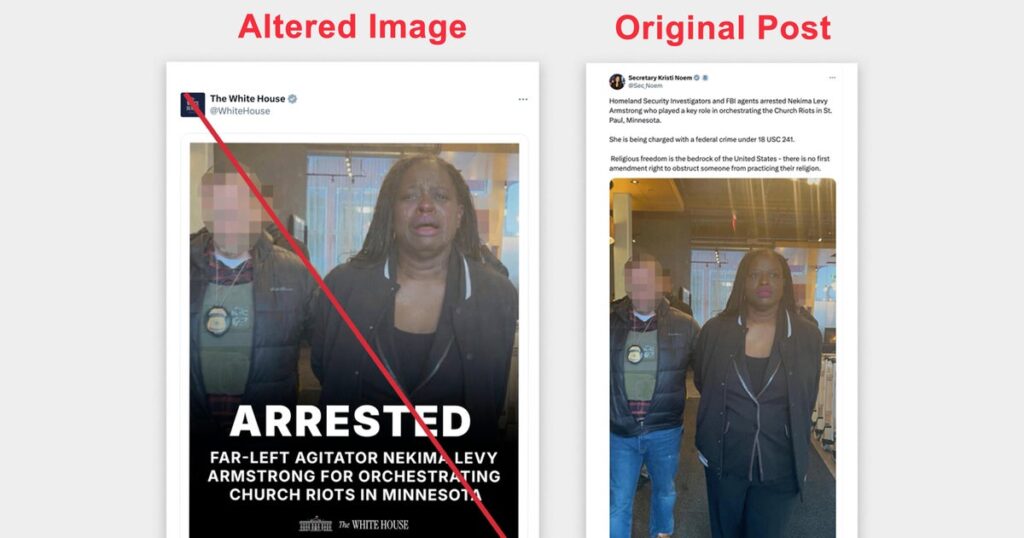
The political landscape continues to evolve in unexpected ways, as evidenced by a recent incident involving a digitally altered image posted by the White House. The image in question depicted civil rights attorney Nekima Levy Armstrong, who was arrested during a protest against U.S. Immigration and Customs Enforcement (ICE) at a Minnesota church. The original photograph, shared by Homeland Security Secretary Kristi Noem, showed Armstrong with a neutral expression. However, the White House later shared an altered version that appeared to show her crying, accompanied by a caption referring to her as a "far-left agitator." This post circulated on social media, including a repost by Vice President JD Vance, igniting a wave of criticism and concern about the use of manipulated images in political discourse.
Jordan Kushner, an attorney representing Armstrong, condemned the altered image as "extremely offensive," arguing that it misrepresented her behavior during the arrest. He described the manipulation as a significant injustice, emphasizing that the prosecution itself is politically motivated. "By posting a fictitious picture, they are prejudicing the potential jury pool," Kushner told CBS News. This incident raises troubling questions about the ethics of digitally altering images, especially when they pertain to real-life legal and social issues.
Digital forensics expert Hany Farid, a professor at the University of California Berkeley, weighed in on the implications of the incident, noting that while the exact methods of alteration remain unclear, AI likely played a role. "This is not the first time that the White House has shared AI-manipulated or AI-generated content," Farid explained. "This trend is troubling on several levels. Not only are they sharing deceptive content, but they are also making it increasingly more difficult for the public to trust anything they share with us."
The controversy unfolded against the backdrop of a wave of protests in the Twin Cities, ignited by the recent fatal shooting of Renee Good by an ICE officer. Armstrong's involvement in the protest was significant; she is a former president of the Minneapolis NAACP and has been a vocal advocate for civil rights. During the demonstration at Cities Church in St. Paul, where a local ICE officer serves as a pastor, she and several others were arrested. Armstrong is charged under 18 USC 241, which prohibits the intimidation of individuals exercising their constitutional rights. A judge has since rejected a request for a detention hearing, and she is expected to be released.
Along with Armstrong, two others, Chauntyll Louisa Allen and William Kelly, were also arrested. However, a magistrate judge declined to sign a complaint against independent journalist Don Lemon, who was present at the protest, affirming that he was engaging in constitutionally protected activity as a journalist.
This incident is not an isolated one. Former President Donald Trump has a history of sharing AI-generated images on social media, an approach that raises concerns about the potential for misinformation and manipulation. On one occasion, he posted an AI-generated image that showed him holding an American flag in Greenland, standing next to Vice President Vance and Secretary of State Marco Rubio. Such instances not only blur the lines between reality and fabrication but also complicate the public's ability to discern the truth in political messaging.
The White House's social media post drew significant backlash, with many commenters pointing out the apparent manipulation of the image. In response to inquiries regarding the authenticity of the photo, the White House's press office referred to the post as a "meme," asserting, "Enforcement of the law will continue. The memes will continue. Thank you for your attention to this matter."
As the discourse surrounding the use of AI in political communications continues to unfold, this incident serves as a notable example of the complex interplay between technology and public perception. The manipulation of images not only impacts individual reputations but also shapes broader discussions about civil rights, political motivations, and the public's trust in government institutions. As Americans navigate this evolving landscape, the implications of such practices on democracy and civil discourse remain to be seen.
You Won't Believe What This Celebrity Just Exposed—The Shocking Legal Battle Details You NEED to Know!
Shocking Upset: Alianza Lima Crushes Messi's Inter Miami 3-0—You Won't Believe How!

Is Australia’s Scorching Heatwave a Warning Sign? New Study Says Climate Change is 5X Worse!
Shocking Climate Crisis Updates: Are We Just 3 Years Away from Irreversible Damage?
You Won't Believe How This South Korean Startup's Wind Turbine Could Change Urban Life Forever!
Tennessee's Dynamic Duo: Will These 2 Stars Change the NFL Draft Forever? Find Out!
You might also like: