
Unlock the Hidden Health Secrets: What Your Exposome Reveals About Your Risk of Disease!

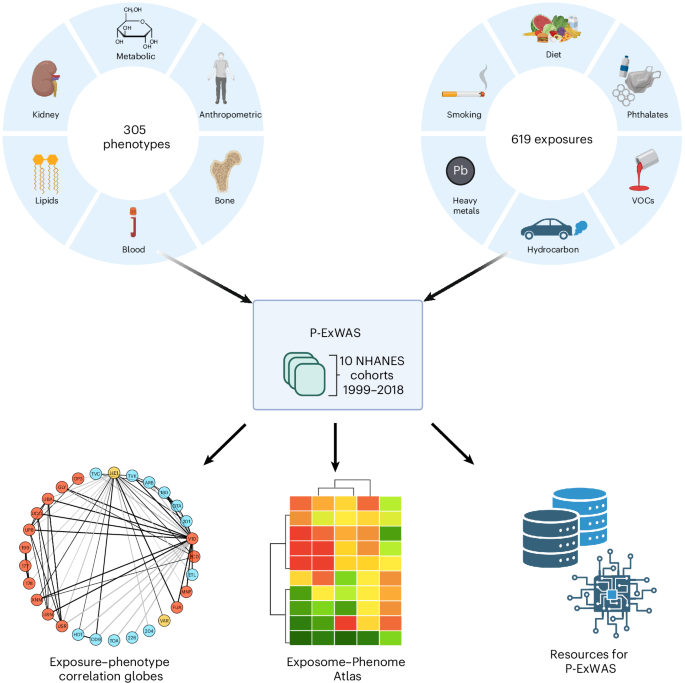
A recent study leveraging data from the National Health and Nutrition Examination Survey (NHANES) has revealed significant insights into the relationship between environmental exposures and various health phenotypes. This research, conducted under the auspices of the National Centers for Health Statistics (NCHS), has been deemed ‘not human subjects’ research by the Harvard Institutional Review Board (IRB24-1004), allowing for the use of previously consented data from NHANES participants. The findings have been compiled into a database known as the Phenome-Exposome Atlas, which catalogs these associations for further analysis and exploration.
The NHANES datasets span multiple cycles from 1999 to 2018, encompassing approximately 10,000 participants per survey. The research employed a systematic approach called P-ExWAS (Phenotype-Exposome Wide Association Study) to analyze the data. This approach allowed researchers to associate various environmental exposures, such as pollutants and dietary factors, with health outcomes across different demographic segments.
To facilitate the analytical process, the researchers developed an R statistical package named nhanespewas. This package includes several features aimed at improving data association and analysis. It allows users to catalog phenotypes and exposures, apply survey-weighted linear models, and aggregate associations across independent surveys for a comprehensive understanding of correlational trends. The full methodology and the code for the package are openly accessible via GitHub, ensuring the transparency and reproducibility of the research.
Utilizing a robust sample size—median participant range of 7,464—this observational, cross-sectional study focused on phenotype–exposure pairs with a minimum of 500 participants across at least two survey cycles. This approach yielded valuable statistical insights, allowing for power calculations and effective handling of missing data. Statistical analyses were conducted using survey-weighted linear regression, which accommodated the complex sampling design of NHANES, ensuring that findings were representative of the broader U.S. population.
The research cataloged a total of 322 unique phenotypes and 859 different environmental exposures. With rigorous filtering criteria, the study was able to assess nearly 119,643 associations between various pairs, demonstrating a thorough examination of how lifestyle and environmental factors could correlate with health outcomes. Importantly, these associations were adjusted for various demographic covariates, including age, sex, ethnicity, income, and education, enhancing the reliability of the findings.
One noteworthy aspect of this study is its capacity to explore the relationships between multiple exposures and phenotypes, examining how these connections might vary based on demographic factors. For instance, responses to environmental pollutants could differ significantly across age groups or socioeconomic backgrounds, shedding light on health disparities that exist within the population.
The implications of this research are far-reaching, as understanding the interplay between environmental factors and health outcomes can inform public health initiatives and policy-making. The findings could help guide regulations on environmental pollutants and nutritional guidelines, ultimately striving to improve community health outcomes. Furthermore, the study’s findings reiterate the importance of integrating diverse data streams to foster a more comprehensive understanding of health determinants.
With the availability of the Phenome-Exposome Atlas and the nhanespewas R package, researchers and public health officials now have access to valuable tools that can facilitate ongoing investigations into health exposures and outcomes. This ability to analyze extensive datasets will likely advance the field of epidemiology, enhancing our understanding of the myriad factors that influence health in the American population.
As the study underscores the significant role that environmental exposures play in shaping health phenotypes, it paves the way for further research that could lead to actionable insights aimed at mitigating risks associated with these exposures. Ultimately, efforts to address such public health challenges will hinge on the continued integration of data, innovative analytical techniques, and an unwavering commitment to improving health equity across diverse communities.
Antarctic Penguins Are Doing THIS to Survive Climate Change—You Won't Believe Their Shocking Strategy!

US-China Summit Delayed: What Takaichi's White House Visit Could Mean for Global Tensions!

Unbelievable Twist in Illinois 14th Primary: Shocking Results You NEED to See NOW!

Unlock the Hidden Gems: 7 Mind-Blowing Events You Must Experience March 20-26! Don't Miss Out!

You Won’t Believe What Happened After 10 Years Together – Their Relationship Took a SHOCKING Turn!

Is $10 Gas Just the Beginning? Shocking Secrets from 83 Years of Fuel Price Chaos!
You might also like: