
Trump's Stunning Move: What Happens When He Meets 5 Powerful Latin Leaders? You Won't Believe the Consequences!

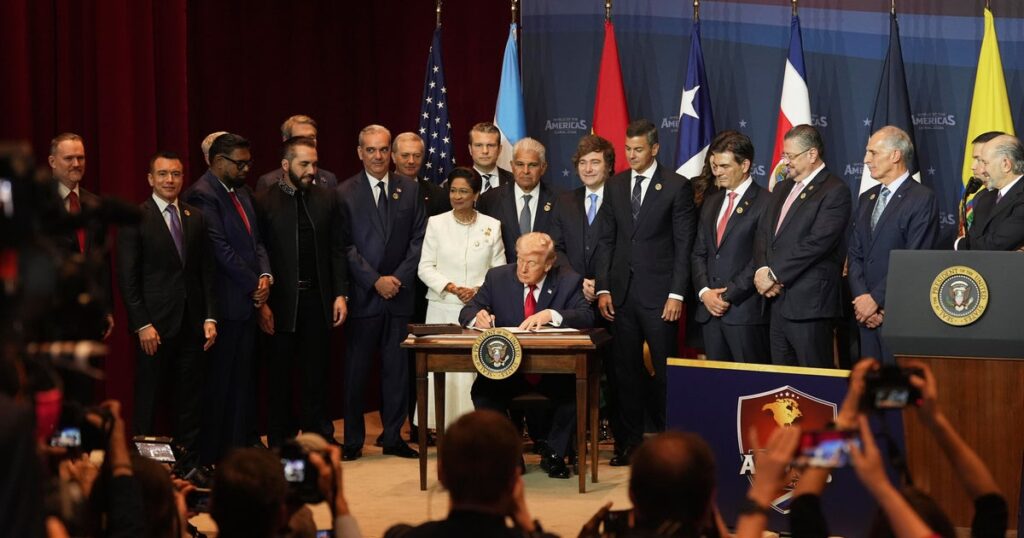
In a significant move to address escalating violence linked to drug cartels, President Donald Trump called on Latin American leaders to unite for a comprehensive response during the "Shield of the Americas" summit held at the Trump National Doral Miami on March 7, 2026. This gathering reflects the Trump administration's ongoing commitment to focus on foreign policy in the Western Hemisphere, even amid pressing global crises.
The summit comes just two months after a bold U.S. military operation aimed at capturing then-Venezuelan President Nicolás Maduro, who now faces drug conspiracy charges in the United States. In his opening remarks, President Trump emphasized a collective refusal to tolerate lawlessness in the region, stating, "We cannot and will not tolerate the lawlessness in our hemisphere any longer."
Joining Trump at the summit were key officials including Secretary of State Marco Rubio, Defense Secretary Pete Hegseth, and former Secretary of Homeland Security Kristi Noem, who recently took on the role of Special Envoy for The Shield of the Americas. Other notable attendees included Treasury Secretary Scott Bessent, Commerce Secretary Howard Lutnick, and U.S. Trade Representative Jamieson Greer.
Trump underscored the urgency of addressing cartel violence, pointing to Mexico as the "epicenter of cartel violence." He argued that these criminal organizations are responsible for "a deep bloodshed and chaos" throughout the hemisphere. During the summit, Trump signed a proclamation aimed at establishing an Americas counter-cartel coalition, with a strong emphasis on military involvement: "The only way to defeat these enemies is by unleashing the power of our militaries," he declared. "You have to use your military."
This focus on military intervention marks a stark contrast to previous strategies. The backdrop to this summit includes Trump's recent collaboration with Israel to initiate military action against Iran, a conflict that has already claimed hundreds of lives and unsettled global markets. While focusing on Latin America, Trump is concurrently facing international backlash over this Middle Eastern engagement.
As the summit unfolded, Trump had to keep his schedule tight, preparing to attend a dignified transfer ceremony for six U.S. troops killed in a drone strike in Kuwait, the day after the U.S. and Israel launched their military campaign against Iran. This dual focus showcases the administration's attempt to balance multiple foreign policy challenges while reasserting U.S. influence in its own backyard. Trump's commitment to reversing years of perceived neglect in the region was echoed by Hegseth, who criticized past administrations for being "obsessed with every other theater and every other border in the world except our own."
Leaders from Argentina, Bolivia, Honduras, and the Dominican Republic participated in the summit, emphasizing a shared conservative vision for the Western Hemisphere. Notably absent were the region's two dominant powers, Brazil and Mexico, as well as Colombia, a critical ally in U.S. anti-narcotics efforts. This absence highlights the divided landscape of Latin American politics, where alliances can shift dramatically based on ideological lines.
The summit's concept emerged from the collapse of what was supposed to be the 10th Summit of the Americas, initially scheduled to occur last year. That gathering was scrapped due to U.S. military build-up off the Venezuelan coast and controversies surrounding the exclusion of Cuba, Nicaragua, and Venezuela from participation. The revised summit was intended to promote an "America First" policy, leveraging U.S. military and intelligence resources—a strategy not seen in the region since the end of the Cold War.
Trump's administration has increasingly viewed countering Chinese influence in Latin America as a priority, framing this initiative within the context of a "Trump Corollary" to the Monroe Doctrine. This new approach aims to curtail Chinese investments and infrastructure projects in the region, an endeavor that has already manifested in pressure on Panama to withdraw from China's Belt and Road Initiative. The ramifications of these actions could lead to a significant reshaping of alliances, particularly as U.S. foreign aid diminishes while China continues to offer trade and investment opportunities to many Latin American countries.
Experts note that while the U.S. offers a hardline approach, China's trade-centric strategy presents a tempting alternative for many regional leaders. Kevin Gallagher, director of Boston University’s Global Development Policy Center, remarked, "The U.S. is offering the region tariffs, deportations, and militarization, whereas China is offering trade and investment." As the rivalry between the U.S. and China intensifies, regional leaders may find themselves in a position to leverage these competing influences for their own benefit, balancing relationships according to their national interests.
This summit signals a pivotal moment for U.S.-Latin America relations, particularly as the Trump administration seeks to reclaim its influence in a region increasingly seen as a battleground for global power dynamics. The effectiveness of this new strategy remains to be seen, but both regional leaders and U.S. officials are acutely aware of the stakes involved in this shifting landscape.
Raiders Shock NFL: Maxx Crosby to Ravens? Geno Smith Cut! What’s Next for Joe Mixon?
You Won't Believe What Happens When You Try to Access This Forbidden Page—Find Out Now!
Bitcoin's 50% Crash: Are Canadian Investors About to Lose Everything? Find Out Now!

HBCU Coach's Shocking Move: What This Trump Roundtable Could Mean for College Sports!

Trey Hendrickson’s Shocking NFL Free Agency Moves After Maxx Crosby’s Jaw-Dropping Trade—What Happens Next?
Is This 1 AI Stock the Secret to Beating Polymarket's Predictions? You Won't Believe the Shocking Returns!
You might also like: