
Trump’s Shocking Promise: Can He Really Pardoning Tina Peters? Experts Warn of Major Consequences!

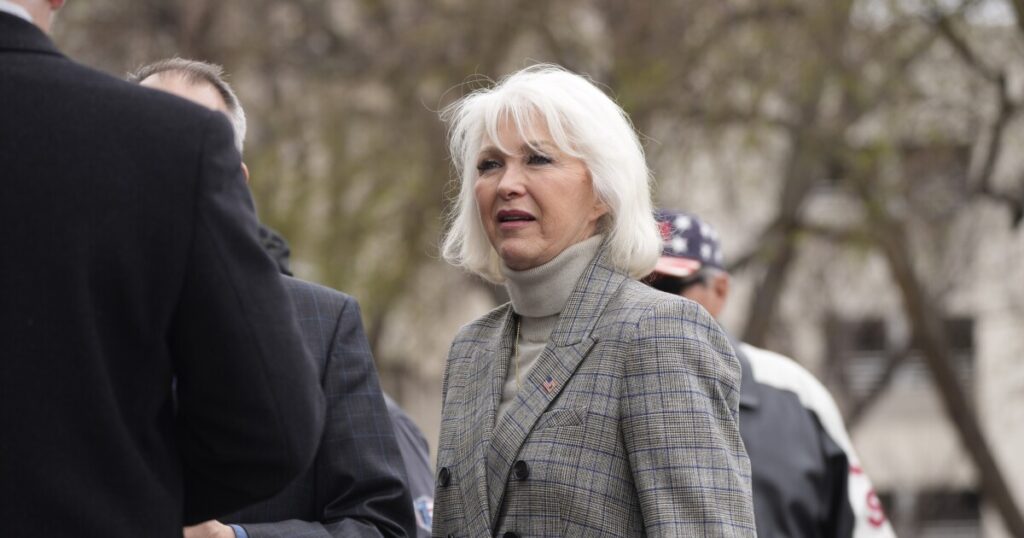
DENVER — In a surprising move, President Donald Trump announced on Thursday that he would grant a “full pardon” to former Mesa County Clerk Tina Peters, who was convicted last year of tampering with Colorado's election systems during the contentious 2020 presidential election. Peters was sentenced to nine years in prison, having been found guilty of granting unauthorized access to the voting systems she oversaw, all while continuing to propagate discredited claims of voter machine fraud.
In a post on his Truth Social platform, Trump characterized Peters as a “Patriot who simply wanted to make sure that our Elections were Fair and Honest.” He asserted that his pardon was a response to what he described as relentless targeting by Democrats against Peters for her attempts to “expose Voter Fraud in the Rigged 2020 Presidential Election!”
However, legal experts quickly pointed out the limitations of Trump's pardon power. David Lane, a civil rights lawyer based in Denver, remarked, “It’s purely performative, like 99% of the stuff he does. It has no impact on anything. She is not charged with any federal crimes. She is not convicted on any federal crimes. And President Trump has no ability to stick his nose into the Colorado justice system.” The American Bar Association further clarified that a U.S. president can only offer pardons for offenses against the United States, not for state crimes.
State Officials Respond
Reacting swiftly to Trump's announcement, Colorado Secretary of State Jena Griswold condemned the pardon, labeling it “an assault not just on our democracy, but on states' rights and the American Constitution.” Griswold emphasized that Peters was convicted by a jury of her peers in a state court, asserting that Trump has no constitutional authority to pardon her.
Dan Rubinstein, the Mesa County District Attorney, expressed similar sentiments, stating that Trump “does not have the authority to pardon her. No court will uphold that order.” The Colorado Democratic Party also chimed in, with Chair Shad Murib saying they were not surprised by what he termed a “meaningless pardon for his friend and fellow election denier Tina Peters.” Murib added, “For a president who obviously doesn't respect the rule of law, this is not surprising. Nobody is above the law, not even the president's friends.”
Colorado Attorney General Phil Weiser commented that the idea of a president pardoning someone convicted in state court would be “an outrageous departure from what our constitution requires.” He highlighted the principle that states have independent sovereignty and manage their own criminal justice systems without federal interference.
Trump’s latest intervention in state matters came just days after a federal judge denied Peters’ request for release while she appeals her state conviction. Peters had filed a federal lawsuit to gain bond during her appeal, but the state argued that federal courts should not get involved in pending state cases. Federal magistrate judge Scott Varholak ruled that Peters failed to establish a case for federal intervention, despite her claims that her First Amendment rights were violated during sentencing. The sentencing judge, Matthew Barrett, labeled her a “charlatan” and noted her actions undermined the democratic process.
Throughout this ordeal, Peters has maintained her innocence, insisting her actions were in service of uncovering alleged fraud. Her legal team has argued that the sentencing judge was incorrect to label her statements as “lies” without evidence to support any danger posed by her speech. Supporters like retired Lt. Gen. Michael Flynn have rallied for her release, with Trump previously threatening “harsh measures” if she remained incarcerated.
Amidst this political drama, the Colorado Department of Corrections denied a request made by Trump’s administration to transfer Peters to federal custody. Trump had expressed a desire for Peters to be more involved in investigations related to the 2020 election. A spokesperson for the CDOC clarified that transfer requests must originate from state authorities, not external entities.
Just a day after Peters' appeal was rejected, the U.S. Department of Justice announced it would launch a sweeping investigation into alleged violations of inmate rights across Colorado’s correctional facilities. This inquiry will focus on concerns of inadequate medical care, unsafe conditions, and excessive force against juveniles. Some, like Lane, have expressed skepticism about the timing of the DOJ's investigation, speculating it may be a response to the Colorado administration’s refusal to comply with requests involving Peters.
Despite Trump's claims, there has been no substantial evidence of widespread fraud in Colorado elections, a fact consistently reinforced by numerous county clerks, many of whom are Republicans. Peters’ prosecution was led by a Republican district attorney, and her case received support from other officials within her conservative-leaning county.
The unfolding situation raises significant questions about the interplay between state and federal powers, particularly regarding the authority of a president to intervene in state judicial matters. As this narrative continues to develop, it underscores the complexities of American democracy and the ongoing debates surrounding election integrity.
H3N2 Flu Strain Explodes in the UK: Are You Safe? Shocking Symptoms You Can’t Ignore!
Why 87% of Americans Are Being Locked Out of Their Own Online Accounts—Find Out If You're Next!

Stillman College’s Shocking Move: Women’s Flag Football Set to Change Everything—Will You Be Left Behind?

This Kobe and Shaq-Signed Ball Just Shattered Auction Records—What’s It Worth Now?

Tampa's SHOCKING Collapse: How Cousins and Pitts Stunned the Buccaneers in a 29-28 Playoff Heartbreaker!

Polar Bears' DNA Changing – Could This Be Their Last Hope Against Climate Chaos?
You might also like: