
The Shocking Truth: What Really Happened to Jackie Kennedy's East Wing Legacy? You Won't Believe It!

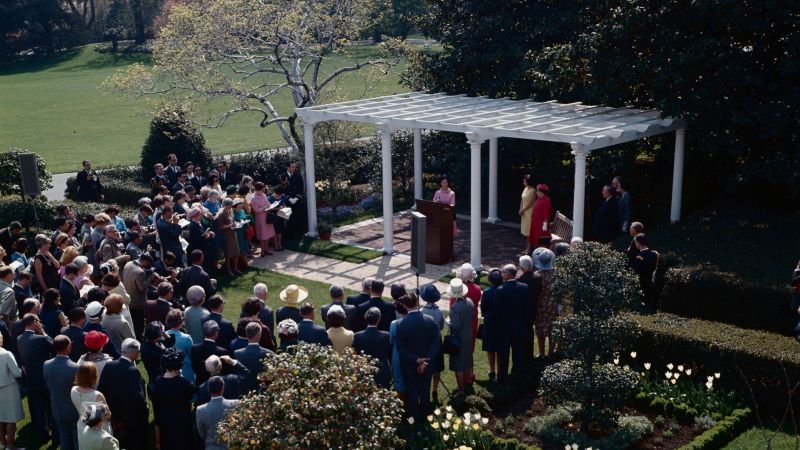
When the historic East Wing of the White House was unexpectedly demolished last year to pave the way for President Donald Trump’s new ballroom construction, it marked the end of an era for an important piece of White House history. Among the casualties was the beloved Jacqueline Kennedy Garden, a tribute dedicated in 1965 by former First Lady Lady Bird Johnson to honor her predecessor’s significant contributions to the White House.
The garden, featuring an iconic pergola designed by renowned architect I.M. Pei, was dismantled during this renovation. Its trees were sent to various nurseries for preservation, while the pergola itself was put into storage. This abrupt loss has been met with dismay, particularly from the Kennedy family.
Jack Schlossberg, the grandson of John F. Kennedy, expressed his deep concern in an interview with CNN. “President Trump has a deep obsession with my family — from the East Wing to the Rose Garden, the Kennedy Garden, to the plane, the list goes on. But he is attacking all families each and every day with higher costs, careless war, and a deep corruption,” Schlossberg stated. He is currently running for Congress as a Democrat and added, “My grandmother believed in the people of this nation. Every single person. She wanted us to see gardens, and color, and the brightness of life. What we have now is darkness.”
More than six decades after Lady Bird Johnson praised Jacqueline Kennedy's "unfailing taste," plans for the landscaping surrounding the new ballroom are starting to emerge. Landscape architect Rick Parisi presented his designs to the National Capital Planning Commission (NCPC) earlier this month, introducing a new garden that will occupy the former site of the Kennedy Garden. This garden will extend south across the length of the expansive ballroom and will include features like a grand staircase, a round brick patio made with “original Mount Vernon brick,” large granite paver pathways, and four topiary holly trees from the original garden. Notably, a fountain from the previous garden will be relocated and integrated into the new design.
However, this redesign has sparked controversy among landscape architects and historic preservation experts. Critics argue that the new plans reflect a significant departure from the original garden's aesthetic and purpose. The driveways in the South Lawn area, which were part of a historic design utilizing ellipses, will be reconfigured, disrupting its circular shape and compromising the established landscape.
During the NCPC meeting, many experts highlighted the "incongruous sharp bend" of the new driveway design. Priya Jain, an architect and chair of the Heritage Conservation Committee of the Society of Architectural Historians, noted that it not only looks jarring but also strays from the soft, curved paths that define the Olmsted plan — a comprehensive design guide established by Frederick Law Olmsted in 1935 that has governed changes to the White House grounds for nearly a century.
Renowned building restoration specialist Rob Cagnetta emphasized the importance of architectural integrity, stating, “Architecture communicates meaning. The White House is one of the most recognizable civic buildings in the world, and its physical prominence reflects its role as the center of American executive leadership. Any new construction within this should reinforce that meaning, rather than dilute it.”
Charles Birnbaum, a landscape architect and president of the Cultural Landscape Foundation, firmly believes that the current plans are “contradictory to everything that the Secretary of the Interior established.” Having spent 15 years coordinating the National Park Service Historic Landscape Initiative, Birnbaum asserted, “It wouldn’t have been approved by the agencies. No.” He noted that significant alterations to visual and spatial relationships have occurred due to the proposed changes.
One of the most poignant aspects of the garden’s history is its inception. The idea for a garden on the east side of the White House originated with President Kennedy in 1962, where he envisioned a space that offered both beauty and utility, including areas for children to play and a small plot for herbs for the White House chef. Following Kennedy's assassination, Lady Bird Johnson resurrected the plans, dedicating the garden to Jacqueline Kennedy as a tribute to her stewardship.
The Jacqueline Kennedy Garden has been an integral part of White House tours, serving as a peaceful retreat for both first families and the public alike. Its sudden removal raised eyebrows, especially among those who hold the garden's legacy dear. A source familiar with Rachel “Bunny” Lambert Mellon, the garden's designer, revealed that they learned of the garden’s demolition alongside the public.
As Schlossberg aptly put it, “Kennedy is a pillar of the modern preservation movement.” The profound implications of the current administration’s actions extend beyond aesthetic changes; they encapsulate a deeper disconnect from history and cultural significance. As the White House continues to evolve, the loss of the Kennedy Garden serves as a reminder of the delicate balance between modernization and the preservation of legacy, a conversation that is far from over.
Cowboys Set to Snag Star Tackler — Will This Game-Changer Save Their Season?

NFL Mock Draft Shocker: Will Your Team Lose the Top Prospect? Discover the Odds NOW!

You Won't Believe What Riccardo Calafiori Revealed About His Fitness Scare – Is He in Danger?
Your Browser Could Be Putting Your Data at Risk—Discover the Shocking Truth Before It's Too Late!

Is Your City on the Brink? Shocking Climate Data Reveals Hidden Dangers You Can't Ignore!

Ex-Governor Higashikokubaru's Shocking Comeback: Will He Change Miyazaki Forever?
You might also like: