
Tech Giants Partner with Unions: Are AI Data Centers the Future or a Nightmare? Find Out NOW!

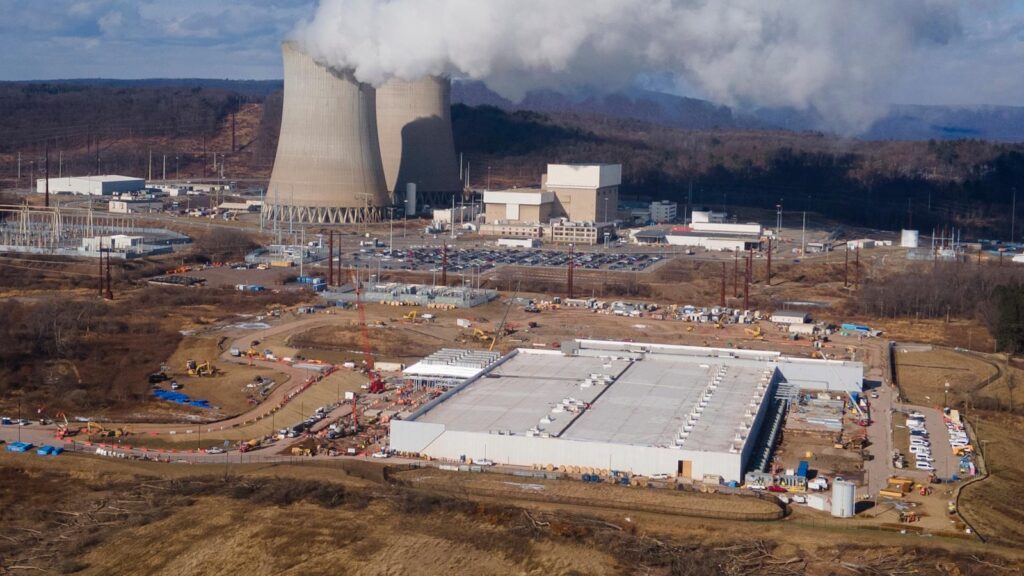
As the race for artificial intelligence (AI) dominance intensifies, a surprising ally has emerged: America’s building trades unions. These organizations, traditionally seen as the voice of the American worker, are now playing a crucial role in shaping the country’s AI economy, collaborating with some of the richest companies in the world.
Unions are finding themselves at the forefront of massive data center projects, responding to an explosive demand for skilled labor. This demand has sparked a scramble to recruit new apprentices, a trend that is bringing new life to organized labor sectors across the country. With tech giants and supportive government officials emphasizing the need for AI superiority in a national security context, unions are aligning with these interests, showcasing a strategic partnership that redefines their traditional roles.
In recent discussions, Rob Bair, president of the Pennsylvania Building and Construction Trades Council, emphasized the need for constructive dialogue between communities and tech companies. “When people say, ‘data centers are the root of all evil,’ we’re just saying, ‘look, they do create a hell of a lot of construction jobs, which we live and work in your communities,’” Bair noted. He advocates for communities to articulate their needs, such as improvements to project plans or investments in local schools, rather than simply opposing development.
The data center construction boom has led to significant growth in union training programs, with some organizations reporting a doubling of apprentice class sizes. For instance, the Columbus-Central Ohio Building and Construction Trades Council estimates that data centers account for at least 40% of the work hours for its members. In Washington, D.C., the International Brotherhood of Electrical Workers Local 26 claims that number jumps to at least 50%. In fact, the North America’s Building Trades Unions announced a record number of members and apprentices in 2025.
Sean McGarvey, president of North America’s Building Trades Unions, linked this growth to several factors, including the construction of data centers, power plants, and initiatives from the Biden administration that subsidized semiconductor and electric vehicle battery factories. The surge in data centers, known for their voracious energy consumption, is prompting a corresponding boom in power plant construction, creating additional opportunities for union members who build and maintain energy infrastructure.
The Boilermakers Local 154, for instance, has seen a remarkable turnaround after facing years of decline. Shawn Steffee, a union official, reported that they have gone from recruiting zero apprentices for four years to assembling a class of over 200, driven by the growing demand for skilled labor in energy sectors.
Meanwhile, tech giants like OpenAI and Google are investing heavily in training programs to develop a workforce that can meet their needs. “Across the country, highly skilled union construction workers are laying the foundation for the AI economy,” stated Sam Altman, co-founder and CEO of OpenAI. Google recently announced a $10 million grant to a union-backed electricians training program, projected to expand the electrician workforce pipeline by 70%.
However, this partnership has raised eyebrows among critics. Mark McManus, general president of the United Association of Union Plumbers and Pipefitters, acknowledged the concerns but countered that rejecting collaboration with tech companies would be unrealistic. “If we chose as a union to have a moratorium on building the data centers because we didn’t believe it was right for America, the data centers would still be getting built,” McManus insisted. “They’re not stopping because of organized labor.” His union now boasts members working on over 90% of data center projects in the U.S.
Despite the apparent benefits, the exact percentage of data center projects utilizing union labor remains uncertain. A late survey from the Associated General Contractors of America indicated that union representation in data center construction likely resembles the broader commercial construction landscape, where approximately one-third of the workforce is unionized. National unions have also negotiated labor agreements on significant projects, such as the Oracle and OpenAI Stargate campus in Michigan and the “Project Blue” data center campus in Arizona.
In Pennsylvania, Governor Josh Shapiro recently announced a $20 billion investment by Amazon for two data center projects in the eastern part of the state, with union representatives standing by his side. “This is really unique, what we’re building here in this commonwealth. People coming together with common purpose to get stuff done,” Shapiro remarked.
On the legislative front, unions have actively opposed various proposals aimed at regulating data centers. For instance, they fought against a statewide moratorium in Maine and standards in Illinois that would require data centers to supply their own energy. In Virginia, unions succeeded in defending a sales tax exemption that has helped make the state a major data center destination. However, this alignment has led to tensions, with some lawmakers, like Pennsylvania State Senator Katie Muth, expressing frustration at the difficulty of garnering Democratic support for stricter regulations on data centers, which are often undermined by union-backed initiatives.
The unions' influence is palpable at municipal meetings across the country, where they frequently advocate for data center projects. However, their presence has sometimes been contentious. In Joliet, Illinois, a local resident expressed concerns about union members “bullying” attendees at council meetings, while in Hobart, Indiana, another community leader praised union representatives for being “the adults in the room,” acknowledging their understanding of business and tax structures.
As the landscape of labor and technology evolves, the collaboration between unions and tech giants in the burgeoning AI economy will likely continue to shape the conversation around labor rights, community engagement, and economic growth in the United States.
Ravens’ Bold Move: Could Stefon Diggs Leave Bills for Raiders? Shocking Details Inside!

You Won't Believe What the vivo X300 Ultra Captured in Hong Kong—340x Telephoto Magic Exposed!
Google Cloud's Thomas Kurian Drops a Bombshell: How Two New Chips Could Topple Microsoft and Amazon—Are You Ready for the Shock?

Ethereum’s Price Should Have Crashed—Why This Expert Warns You’re Missing a Major Red Flag!

Is Indiana on the brink of a marijuana revolution? Governor Mike Braun hints at shocking policy changes!

Atrium's Shocking $2B Power Move: How WakeMed Could Change Forever! Don't Miss Out!
You might also like: