
Snapchat’s AR Specs Launch: Could This $1 Billion Gamble Mean Its Downfall? Find Out Now!

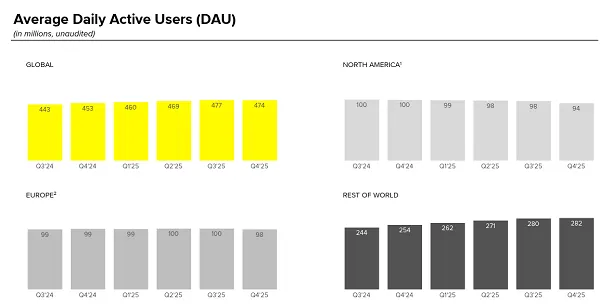
Snapchat has recently released its performance update for Q4 2025, revealing a mixed bag of results that underscore both challenges and opportunities for the social media platform. Notably, the app experienced a decline in daily active users (DAUs), losing 3 million users since Q3 and settling at 474 million DAUs. Despite this setback, Snapchat reported a steady revenue increase, with earnings reaching $1.72 billion, marking a 10% rise compared to the same quarter last year.
This decline in active users is largely attributed to external factors. The app was banned in Russia in early December as part of a government initiative to promote domestic social media platforms. Additionally, new restrictions in Australia aimed at under-16 users led to further user losses. These events collectively resulted in an estimated loss of 8.5 million users. However, the fact that Snapchat only reported a 3 million net loss suggests that the platform has managed to retain its core user base relatively well.
Yet, the troubling trend of declining users in the U.S.—Snapchat's key revenue market—raises questions about its future growth potential. The app has been losing users both domestically and in the European market, indicating that it may have reached a saturation point. To sustain revenue growth, Snapchat may have to rely increasingly on ad placements, which could risk alienating users if not balanced effectively.
Despite the user decline, Snapchat's revenue growth has been bolstered by its focus on small and medium-sized businesses (SMBs), as well as its non-advertising projects, such as Snapchat+. The company has set ambitious goals to diversify its revenue streams, stating in its letter to shareholders that it aims to foster direct connections between brands and Snapchatters. Snap plans to achieve this by leveraging artificial intelligence to enhance the advertising experience, making it more efficient for advertisers and more valuable for users.
Snapchat has also highlighted significant growth in its subscription service, Snapchat+. In Q4, the service saw a 71% year-over-year increase, reaching 24 million subscribers. This shift suggests that Snapchat is now prioritizing monetizing its existing audience over mere user growth. However, this strategy carries risks. Overloading users with ads could drive them away, while subscription models have historically struggled to generate substantial revenue in the social media space.
Looking ahead, Snapchat is poised to launch its highly anticipated AR Specs, a set of augmented reality-enabled sunglasses. Snap has positioned itself as a leader in AR engagement, and the upcoming launch aims to capitalize on this expertise. However, it faces tough competition from tech giants like Meta, which has a significant head start in the smart glasses market. Although Snap has organized its AR Specs division as a separate business unit to mitigate risks associated with potential losses, the challenge remains substantial.
As Snap's CEO Evan Spiegel noted, "We believe Snap is uniquely positioned to lead the next wave of spatial computing." The company's strategy involves integrating its software, tools, and hardware into a cohesive AR platform. However, as competition heats up, particularly from Meta which has a personal vendetta against Snap for previously rejecting a takeover offer, the outcome remains uncertain.
The crux of Snapchat's current dilemma is whether it can strike the right balance between monetization and user experience. Will the company overload its platform with ads in an attempt to recoup losses, or will it effectively capitalize on its existing user base to diminish market concerns about shrinking daily active users? As Snapchat navigates these challenges, its ability to adapt and innovate will be critical for maintaining its relevance in an increasingly competitive landscape.
Governor Lee's SHOCKING Final Address: What He Revealed Will Leave You SPEECHLESS!
Is Your Browser Secretly Sabotaging Your Online Safety? Discover the Shocking Truth Now!

You Won't Believe How Houston Realtors Are Hiding Flood Risks—What Buyers Need to Know NOW!

Is George Borrello's Re-Election Bid a Game-Changer for NY? Shocking Secrets Inside!

Lawmakers Just Took a Shocking Step: Are School Vaccine Requirements About to Vanish Forever?

You Won't Believe These 5 Super Bowl Snacks Will Steal the Show in 2026—#3 is a Game-Changer!
You might also like: