
New Closed Primaries Bill Sparks Explosive Clash: Which Lawmakers Are Furious?

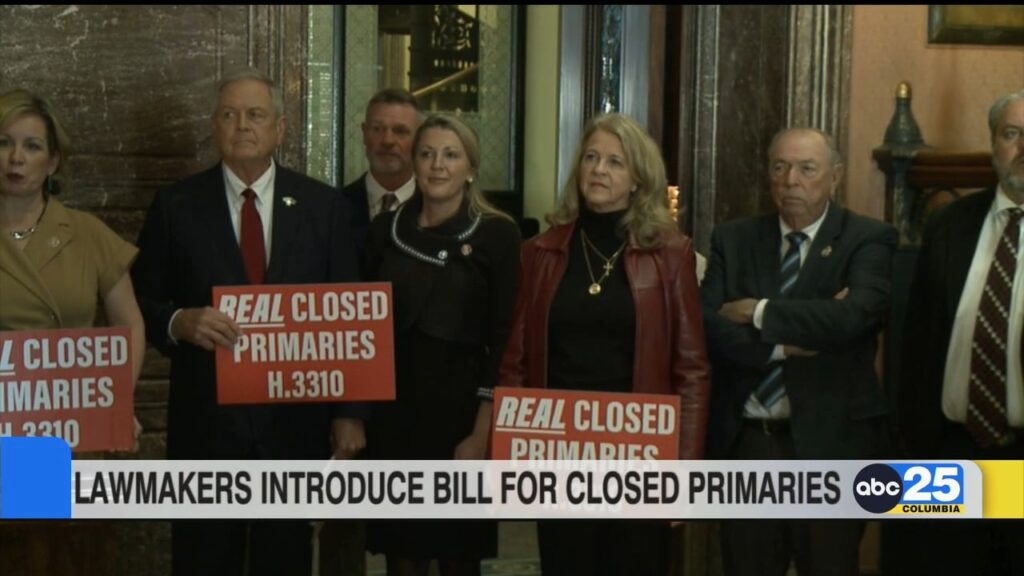
COLUMBIA, SC (WOLO) — A proposed bill in South Carolina is stirring debate among lawmakers regarding the future of primary elections in the state. If passed, Bill H.3310 would mandate closed primaries, allowing only registered members of a political party to vote in that party's primary elections. This legislative move, introduced by Representative Mike Burns and backed by gubernatorial candidate Ralph Norman, reflects a push for tighter party control during the electoral process.
Representative Ralph Norman argues that the current system leads to significant disruptions in the electoral process. “You’ve got such a diversion between the two parties. And to have close elections, particularly in statewide primaries, and you have people winning by 30 votes, 40… You should not be able to disrupt the will of the people,” Norman stated, emphasizing that closed primaries are equally crucial for presidential elections. “It’s important across the board. There is no boundary it doesn’t affect. This helps this state,” he added.
However, not all South Carolina leaders are on board with this proposal. Governor Henry McMaster has voiced his opposition, indicating that he would veto the bill if it reaches his desk. “The question is, ‘Does it make it easier for people to vote, or cause people to want to vote, or does it put obstacles in their way?'” McMaster stated. He expressed concern that the bill, as currently written, could create barriers for voters. “What I’ve seen, as written, these bills so far, it seems to me they’re putting obstacles in voters’ way.”
A key stipulation of the bill is that voters would have to register as a member of a political party at least 60 days before the primary, a requirement that some critics argue could disenfranchise independent voters. Senator Tameika Isaac Devine, a Democrat, warned that such a change could negatively impact the political landscape in South Carolina. “I think about a third of our voters typically consider themselves Independent. Some people decide they’re a Republican today and decide they’re a Democrat tomorrow. I think they ought to be able to do that,” she noted, emphasizing the importance of maintaining open access to the electoral process.
Governor McMaster echoed these sentiments, highlighting the historical roots of the Republican Party, which he argues were built on an open primary system. “We allowed an open primary. We didn’t restrict it to those who had a Republican card. And people in the presidential primaries especially, if they wanted to vote, we said ‘Come on in!’” McMaster remarked. He acknowledged concerns that members of opposing parties might try to sway elections by voting in the primaries, but he believes such instances are rare.
In a twist, a competing bill is also being introduced that would close the primaries but allow voters registered as Independents to participate in either party's primary. “I want a strong one, I don’t want a watered-down version, and I think we can get the job done,” said Norman, indicating that while he is committed to the closed primary concept, he is open to discussions regarding inclusivity for independent voters.
The implications of this proposed legislation could reshape the political landscape in South Carolina, particularly as the Statehouse gears up to consider the bill for the first time on January 22nd. As discussions unfold, the debate highlights broader questions about voter access and party integrity, reflecting a tension that resonates across the nation.
Unlock the Secret: How MIT's Shocking Smartphone Study Could Change Your Life Forever!
Trump's Shocking Midterm Proposal: Is Insurrection Act Next? You Won't Believe the Consequences!

This PS4 Exclusive Just Dropped to Under $10—Find Out Why Gamers Are RUSHING to Buy It!

Iran's Shocking $7.8 Billion Crypto Surge: Protests Spark Bitcoin Boom—Are You Missing Out?

Supreme Court Justices Secretly Debate Shockingly High Real Estate Fees—Is Your Home at Risk?
Sam Darnold’s Shocking Injury Update: Will He Risk It All Against the Seahawks? You Won’t Believe What’s at Stake!
You might also like: