L.A.'s Bold Move: 10,000 Apartments in Empty Offices—Will Your Neighborhood Change Forever?

In a significant policy shift aimed at addressing Los Angeles' housing crisis, city officials have simplified the process for converting empty commercial buildings into residential units. This initiative is poised to create thousands of new apartments in a city grappling with a severe shortage of housing.
Developer Garrett Lee, president of Jamison Properties, is already set in motion. After years of difficulty in attracting white-collar tenants to a high-rise office building on the edge of downtown, Lee has embarked on a project to transform the space into approximately 700 apartments. He describes the newly implemented Citywide Adaptive Reuse Ordinance as “monumental for the city,” opening the door for many more housing conversions.
The updated ordinance, which went into effect this month, broadens the scope of eligible buildings beyond the original 1999 guidelines. While the previous rules focused mainly on older buildings in downtown Los Angeles and applied to structures erected before 1975, the new guidelines allow for the conversion of commercial buildings that are just 15 years old throughout the city, streamlining the approval process. City staff can now approve these conversions without the lengthy reviews that often lead to City Council involvement.
According to Lee, this change eliminates one of the most significant obstacles for developers: uncertainty about how long it will take to initiate construction. “When you take that risk off the table, it materially improves the feasibility of conversions,” he said. He highlights that this policy addresses not only the housing shortage but also the long-term issue of office vacancies.
The city currently has over 50 million square feet of vacant office space, as noted by industry experts. This vast expanse of empty buildings provides a substantial opportunity for transformation. Developer David Tedesco is also capitalizing on the new ordinance by moving ahead with plans to convert a former Sunkist headquarters in Sherman Oaks, which was not previously included in adaptive reuse guidelines, into 95 apartments.
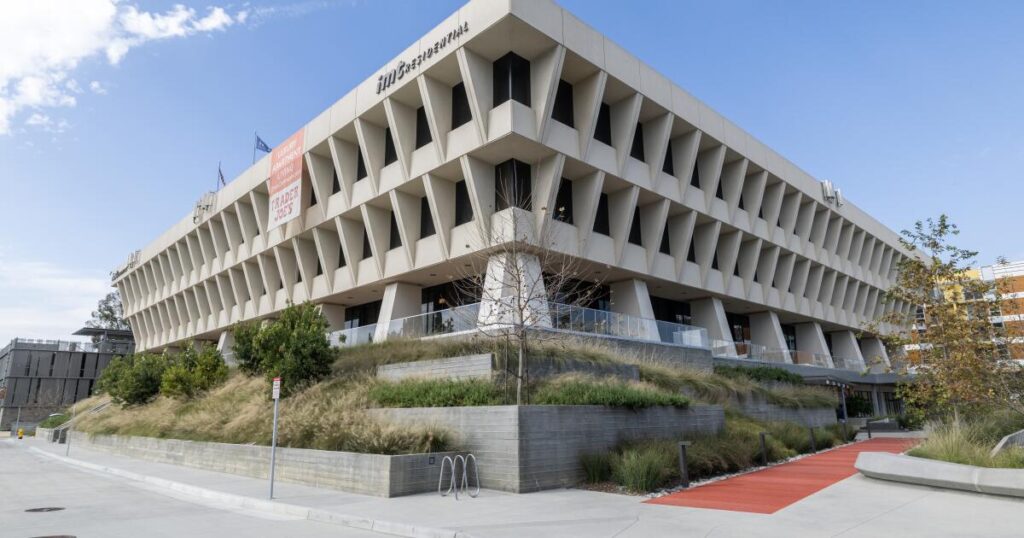
Tedesco’s company, IMT Residential, aims to repurpose the striking inverted pyramid structure, which served as Sunkist’s base from 1970 to 2013. The Los Angeles Conservancy has recognized the building as significant enough to potentially warrant landmark status. The previously planned renovations for new office space were shelved in light of the drastic drop in demand for such spaces post-pandemic. “We could move forward a lot faster,” Tedesco noted, emphasizing the efficiency gained from the new regulations.
As early as the 2000s, the original adaptive reuse ordinance demonstrated a strong demand for downtown living, leading to a residential renaissance in an area that had been predominantly commercial. Ken Bernstein, a principal city planner in L.A.’s Planning Department, stated that the updated guidelines “unlock the potential” for thousands of underutilized structures, including commercial centers along Wilshire Boulevard, Ventura Boulevard, and South Los Angeles.
Not limited to office buildings, the ordinance opens possibilities for converting industrial buildings, retail stores, and even parking garages into residential units. Bernstein envisions shopping centers repurposing part of their retail and garage space for housing, an idea that could breathe new life into struggling commercial areas.
Despite the potential benefits of the ordinance, developers still face several challenges. High interest rates are making construction loans more expensive, while increased tariffs are driving up material costs. Additionally, recent regulations, such as Measure ULA—Los Angeles' "mansion tax"—have raised concerns about profitability in the housing market. Karin Liljegren, an architect specializing in adaptive reuse, remarked that this measure is impeding development within the city.
While L.A.'s median rent saw a decrease, dropping to $2,167 in December—the lowest level in four years—experts disagree on whether this is a temporary plateau or a sign of long-term changes in the market. Conversion activist Nella McOsker expressed optimism about the new ordinance, labeling it “tremendous” for allowing greater flexibility in redevelopment. However, she emphasized that L.A. should consider offering financial incentives akin to those in cities like New York and San Francisco, which have employed tax relief programs to stimulate development.
As developers like Lee adapt their strategies, he plans to leverage the new ordinance by designing smaller units within his projects, helping to lower rents. The ordinance's rolling 15-year age requirement will also facilitate a continuous influx of suitable candidates for conversion, as newer buildings often require fewer renovations to meet safety codes.
As Los Angeles navigates its ongoing housing crisis, the newly enacted Citywide Adaptive Reuse Ordinance presents a promising avenue for revitalizing the city’s vacant commercial spaces while addressing the pressing need for affordable housing. The future of urban living in L.A. may well hinge on the ability of developers to transform these spaces into homes.
Shocking Truth: Are We Underestimating Wastewater Emissions by 50%? The Alarming Data You Must See!

Super Bowl LX vs. Bad Bunny: Why 128.2 Million Watched Him Instead—You Won't Believe the Shock!

Caleigh Mackenzie's Shocking Age Revealed: How She Built a $1M Fitness Empire! You Won't Believe Her Journey!

Shocking Discovery in Arizona: What Investigators Found Could Change Everything in Nancy Guthrie's Case!

Hamilton County's Real Estate Market Just Took a SHOCKING Turn—Inventory Rises, But What Does This Mean for Buyers?

Is the White House Hiding a $10 Million Secret? Court Ruling Could Change Everything!
You might also like: