
Korea’s 2026 Startup Package: Will It Really Transform Your Future? Don’t Miss Out!

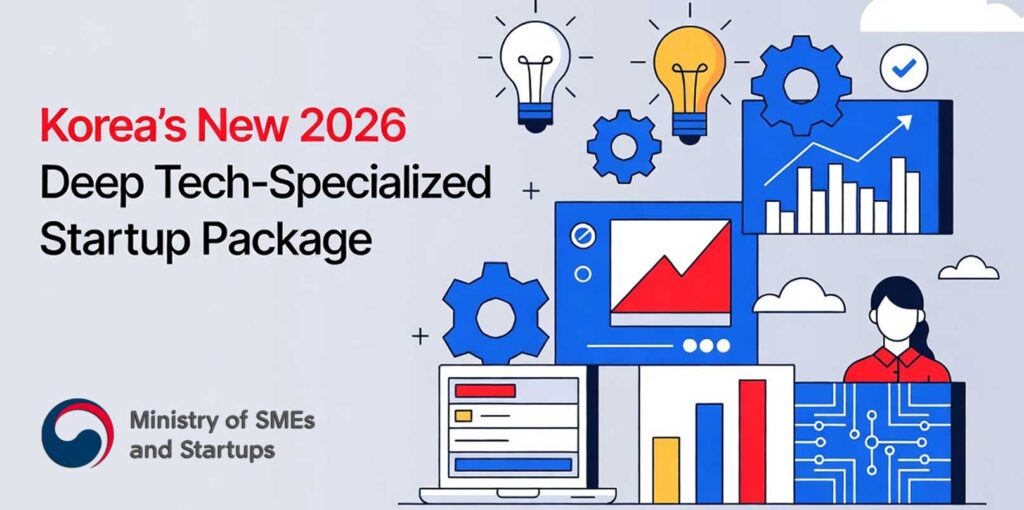
South Korea is undergoing a significant transformation in its approach to startup financing, shifting towards a robust long-term innovation infrastructure. The Ministry of SMEs and Startups (MSS) has officially unveiled its 2026 Startup Package Program, initiating this initiative with the Deep Tech-Specialized track. This move signals the country’s commitment to nurturing advanced ventures in artificial intelligence, robotics, and bio-health, which typically require extensive research, validation, and commercialization time.
This restructuring aims to do more than just provide funding; it seeks to create a comprehensive ecosystem that integrates financial resources with technological development and regional balance. By establishing a well-connected architecture for innovation, Korea is positioning itself to lead in the next wave of technological advancement.
📰 Table of Contents
Launch of the Deep Tech-Specialized Track
Applications for the Deep Tech-Specialized track officially opened on January 6 and will close on January 27 at 4:00 PM KST, available via K-Startup at www.k-startup.go.kr. The first phase of this initiative is set to support 175 deep tech startups, comprising 100 early-stage companies and 75 scale-up (leap stage) companies. These startups will operate within five strategic technology domains: big data and AI, bio-health, future mobility, eco-friendly energy, and robotics.
Each selected startup will be eligible for commercialization funding tailored to their stage of development, including:
- Early Startups (within 3 years): up to KRW 150 million (~ USD 115,000).
- Scale-Up Startups (3–10 years): up to KRW 300 million (~ USD 230,000).
In addition to financial backing, the MSS and its partner agencies plan to offer comprehensive support in the form of mentoring, investment connections, technology transfer assistance, and programs aimed at facilitating global expansion, specifically designed for high-complexity sectors.
Comprehensive Support for Startups
The Startup Package Program emerges as one of Korea's most extensive government-backed initiatives aimed at fostering entrepreneurial growth. This initiative supports startups through three distinct stages:
- Pre-Startup Package for companies in the planning stage,
- Early Startup Package for those established within three years, and
- Startup Leap Package for ventures that are between three to seven years old, extendable to ten years for new industries.
Beginning in 2026, the MSS has restructured the support system into three specialized categories:
- Deep Tech-Specialized for high-technology ventures,
- General for startups across various industries, and
- Investment-Linked for startups with proven fundraising capabilities.
The initial launch of the Deep Tech-Specialized Package underscores a broader policy intention to align Korea’s startup framework with global innovation standards, tailoring financial aid to the technology readiness level (TRL) and investment maturity of each venture.
An MSS official pointed out that deep tech startups require long-term, patient capital, emphasizing that the Deep Tech-Specialized Package was introduced through the 2025 supplementary budget to "thicken the foundation" of Korea’s high-technology ecosystem. The official stated,
“Deep tech startups need sustained support to refine technology and achieve commercialization. This stage-specific and region-sensitive program is designed to improve their success rate and accelerate Korea’s transformation into a high-value innovation economy.”
Focus on Regional Balance
Significantly, the 2026 Startup Package introduces a regional preference policy aimed at addressing the economic divide between the Seoul metropolitan area and other regions. Non-metropolitan startups will benefit from differentiated private contribution ratios based on regional classifications:
- Special Support Areas: 10% private share (government covers 90%),
- Preferential Support Areas: 20% private share,
- General Areas: 25% private share.
This includes 40 rural counties identified as population-declining and underdeveloped, thereby reducing the financial burden on early-stage founders outside major urban centers. This adjustment aims to create a more geographically balanced innovation landscape.
The launch of Korea’s 2026 Startup Package marks a pivotal shift in national innovation policy, moving from short-term funding initiatives to long-term ecosystem development. By unifying critical sectors like AI, robotics, bio-health, energy transition, and future mobility under a single strategic framework, the government is positioning itself as a hub for industrial intelligence and sustainability. This evolution not only aligns with global innovation models seen in Japan, Singapore, and the EU but also positions Korea as a potential leader in attracting both domestic and international startups.
Ultimately, the initiative represents more than just a fiscal cycle; it signals a transformative approach to startup finance, emphasizing sustainability, endurance, and inclusivity. By treating startup finance as infrastructure rather than intervention, the MSS is establishing a model where capital, knowledge, and geography converge to lay a solid foundation for high-technology entrepreneurship.
– Stay Ahead in Korea’s Startup Scene –
Get real-time insights, funding updates, and policy shifts shaping Korea’s innovation ecosystem.
➡️ Follow KoreaTechDesk on LinkedIn, X (Twitter), Threads, Bluesky, Telegram, Facebook, and WhatsApp Channel.
Travis Kelce Set to Break Records? NFL Broadcasters Are Rushing to Cash In—You Won't Believe the Details!

Why 90% of Health Influencers Fail: Davey Fisher Reveals Shocking Secrets You MUST Know!
Social Media's Shocking Impact: Are You One of the 70% Losing Followers for Good?

You Won't Believe Which 'Healthy' Snacks Are Now Classified as Junk Food—Find Out Tonight!

Mass. Residents Shocked as U.S. Vaccine Policy Shifts—What You NEED to Know NOW!

Why Caesars Entertainment's Shocking 30% Share Drop Has Investors Panicking – Are You Next?
You might also like: