
Is the ‘Sell America’ Trade Doomed? ING Reveals Shocking Damage to the Dollar!

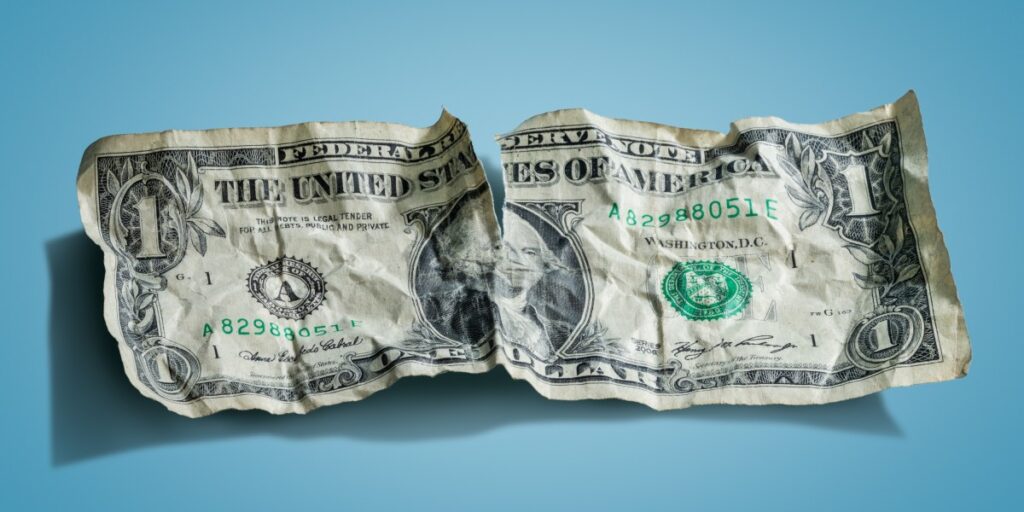
The U.S. economy showed promising signs last year, growing at an annualized rate of 4.4% and experiencing a decline in inflation. The stock market too painted an optimistic picture, climbing nearly 12% over the past 12 months. At first glance, these indicators would suggest that investors should have strong confidence in the U.S. dollar. Yet, the reality tells a different story.
The U.S. dollar has been on a downward trend, losing approximately 9.4% of its value against a standard basket of foreign currencies over the last year, with a nearly 10% decline projected for 2025. While fluctuations are common in currency markets, the greenback has been steadily losing ground since 2022.
Notably, the dollar has depreciated by 8% against the British pound in the last year, a surprising statistic given that the U.K.'s annual economic growth stands at a mere 1.3%, significantly lagging behind the United States. Moreover, currency traders seem to differ from the White House's bleak outlook on Europe, as the dollar has dropped nearly 12% against the euro. In practical terms, this means that each dollar currently buys only 84 cents in Paris.
As for equity markets, the Stoxx Europe 600 index is up nearly 4% year-to-date, contrasting with a slight decline of 0.14% in the S&P 500. This divergence highlights ongoing investor sentiment, which has shifted toward the European markets despite the U.S. economy's robust statistics.
According to ING analyst Francesco Pesole, the "Sell America" trade remains a persistent theme. While the U.S. economy appears strong on the surface, several headwinds continue to weigh on the dollar. Chief among these is rising unemployment and weak hiring rates. Data from Lawrence Werther and Brendan Stuart at Daiwa Capital Markets suggests that January's job creation figures may be revised down, indicating that what initially appeared to be a strong performance might have been a statistical anomaly.
One of the Federal Reserve's primary responsibilities is to bolster the labor market. If job numbers continue to falter, the Fed may consider new measures to inject liquidity into the economy. Although the Fed maintained interest rates at 3.5% during its January meeting, Wall Street analysts predict as many as two additional cuts are likely this year. This prospect raises concerns for dollar-denominated assets, as lower interest rates usually lead to diminished demand.
Pesole noted that the recent uptick in the U.S. macroeconomic environment has not been sufficient to restore the dollar's value, stating, “The mid-January 'sell America' episode is leaving lasting damage on the greenback—much like in summer 2025. Last week’s post-payrolls reaction confirmed that confidence hasn’t returned.” Furthermore, he remarked that the dollar has seen a significant erosion of its traditional safe-haven value.
Despite the bleak outlook for the dollar, here's a snapshot of the markets as of this morning:
- U.S. markets are closed for a national holiday today. The S&P 500 closed flat at 6,836.17 in its last session.
- STOXX Europe 600 was up 0.33% in early trading.
- The U.K.’s FTSE 100 was up 0.22% in early trading.
- Japan’s Nikkei 225 was down 0.24%.
- China’s CSI 300 is closed for the Chinese New Year.
- The South Korea KOSPI is closed for the Chinese New Year.
- India’s NIFTY 50 was up 0.83%.
- Bitcoin rose to $68.9K.
In summary, while the U.S. economy boasts impressive growth figures, underlying challenges such as rising unemployment and anticipated interest rate cuts are casting a shadow over the dollar's prospects. Investors are watching closely, and the current economic landscape suggests a cautious outlook for the greenback.
Putin's Shocking Move: 66 Million Russians Face Social Media Blackout—What Comes Next?
You Won't Believe Why This 37-Year-Old European's Liver Is Healthier Than an Indian Teetotaler’s!

Winter Olympics at Risk? Shocking Climate Data Reveals Potential for Last Games Ever!

Could Bennet’s Shocking Plan Change Colorado’s Future? Discover the Hidden Truth About Affordability!

Dana White's Shocking White House Update: Could This Change UFC Forever? You Won't Believe What He Revealed!
Unlocking Secrets: What Happens When You’re Denied Access? Shocking Truth Revealed!
You might also like: