
Is Michelangelo's Masterpiece Doomed? Shocking Climate Change Changes You Won't Believe!

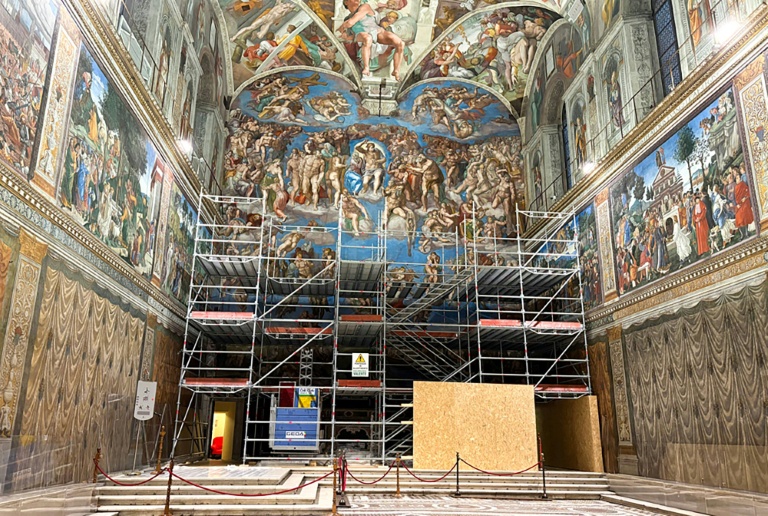
Michelangelo's iconic fresco, The Last Judgment, located in the Sistine Chapel, is undergoing its most significant restoration in over thirty years. This project aims to eliminate a light whitish residue left by the perspiration of countless visitors, which has dulled the vibrant colors of this 16th-century masterpiece.
The Vatican has announced that the restoration will enhance the fresco's original hues, bringing back its striking visual appeal. Measuring nearly 14 meters (46 feet) high and covering an area of 180 square meters, the painting features an astonishing 391 figures. Visitors can still access the chapel during the restoration, although they will be greeted by large scaffolding obscured by a reproduction of Michelangelo's work.
During a press tour for the project, Barbara Jatta, director of the Vatican Museums, likened the process of unveiling the fresco to “removing a cataract,” highlighting the transformative effect of the restoration. The Vatican explains that the unsightly substance—identified as calcium lactate—is invisible to the naked eye. To remove it, conservators are using distilled water applied through a layer of Japanese paper.
Fabio Morresi, the head of scientific research at the Vatican Museums, noted that increased transpiration from visitors has been exacerbated by climate change, leading to higher levels of lactic acid that convert to calcium lactate. As a result, the preservation of the chapel has necessitated careful management, including measures to reduce visitor capacity at any one time. The Sistine Chapel is not only a tourist destination but also a sacred space where cardinals gather for conclaves to elect new popes.
The emotional weight of this restoration is palpable for Morresi, who has been with the Vatican since the previous major restoration began in 1988. As he approaches retirement, he expressed a personal connection to this undertaking, stating, “It’s marvelous... There’s a piece of me in here.”
Completed between 1536 and 1541, The Last Judgment serves as the centerpiece of the Sistine Chapel, located just behind the altar. Historical accounts recount that then-Pope Paul III was so struck by the work that he fell to his knees, asking for forgiveness upon first viewing it. The painting has not been without controversy; its many nude figures sparked scandal, leading to some being covered with painted cloths after Michelangelo's death. A previous restoration in 1994 saw the removal of some of these painted cloths, but much work remains to fully restore the original vision of the artist.
The current restoration project is generously funded by donors from the United States, underscoring the international interest in preserving this cultural treasure. Since 2010, the Vatican has undertaken a comprehensive restoration of the Sistine Chapel, addressing various sections of the iconic structure as needed. While most work typically proceeds without the need for scaffolding when the chapel is closed, the sheer scale of restoring The Last Judgment required a different approach.
As the restoration progresses, the anticipation builds not just for the aesthetic revival of Michelangelo’s work, but for the continued cultural significance it holds within the context of the Vatican and the larger world. With the completion of this restoration anticipated before Easter, art enthusiasts and visitors alike await the moment when the fresco’s brilliance will be unveiled once more.
You Won't Believe These 5 Game-Changing Smartphones Under $400 – Grab Them Before They're Gone!

You Won't Believe How the Pistons Stunned the Cavs in Overtime—Is This the Start of a Championship Run?

Why Rep. Roth's SHOCKING Response to the Governor's Final Address Will Change Everything!
Bitcoin Crashes Below $64K: What U.S. and Israel's Iran Strikes Mean for Your Wallet!

Why Are Always-Single People Craving Deeper Connections More Than Ever? The Shocking Truth Revealed!

Why Anthropic's CEO Just Accused the White House of a Shocking 'Retaliatory' Move!
You might also like: