
Hollywood's Shocking Shift: Is Faith-Based Entertainment the Secret to Saving Cinema?

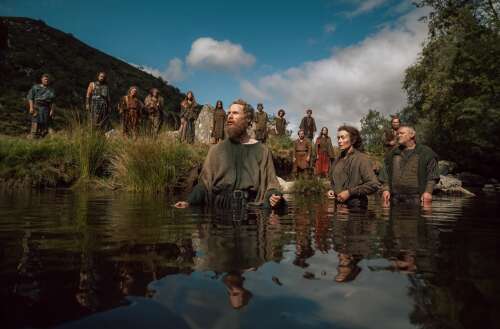
LOS ANGELES – This fall, Hollywood is taking a spiritual turn, featuring a lineup of films that delve into themes of faith and morality. From Josh O’Connor playing a conflicted priest to Keanu Reeves as an angel who has lost his wings, the industry is exploring religious narratives like never before. Elizabeth Olsen, too, finds herself in a romantic quandary in the afterlife.
It appears that Hollywood has found God, but this exploration of spirituality goes beyond big-budget productions and indie films. In recent years, there has been a marked increase in the number of films and television shows that approach topics of faith, particularly Christianity, from a confessional perspective. These projects are resonating strongly with audiences, leading to significant box office successes.
For instance, animated biblical films like Angel Studios’ upcoming musical “David” have risen to prominence, racking up over $14 million in theatrical pre-sale tickets before its release. Additionally, Martin Scorsese’s docudrama series “The Saints,” which premiered last year on Fox Nation, has become the platform’s most-watched series.
“There has been a revival, a revolution of sorts, of spirituality and faith content,” stated Traci Blackwell, head of targeted content for Prime Video and Amazon MGM Studios, during a recent Variety event focused on faith and spirituality in entertainment. Amazon has also jumped into the fray, premiering its own biblical drama, “House of David,” and securing exclusive U.S. streaming rights to the significantly popular series “The Chosen,” which chronicles the life of Jesus.
📰 Table of Contents
The 'Chosen' Effect
Historically, faith-based entertainment has had its high points, such as Mel Gibson’s “The Passion of the Christ,” which held the title of the highest-grossing R-rated film in the U.S. and Canada for two decades. However, such successes have been rare in the 21st century. Paul Dergarabedian, senior media analyst at Comscore, pointed out that Hollywood has often faced criticism from the faith community for neglecting films that reflect their values.
As studios recognize the lucrative potential of faith-based films, the success of “The Chosen” has been pivotal. Launched in 2017 by Angel Studios, it took some time to catch on, but as CEO Neal Harmon recounted, “It was like pulling teeth to get people to watch it. People have this idea that faith means cheesy or preachy. And we had to break through that barrier.” The hard work paid off; since Fathom Entertainment began distributing “The Chosen” theatrically in 2023, the series has grossed more than $116 million domestically.
Angel Studios, while not a Christian organization, focuses on distributing and marketing “values-based entertainment,” which encompasses various narratives beyond just faith stories. They have a slate of religious films in production, including “Zero A.D.,” set for release in 2026.
Additionally, Lionsgate is gearing up for the February release of “I Can Only Imagine 2,” a sequel to the 2018 biopic about the popular Christian song, which was among the highest-grossing Christian films in U.S. history. Co-director Andrew Erwin noted a “massive shift” in the last five years regarding Hollywood’s willingness to produce faith-based films, attributing much of the change to improved storytelling techniques. “We didn’t have the knowledge of how to do the filmmaking side of things. And so, I think the storytelling has gotten a lot better,” he said.
As Lionsgate prepares to distribute the first part of Gibson’s two-part sequel to “The Passion of the Christ” in 2027, the faith-based film genre appears to be carving out a more substantial presence in Hollywood.
Defining 'Faith-Based'
Interestingly, defining what constitutes faith-based programming is as complex as defining pornography. For example, themes of belief and guilt are present in O’Connor’s “Wake Up Dead Man: A Knives Out Mystery,” yet few would categorize it as a religious film. Meanwhile, Amanda Seyfried portrays the founder of the Shakers sect in “The Testament of Ann Lee,” a project that has garnered Oscar buzz, yet discussions of its faith themes remain muted.
Even Scorsese’s “The Last Temptation of Christ” and Paul Schrader’s “First Reformed,” which also stars Seyfried, are not widely viewed as Christian films, despite their creators’ strong ties to their respective traditions. Francesca Scorsese noted that her father’s film was a means for him to explore his faith, saying, “This film was his way of exploring his faith and exploring who his God is.”
However, many behind the recent projects resist being labeled as explicitly religious, even when audiences perceive them that way. Jonathan Roumie, who portrays Jesus in “The Chosen,” stated, “I wouldn’t characterize it so much as overtly Christian. It’s a historical drama that centers on Jesus.”
For studios and filmmakers, recognizing a project’s religious perspective can be a double-edged sword. Dergarabedian observed, “If you’re buying in on going to the movie theater for a faith-based movie, you know you’re gonna have people around you who are really into the experience. The minute you say ‘faith based,’ though, it kind of puts a movie in a box.”
Many Christians celebrate this growing trend for reasons beyond its monetization potential. Phil Wickham, a Grammy-nominated Christian artist who voices David in the forthcoming Angel film, expressed satisfaction with the success of productions like “The Chosen” and “House of David.” He noted, “Growing up, anything that was Christian media felt so preachy… But now I think there’s just more opportunity to tell bigger stories over the course of a series and more people willing to really dig in and tell something with excellence and beauty.”
Though it remains uncertain whether this trend is a lasting shift in Hollywood or a fleeting moment, the success of these projects has garnered attention in an industry otherwise facing significant challenges.
As Jason Klarman, Fox News Media’s chief digital and marketing officer, remarked, “Hollywood usually follows money. Even when the trend ends, we’ll still be doing it.” This suggests that faith-based narratives could remain a fixture in the entertainment landscape, appealing to a growing audience eager for stories that resonate with their beliefs.
EU's Shock Move: 2035 EV Goals SLASHED! What This Means for Startups and Your Wallet!

Indiana Lawmaker Reveals SHOCKING Truth: Why Crypto Bills Could CRASH—Are You Prepared?
Is Dylan Raiola Leaving His Dream School? Shocking QB Transfer Portal Moves That Could Change College Football Forever!

You Won't Believe What the Leaked Steam Machine Video Reveals—Is This the End of Console Gaming?

You Won't Believe Joe Wicks' Shocking Childhood Struggles—What He Reveals About Success Will Change Everything!

Why Did Jon Medved's ALS Diagnosis Lead to a Shocking Resignation? The Unexpected Twist Will Leave You Speechless!
You might also like: