
Dow and Nasdaq Plunge: Is Trump’s Iran Warning About to Trigger a Market Meltdown?

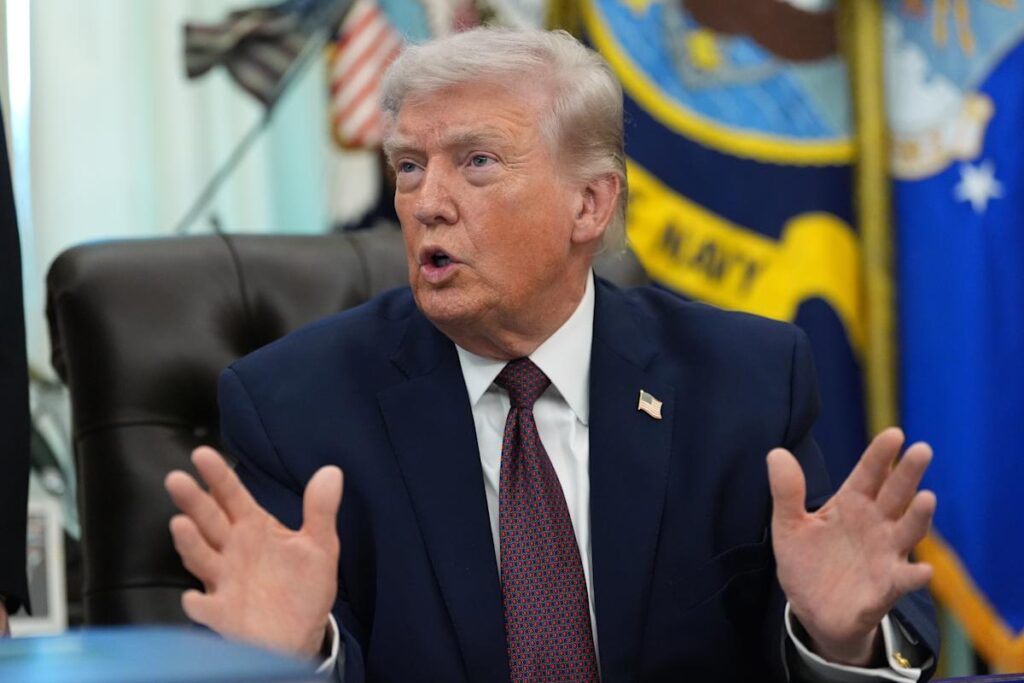
Oil prices surged while U.S. equity futures took a hit following President Donald Trump's address to the nation on Wednesday night. In his speech, Trump emphasized that the U.S. is nearing the completion of its goals, but he cautioned that the "war is not over yet." This statement sent ripples through global markets, particularly in the oil sector.
Futures on Brent crude (BZ=F), the international benchmark, rebounded sharply from earlier losses, rising approximately 4.8% to around $106 per barrel after dipping below $100 earlier in the trading session. Meanwhile, futures on West Texas Intermediate (WTI) crude (CL=F) saw a similar reversal, gaining about 4.2% and trading near $104.30.
In contrast, futures for the S&P 500 (ES=F) fell by roughly 1%, while the Dow Jones Industrial Average (YM=F) experienced a slightly smaller decline of 0.9%. The contracts on the Nasdaq 100 (NQ=F) reported a loss of approximately 1.1%. This stark divergence in market reactions illustrates the complexities and uncertainties surrounding U.S. foreign policy and its implications for the global economy.
While Trump’s remarks did not introduce any new information, they hinted at an escalation of U.S. involvement in the conflict, particularly concerning Iran. He stated that the U.S. aims to send Iran "back to the stone ages" in a bid to dismantle its capacity to pose threats to global security. This statement raises concerns regarding potential military actions and their broader geopolitical ramifications, particularly in regions critical to energy supplies.
There had been reports suggesting that Trump was contemplating withdrawing U.S. military forces from Iran within two to three weeks while leaving unresolved issues surrounding control of the Strait of Hormuz, a vital energy chokepoint through which a significant portion of the world's oil supply is transported. However, during his address, Trump refrained from taking a definitive stance on military withdrawal, leaving many analysts and investors uncertain about future U.S. policy in the region.
The fluctuations in oil prices are particularly significant not only for the energy sector but also for American consumers, who often feel the impact at the pump. With rising oil prices, there could be a cascading effect on inflation, which has been a major concern for many Americans as the economy continues to recover from the pandemic.
As the situation develops, the interplay between U.S. military engagement, oil prices, and market reactions will be closely monitored by investors and policymakers alike. The global energy market remains sensitive to geopolitical tensions, and any escalation could further impact both domestic and international economic stability.
Vantaa's High-Tech Startup Challenge: Will Your Idea Be the Next Million-Dollar Breakthrough?

You Won't Believe How One Classroom Can Transform Equity in Athletics—Discover the Shocking Truth!

Is This $3 Healthcare Stock Hiding a $1 Billion Secret? Don't Miss Out on the Shocking Truth!

You Won’t Believe What I Discovered About Happiness in Solitude—#3 Will Shock You!

6 Arrested at 'MainStreet America' After Dangerous Social Media Challenge—What Happened Next Will Shock You!
Trump's Shocking Speech Sends ASX Plummeting—Find Out How Oil Prices Could Hit $106 Again!
You might also like: