
Coinbase's Brian Armstrong Clashes with France’s Central Bank Chief—You Won't Believe What Happened Next!

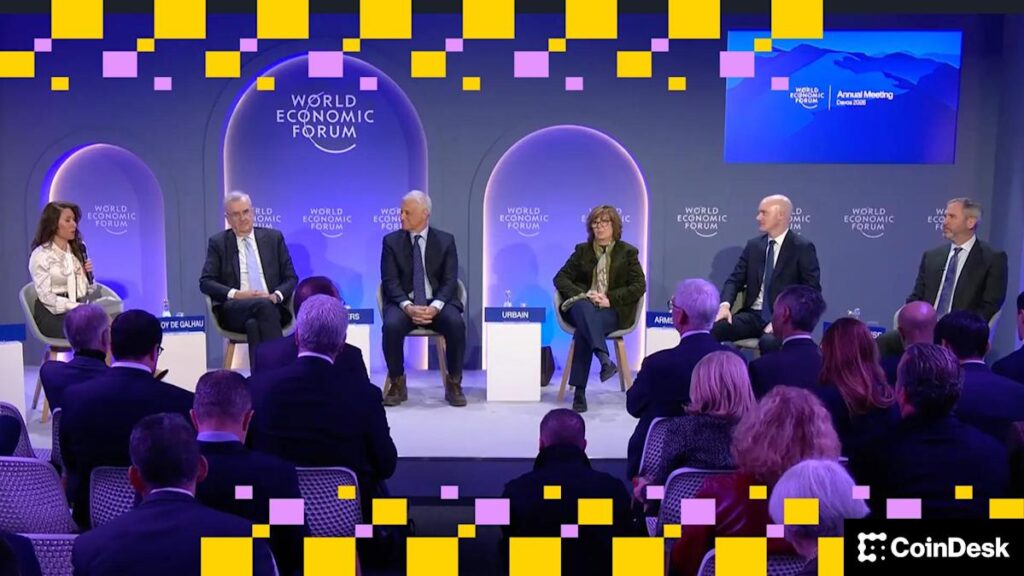
As the world's financial leaders and crypto executives converged in Davos, Switzerland, for the World Economic Forum, a panel discussion intended to explore the future of blockchain technology quickly turned into a heated exchange. The session, titled "Is Tokenization the Future?" featured Coinbase CEO Brian Armstrong and Bank of France Governor François Villeroy de Galhau, who clashed over the contentious issues surrounding stablecoins and Bitcoin.
The focus of the debate largely pivoted to stablecoins, specifically the question of whether these fiat-pegged tokens should offer interest to their holders. Armstrong championed the idea, arguing it would benefit consumers by allowing them to earn more on their money. He raised concerns about global competitiveness, stating, “First, it puts more money in consumers’ pockets. People should be able to earn more on their money. Second, global competitiveness: China has said its CBDC will pay interest, and offshore stablecoins already exist. If U.S.-regulated stablecoins are banned from paying rewards, offshore competitors flourish.”
Villeroy de Galhau, however, dismissed the notion of interest-bearing stablecoins as a systemic risk to the traditional banking sector. He firmly stated, “The answer is no,” when asked if a digital euro should pay interest, emphasizing that the primary public purpose should be the stability of the financial system.
The panel also included prominent figures such as Standard Chartered CEO Bill Winters, Ripple CEO Brad Garlinghouse, and Euroclear CEO Valérie Urbain, with Karen Tso, a CNBC Squawk Box co-anchor, moderating the discussion. While Garlinghouse maintained a conciliatory stance, noting the importance of competition and a level playing field, he clarified that “Ripple doesn’t have as much of a dog in that fight.”
In contrast, Winters aligned with the crypto advocates, highlighting that without yield, tokens risk losing their appeal as a “store of value.” He stated, “Tokens are going to be used for two things. They’ll be used as a medium of exchange and as a store of value. And as a store of value, they’re much less interesting if they don’t carry a yield.”
The tension extended beyond the panel as it echoed throughout the U.S. legislative front. Armstrong pointed out that discussions surrounding the CLARITY Act had made progress, despite claims that they had stalled following Coinbase's withdrawal of support just hours before the panel. “I wouldn’t say it’s stalled. I’d say there’s a good round of negotiation happening,” he asserted.
He elaborated on his decision to withdraw from the session, framing it as a measure to safeguard competition against traditional finance gatekeepers. He alleged that banking lobbying organizations in Washington, D.C., were attempting to impede competition, stating, “We want to make sure any crypto legislation in the U.S. does not ban competition.”
Garlinghouse echoed Armstrong's sentiments, emphasizing that the call for a level playing field should apply to both crypto companies and traditional banks. “I agree very much with the idea of a level playing field,” he remarked. “Now, I also think a level playing field goes two ways and that crypto companies should be held to standards that banks are, and banks should be held to standards that crypto companies are.”
The discussion intensified further when the topic shifted to Bitcoin. Armstrong argued for a transition to a "Bitcoin standard," suggesting it could serve as a hedge against the devaluation of fiat currency. Villeroy countered this idea, asserting that monetary policy is inextricably linked to democratic governance. “Monetary policy and money is part of sovereignty,” he countered, emphasizing the importance of democratic oversight in financial systems.
As the debate escalated, Villeroy attempted to contrast the trust and accountability of central banks with the decentralized nature of Bitcoin. He expressed his preference for “independent central banks with a democratic mandate” over “private issuers of bitcoin.” Armstrong swiftly corrected him, explaining, “Bitcoin is a decentralized protocol. There’s actually no issuer of it.” He pressed further, turning Villeroy’s argument about independence back on itself: “In the sense that central banks have independence, bitcoin is even more independent. There’s no country or company or individual who controls it in the world.”
Despite the friction, Garlinghouse noted a shared understanding among the panelists that innovation and regulation need to coexist in the evolving landscape of finance. He termed the debate “spirited” and pointed to a consensus on the necessity of finding a balance between fostering innovation and ensuring necessary regulatory frameworks are in place.
The discussion in Davos highlights the growing tension between traditional financial institutions and the burgeoning world of cryptocurrencies. With the U.S. grappling with its regulatory approach, the outcome of these debates may have far-reaching implications for how digital assets are treated globally.
You Won't Believe What This St. Louis Legacy Reveals About America's Hidden Humor!
7 Mind-Blowing 60s Moments You Probably Forgot—Only 3% Remember Them All! Are You One of Them?

10 Mind-Blowing Secrets Only 1950s Babies Know—You Won't Believe #7!

Gym Brawl Turns Deadly: You Won't Believe What Happened When She Threw a 25-Pound Weight!

You Won't Believe How X's New Starter Packs are Transforming Your Creator Experience—Act Fast!

$45M Entertainment Dream in Corpus Christi Stalls—Find Out Why You MUST Know This Shocking Twist!
You might also like: