
China's Unexpected K-Beauty Comeback: Are Startups Ready to Seize the $1 Billion Opportunity?

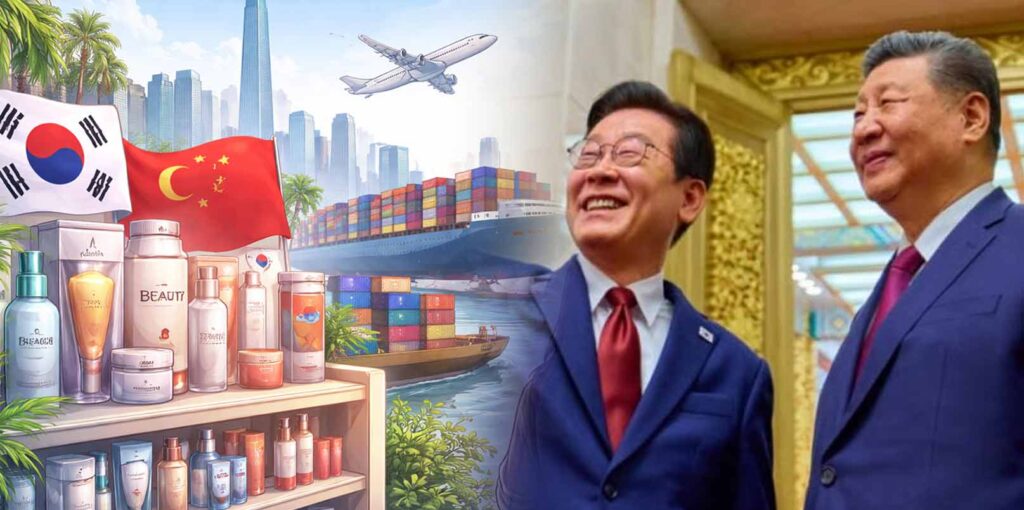
Korea’s long-frozen trade with China is beginning to show signs of thawing following President Lee Jae-myung’s state visit to Beijing on January 5, 2026. This visit, the first in nearly eight years, included significant discussions and the signing of multiple bilateral memoranda, reviving hopes for the easing of China’s informal "Korean Ban" on cultural exports and consumer goods that has been in place since 2017. The optimism surrounding this diplomatic reset has brought renewed attention to the K-beauty industry, which is keen to regain its foothold in a rapidly evolving market.
Symbolic gestures during the visit, including Korea’s First Lady Kim Hye-kyung attending a K-beauty event in Shanghai, engaging with Chinese influencers, and showcasing products from Korean small and mid-sized brands, have fueled anticipation. The presence of the APR Corporation’s Medicube beauty device among the official diplomatic gifts further emphasized Korea’s renewed cultural and technological outreach.
Before the THAAD dispute, China accounted for nearly 40% of Korea’s cosmetics exports, according to data from KOTRA. By 2024, this figure had significantly dropped to about 25%, highlighting the challenges faced by Korean beauty brands in regaining their previous market share.
📰 Table of Contents
A Transformed Market: C-Beauty Dominance and Cautious Optimism
The landscape that K-beauty hopes to re-enter in 2026 is markedly different. Recent data from Qianzhan Intelligence reveals that China’s cosmetics market contracted by 2.8% in 2024, with imports falling 8.3%. In contrast, local brands, known as "C-beauty," experienced growth of 7.5% and captured over half the domestic market share. Brands like Florasis and Flower Knows have thrived by adopting advanced influencer-driven marketing and digital retail strategies, expanding their dominance through live commerce platforms such as Douyin and Xiaohongshu. Major global brands like Estée Lauder and Lancôme have reported negative growth in China, signifying a structural shift in consumer loyalty towards domestic players.
A Korean industry official voiced concerns, stating,
“China remains an attractive market in size, but the way it operates has fundamentally changed. Success now depends on localization and understanding Chinese digital ecosystems, not on the old K-beauty playbook.”
Sentiment within Korea’s cosmetics sector is mixed. Industry insiders recognize that diplomatic overtures alone cannot reverse the profound market transformations over the past several years. One senior executive remarked,
“The Chinese market is still unstable. For Korean cosmetics to regain momentum, the broader K-culture ecosystem needs to reactivate, and that will take time.”
Concerns about fluctuating Chinese consumer confidence and evolving platform regulations heighten the cautious optimism. Another industry expert cautioned,
“We can be hopeful, but this is not the time for aggressive expansion. It’s about reading the new consumer logic—C-beauty has changed the rules.”
Moreover, Korean products face stiff competition from increasingly sophisticated local challengers. The visual and marketing finesse of brands like Flower Knows—which recently opened a pop-up store in Seoul—illustrates how C-beauty is now exporting its aesthetics back to Korea.
The Startup Test Behind K-Beauty’s Next Chapter
The potential reopening of Korea–China trade channels presents not only a commercial rebound but also a stress test for Korea’s startup-driven consumer industries. Small and medium-sized enterprises (SMEs) accounted for over 90% of Korea’s cosmetics exporters in 2025, contributing to a record USD 10.36 billion in exports between January and November. However, experts warn that over-reliance on a single sector could expose structural vulnerabilities.
Roh Min-sun, a senior researcher at the Korea Small Business Institute, stated,
“The cosmetics sector has grown quickly due to low entry barriers and the K-beauty image. But as competition intensifies, margins are tightening. Korea needs to nurture K-beauty while also expanding to new consumer categories.”
Analysts and trade officials see opportunities in merging cultural exports with consumer products, a concept termed “content-linked goods.” KOTRA suggests integrating elements of K-pop, K-drama, and lifestyle branding with everyday products such as functional foods, pet goods, fashion items, and compact health devices. In a marketplace increasingly driven by storytelling, smaller companies can leverage their agility and cultural resonance to stand out beyond cosmetics.
In conclusion, while China’s potential reopening offers Korea’s beauty industry a second chance, it does not promise a repeat performance. The K-beauty wave that once rode the Hallyu boom must now demonstrate its ability to evolve within a data-driven, influencer-dominated marketplace that is increasingly shaped by domestic powerhouses. For Korea’s startups and SMEs, the challenge is to innovate by building localized, tech-integrated, and culturally adaptive models that redefine what “K-beauty” means in Asia’s most competitive consumer market.
– Stay Ahead in Korea’s Startup Scene –
Get real-time insights, funding updates, and policy shifts shaping Korea’s innovation ecosystem.
➡️ Follow KoreaTechDesk on LinkedIn, X (Twitter), Threads, Bluesky, Telegram, Facebook, and WhatsApp Channel.
Trump's Legal Woes Could Ignite a $100 Billion Offshore Wind Revolution—Are You Ready for the Shift?

NBA's Bold Move: How Soccer Fans Could Change the Game Forever – Are You Ready to Be Shocked?

Shoremen's Shocking 12-Point Collapse: What the Mules Did That Left Fans Speechless!

You Won't Believe the 5 Shocking Fitness Tech Trends Unveiled at CES 2026! Are You Missing Out?

Discover How MediaTek's Shocking New Chips Could Change Your Smartphone Game Forever!

4 Android Phones That Outperform the Pixel 10 Pro—#3 Will Leave You Speechless!
You might also like: