
Bitcoin's Dramatic Plunge: Is AI the Hidden Threat Investors Must Fear Now?

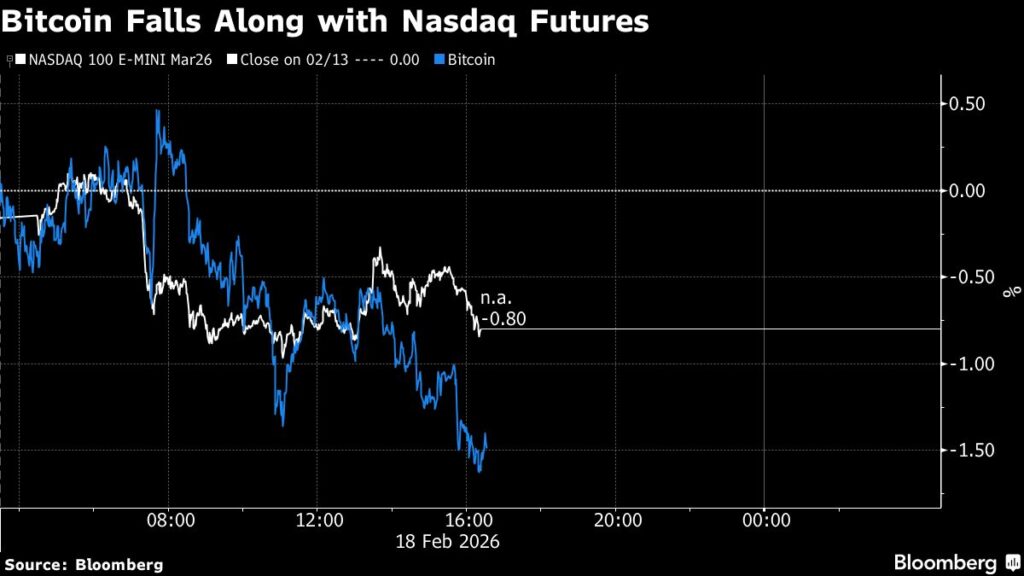
Bitcoin continued its downward trend this week, marking a four-week decline as market volatility mounts and investors express concerns over the economic impact of artificial intelligence (AI). On Tuesday, the cryptocurrency fell as much as 3.2%, dropping to $66,604 before slightly recovering. This movement is reflective of Bitcoin's recent correlation with fluctuations in U.S. equities, particularly tech stocks, which have been in a state of turmoil amid ongoing discussions about AI’s potential disruptions to various economic sectors.
“Sentiment is clearly bleak in crypto markets,” commented Noelle Acheson, the author of the Crypto is Macro Now newsletter. She noted that while there is increasing adoption of cryptocurrencies by traditional institutions, this momentum has yet to be mirrored in the overall market prices, further dampening investor sentiment.
Traders have been grappling with the unpredictable outlook for AI, which has contributed to another tumultuous session on Wall Street. The uncertainty surrounding whether significant investments in AI will yield quick returns has left many feeling uneasy. In the past week alone, $360 million was withdrawn from U.S.-listed exchange-traded funds, marking the fourth consecutive week of net outflows in the crypto market.
The atmosphere in the cryptocurrency sector remains fragile. The CryptoQuant Fear and Greed Index was reported at 10 out of 100 on Monday, indicating a state of “extreme fear” among investors.
Market dynamics are shifting, and as traders look for fresh sentiment drivers, some experts suggest that consolidation may be on the horizon for Bitcoin. Paul Howard, senior director at market maker Wincent, posited that a ruling from the U.S. Supreme Court on tariffs—expected on Friday—could have greater implications than routine announcements from the Federal Reserve or standard inflation reports.
Investors are increasingly debating whether Bitcoin has found a durable support level. Many view the $60,000 mark as critical, but there are concerns that this support may falter should risk appetite in the broader market deteriorate. As Robin Singh, CEO of crypto tax platform Koinly, explained, “One macro wobble, another wave of uncertainty, or even just sustained chop in the mid-$60,000s could easily tip this into a sharper flush back into the $50,000s.”
In a reflection of the current market climate, Harvard University has recently reduced its Bitcoin exposure, selling 1.5 million shares of the iShares Bitcoin Trust ETF (ticker IBIT). Despite this, their position remains one of the largest holdings, trailing only behind investments in Alphabet Inc. and gold. Interestingly, Harvard has also initiated a stake in the iShares Ethereum Trust ETF (ETHA), marking its first foray into the second-largest cryptocurrency. Conversely, Dartmouth College’s endowment has increased its stakes in both Bitcoin and Ether.
The intertwining of traditional finance and the crypto market is becoming increasingly evident, yet the juxtaposition of institutional adoption against a backdrop of declining prices paints a complex picture. As the market grapples with these dynamics, the course of Bitcoin and the broader cryptocurrency sector remains uncertain.
Palantir's Shocking Move: Why This $45 Billion Tech Giant Fled to Miami—What You Need to Know!

You Won't Believe Why Commanders Are Suddenly the Front-Runners for Tyreek Hill! Shocking Stats Inside!

Lone Wolf’s Shocking CEO Choice Could Change Everything—What’s the Risk for Fathom?

Is Your Marriage on the Brink? 3 Hidden Signs He’s Already Checked Out—#1 Will Leave You Speechless!

You Won't Believe What This $3.65M Portland Mansion Hides—Inside Secrets That Will Shock You!

You Won't Believe What Michael Jordan Just Revealed on His Birthday Amid Daytona 500 Scandal!
You might also like: