
Bill Gates Pulls Funding! Shocking Layoffs Hit Climate Change Nonprofit – What Happens Next?

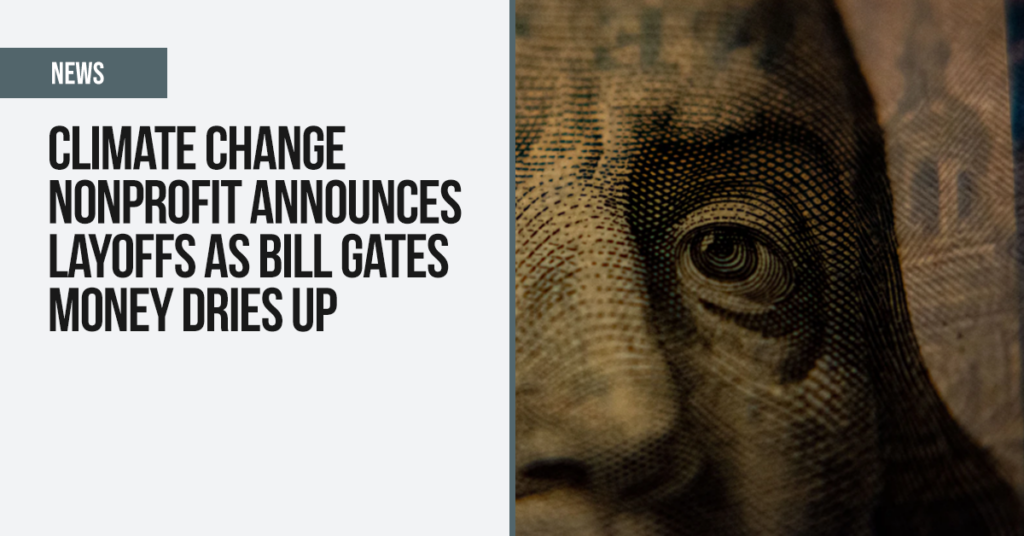
The Connecticut Roundtable on Climate and Jobs (CRCJ), a nonprofit organization that has aimed to merge labor unions and environmental advocacy, recently announced it will begin laying off its small staff of four, effective December 5, 2025. The announcement was made by Roundtable Board Chair John Harrity on the organization’s website. Harrity stated, “After extensive discussion and careful review of our current financial realities, we have made the difficult decision to initiate staff layoffs.” He emphasized the organization’s commitment to stewarding its resources with transparency and integrity, even as it faces tough choices.
Harrity explained that the CRCJ has primarily relied on grants, which have become increasingly scarce in today’s political climate, particularly after the Bill & Melinda Gates Foundation pulled back on funding for climate change organizations. This decision has had a trickle-down effect, impacting smaller groups like CRCJ. “It’s sort of a chain reaction,” he noted, explaining how reduced grants from larger organizations have left smaller entities struggling. “The grants ran out and unfortunately in the current climate there’s less money available for social justice organizations and there’s nothing from the federal government that’s helpful at all.”
Earlier this year, Bill Gates himself expressed a shift in focus regarding climate strategies, suggesting that climate change alarmism is not effective and advocating for a focus on human welfare instead. This change in approach has reverberated through organizations that previously depended on his foundation for funding.
Founded in 2012, the CRCJ has been a project of the Connecticut AFL-CIO, which serves as an umbrella organization for trade unions, and the Inter-Religious Eco-Justice Network (IREJN). The CRCJ's mission has been to educate and foster collaboration between labor, religious leaders, and environmental advocates, striving to create good-paying jobs while addressing the challenges of climate change. The organization has been proactive in advocating for green energy jobs and labor rights, pushing for project labor agreements (PLA) for large-scale green projects.
Among its notable efforts, the CRCJ has supported significant initiatives like the Revolution Wind project off the coast of Rhode Island and Senate Bill 999, enacted in 2021, which established prevailing wage rates for contractors on renewable energy projects over 2 megawatts unless covered by a PLA. Additionally, the organization has advocated for Connecticut to declare climate change an emergency, reflecting its commitment to both climate action and worker rights.
Despite a modest growth in revenue—from $121,421 in 2018 to $370,329 in 2023, peaking at $420,968 in 2020—the organization has faced continuous financial difficulties. In 2023, CRCJ reported a loss of over $25,000, reducing its net assets to $45,000. Staffing expenses accounted for $283,000 in 2023, which was approximately $87,000 less than its contributions. However, the remaining budget was consumed by other expenses totaling $107,000, leading to losses over the past three years: $97,946 in 2021, and $131,451 in 2022.
In its 2023 policy statement, CRCJ reaffirmed its commitment to strong environmental regulations, climate justice initiatives for marginalized groups, and opposition to new fossil fuel infrastructure. The organization emphasized the importance of project labor agreements and labor peace agreements, which aim to provide equitable job access to underrepresented communities.
Despite the challenges, Harrity remains optimistic about the future of CRCJ. “We have a voluntary board which continues to meet and we’re gonna figure out what we can do,” he remarked. He pointed out that there is ongoing interest in climate safety from the community and labor movement, and he believes the organization can still serve as a voice for various groups, particularly within labor.
“Through the use of volunteers and volunteer labor, we think we might be able to have some impact on the legislative process and state policy and possibly rebuild in the future,” Harrity concluded, reflecting a commitment to continue the fight for climate justice and worker rights even amidst financial hardships.
You Won't Believe What the New Redmi Note 15 Reveals About Your Next Phone Choice!

Is Kristi Noem Really Safe? Shocking White House Rejection Unveils Hidden DHS Turmoil!

Apple's Shocking Fitness Plus Upgrade: AI Translations & K-Pop Beats—Will You Be Left Behind?
You Won't Believe What Trump's Security Strategy Reveals About America's Future!

Why Governor Kehoe's 2026 State of the State Address Could Change Everything—Are You Prepared?

Wall Street Dips: What Shocking Rate Cut Could Mean for Your Savings! Don't Miss This!
You might also like: