
Axiom Just Secured $200M—Is This the Key to Safe AI Code or a Recipe for Disaster?

Axiom Quant Inc. is poised to make significant strides in ensuring the safety and accuracy of artificial intelligence-generated code, following a successful Series A funding round that raised $200 million. This investment brings the company's valuation to $1.6 billion and is led by Menlo Ventures, marking a bold bet on a new concept they term "verified AI." This approach aims to eliminate the risk of “hallucinations” in AI outputs, a critical concern in an era where code generation is increasingly handled by AI tools.
Axiom’s founders are addressing a crucial flaw in the way existing AI systems produce software. Current tools, such as Claude Code and CodeRabbit, deliver impressive code that often functions well, but their inherent probabilistic nature raises alarms. As Matt Kraning and C.C. Gong of Menlo Ventures noted in a recent blog post, having code that “frequently works” presents a “terrifying standard” when applied to critical infrastructure systems. “LLMs are statistical by nature—they produce plausible outputs, not provably correct or safe ones,” they explained, emphasizing that this issue isn't merely a bug to be fixed in future models, but an architectural flaw that is here to stay.
Axiom aims to circumvent these risks by training AI systems to generate formally verified outputs in Lean, a specialized programming language designed for mathematical proofs. By utilizing Lean, Axiom guarantees that each step of its AI model's reasoning is "machine-checkable" and logically sound. This methodology employs deterministic proof verifiers to detect errors in outputs, which allows Axiom to provide mathematical certainty that any code function produced by its AI will always yield the correct results and will not introduce hidden vulnerabilities.
The startup first gained attention in October when it raised $64 million in seed funding, and since then, it has made remarkable advancements. In December, its deterministic AI achieved a perfect score on the Putnam Competition, a highly esteemed mathematics exam often regarded as one of the toughest undergraduate challenges worldwide. Just five individuals in the last century have matched this feat, underscoring the potential of Axiom’s technology.
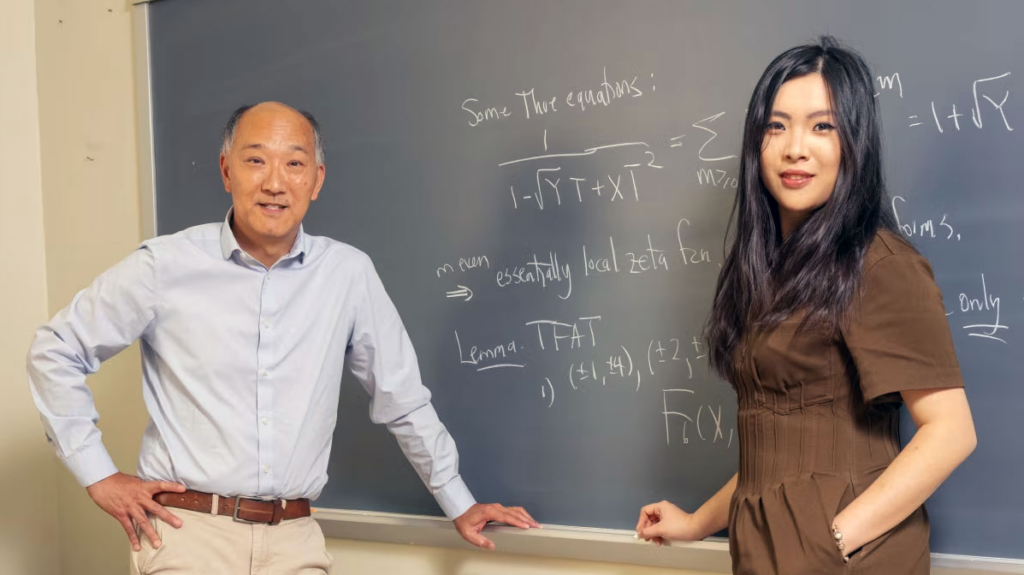
In another groundbreaking accomplishment, Axiom successfully proved a 20-year-old number theory conjecture involving calculus elements for measuring distances along curved surfaces. This specific challenge had eluded Ken Ono, Axiom's founding mathematician, despite his numerous attempts over the years.
For every AI output generated, Axiom constructs a “verified data flywheel” consisting of extensive proof-checked data, which is fed back into its training processes. This recursive self-improvement loop enhances model capabilities while mitigating the risk of “model collapse,” which refers to the data pollution challenges faced by unverified AI models.
At the helm of Axiom is the 25-year-old Stanford University Ph.D. student and math prodigy Carina Hong, who has already won prestigious awards such as the Morgan Prize and the Schafer Prize, and authored nine peer-reviewed publications. She has assembled a formidable team, including Ken Ono, a distinguished mathematician and former vice president of the American Mathematical Society, and Shubho Sengupta, the former director of AI research at Facebook.
Axiom's ambitions are vast, targeting the provable verification of every single line of AI-generated code in a landscape where most software is created with the assistance of large language models. “Every enterprise shipping AI-generated code is accepting unknown risk today—not just of incorrect outputs, but also of unforeseen security vulnerabilities,” noted Kraning and Gong, asserting that Axiom's approach effectively eliminates both categories of risk.
The next steps for Axiom include scaling its training infrastructure and expanding its team of mathematical experts, with the ultimate goal of making formal verification rapid and affordable for all companies utilizing AI. As Axiom Quant continues to make waves in the AI landscape, its mission to forge a safer and more reliable coding future could redefine standards across the industry.
You Won't Believe What Just Happened at Albuquerque's Daniel Webster Park Playground!

Idaho's Shocking Vaccine Rule Change: What Nurses Are Terrified to Tell You!

Shocking Measles Warning: Could This Gresham Grocery Store Exposure Put Your Family at Risk?
Is Your 401(k) at Risk? Experts Reveal Shocking Stock Market Secrets You MUST Know NOW!

Pittsburgh’s Trees Are Vanishing! What Shocking NFL Draft Changes Are Coming?

Mississippi's Fate Hangs in the Balance: Who Will Win the Shocking 2026 District 4 Primary?
You might also like: