
Is the AI Boom About to Burst? Shocking Signs That Could Cost You Millions!

The U.S. stock market continues to show a robust interest in artificial intelligence (AI), with a significant portion of its performance tied to this tech sector. Currently, 75% of returns in the S&P 500 index can be attributed to just 41 AI stocks. Among these, the so-called "magnificent seven" tech giants—Nvidia, Microsoft, Amazon, Google, Meta, Apple, and Tesla—account for an astounding 37% of the index's total performance. Despite some fluctuations in the value of key players like Nvidia and Oracle, investor confidence in AI remains high.
However, this concentration on AI, particularly in the realm of Large Language Models (LLMs), has raised concerns about a potential AI bubble. Nvidia's CEO, Jensen Huang, recently dismissed these worries, asserting, "We are long, long away from that." Yet, not everyone shares his optimism. Critics argue that an over-reliance on this specific type of AI, which has yet to yield profits that match the colossal spending, is testing the patience of investors. Gary Marcus, an AI scientist and emeritus professor at New York University, warns that if an AI bubble were to burst, the repercussions could extend far beyond the tech sector.
Marcus elaborates, noting, "If a few venture capitalists get wiped out, nobody's gonna be really that sad. But with a large part of U.S. economic growth this year down to investment in AI, the blast radius could be much greater." He suggests that the fallout could potentially lead to a broader economic crisis, involving illiquid banks and taxpayer-funded bailouts.
The scale of AI investment is staggering, with estimates indicating that Microsoft, Amazon, Google, Meta, and Oracle will spend around $1 trillion on AI by 2026. In a striking commitment, OpenAI, the developer behind ChatGPT, plans to invest $1.4 trillion over the next three years. However, the projected profits for OpenAI are modest—expected to be just over $20 billion in 2025—raising questions about the sustainability of such high spending.
This AI boom, or bubble as some argue, is driven by the demand for powerful computing resources. The release of ChatGPT-4 in early 2023 marked a turning point, showcasing significant improvements in natural language processing and data handling, largely due to the scale of resources required. For instance, GPT-4 needs 3,000 to 10,000 times more computing power than its predecessor, GPT-2, and has been trained on a staggering 1.8 trillion parameters.
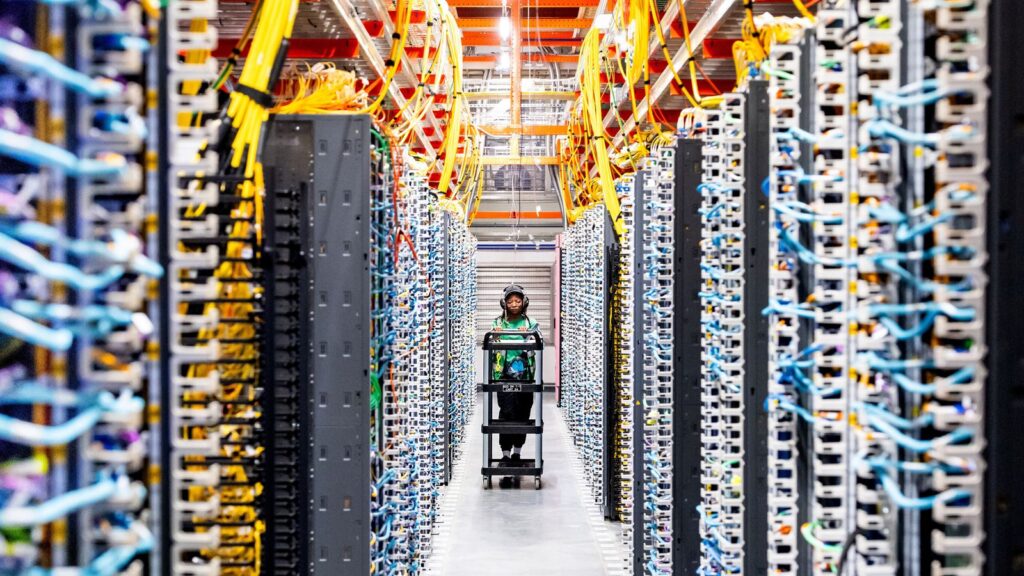
As demand surges, tech companies are rapidly constructing mega-data centers. One such project, called Stargate, initiated by Donald Trump and OpenAI's Sam Altman, is expected to occupy an area the size of Manhattan's Central Park by mid-2026. Meanwhile, Meta's Hyperion data center in Louisiana is nearing completion and will reportedly consume twice as much power as the nearby city of New Orleans.
This rapid expansion is straining America's power grid, with some data centers facing years-long delays in securing grid connections. However, larger corporations like Microsoft, Meta, and Google can sidestep these challenges by building their own power sources. The question remains: once these AI systems are operational, will they be profitable?
Another looming concern is the depreciation of AI infrastructure. Unlike traditional infrastructure that can last decades, AI data centers necessitate frequent upgrades. Nvidia claims its latest chips have a lifespan of three to six years, but skepticism persists. Michael Burry, known for predicting the subprime mortgage crisis, is reportedly betting against AI stocks, arguing that rapid advancements will necessitate chip replacements every couple of years.
Estimates suggest that if AI chips depreciate every three years, the combined value of the five leading tech companies could be reduced by $780 billion; if the rate is two years, that figure could jump to $1.6 trillion. This depreciation could exacerbate the already significant gap between these companies' AI spending and their revenue.
As for user adoption, while AI technologies are indeed gaining traction, the reality is mixed. OpenAI claims to have 800 million weekly active users across its products, doubling since February, yet only 5% are paying subscribers. Business adoption remains sluggish; according to the U.S. Census Bureau, only 12% of companies reported using AI to produce goods and services, a slight drop from earlier figures.
As industry experts highlight, the majority of companies are still in the pilot phase of AI implementation, and many are striving to understand how to leverage this technology effectively. This poses a critical question: how long will shareholders tolerate waiting for returns on their colossal investments? With skepticism surrounding the scalability of current AI models, the spotlight is now on the future viability of these technologies. As Marcus poignantly notes, "You’re spending trillions of dollars, profits are negligible and depreciation is high. It does not make sense." The market may soon have to confront these stark realities.
Cruz Beckham Drops SHOCKING Bombshell: Is Brooklyn REALLY Ghosting the Family Online? You Won’t Believe Why!

Is Your Seafood Really Safe? Discover the Shocking Truth Behind Traceability Tech!

Can You Guess These 10 Shocking Celeb Transformations? #3 Will Leave You Speechless!

Senate Report Reveals SHOCKING Truth: Is Social Media DESTROYING Our Kids? You Won't Believe What They Found!

Is the White House About to Face a $10 Billion Tariff Refund Nightmare? You Won't Believe the Consequences!

America's Health Crisis: 50% of Adults Ignoring This Shocking Warning—Are You at Risk?
You might also like: