
Palladium Named Key to Revolutionizing Tech—Is Your Future at Risk?

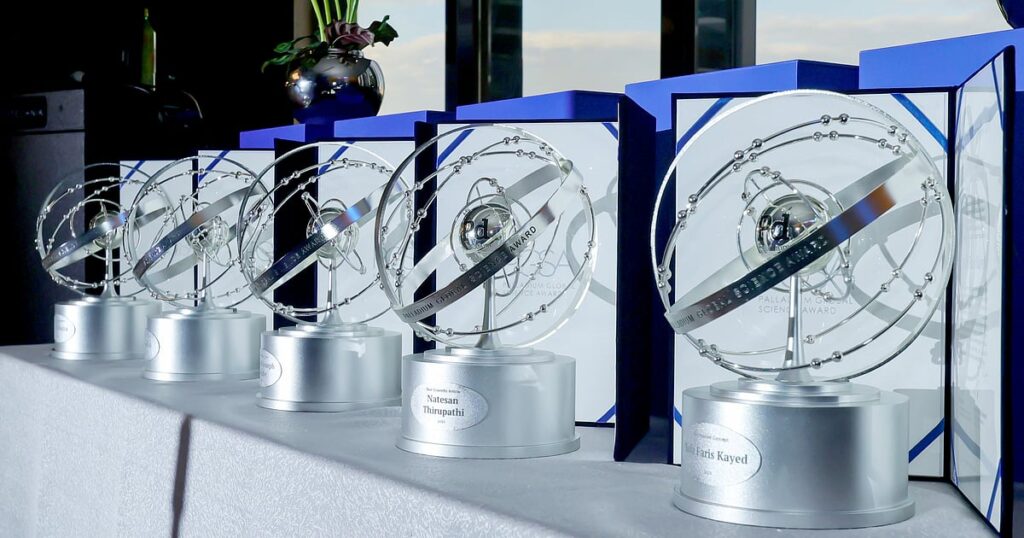
On November 21, 2023, Hong Kong celebrated a significant step in scientific and industrial innovation with the inaugural Palladium Global Science Award. This marks the first global initiative dedicated exclusively to advancing the role of palladium in transformative technologies. Five distinguished scientists from Canada, Japan, India, the United States, and Saudi Arabia were recognized in a ceremony that highlighted their groundbreaking contributions, sharing a total prize fund of $350,000.
The award was launched with the backing of the China Precious Metals Industry Committee (CPMIC), along with support from the Shanghai Metals Market, North-West University in South Africa, and the MDX Research Center for Element Strategy in Japan. Its primary goal is to spotlight innovative ideas that aim to expand palladium's applications beyond its traditional roles, particularly in catalysis, electronics, energy transition, and environmental sustainability.
The ceremony attracted leaders from various sectors, including scientists, business executives, policymakers, and global industry partners, underscoring palladium's strategic importance as a metal that can accelerate decarbonization and drive green manufacturing. Bian Jiang, CPMIC's Executive Chairman, stated, “Palladium is widely known as a powerful catalyst and an essential component in alloys for high-tech industries and clean manufacturing. It is also the largest market metal within the platinum group. Expanding its applications is crucial for ensuring the sustainable development and long-term growth of the industry.”
📰 Table of Contents
A Strategic Prize for a Strategic Metal
The launch of this award addresses a growing global need to push precious metals into new, future-focused applications. Jiang noted that the initiative acts as a bridge between research institutions and real-world industrial needs. “The Palladium Global Science Award was created to address this very need. It provides a unique platform to stimulate the scientific community, identify promising technologies, and support research teams pushing the boundaries of what palladium can achieve.”
Submissions for the award surpassed expectations, with nearly 100 projects from over 30 nations participating. Jiang underscored this with a powerful observation: “All of these projects show that palladium, when positioned correctly within a technological architecture, becomes a natural amplifier of innovation.” He further emphasized the award’s role in stabilizing palladium's importance within future industries, shifting focus from short-term price volatility to the long-term intrinsic value of the metal.
The International Expert Council for the competition, chaired by Professor Francis Verpoort, applied a rigorous standard in evaluating the nominations. “We recognized that true innovation lies not just in groundbreaking ideas, but in their potential to make a tangible impact,” he remarked. “Ultimately, the strongest applications were those where elegant science met practical engineering.” Verpoort also expressed optimism about the award's potential to shape future research and development momentum, suggesting that initiatives starting today could define how the world harnesses palladium for decades to come.
Winners Redefining Palladium’s Future
The awarded scientists made strides in various fields:
Best Scientific Developments in New Palladium Applications: First place – Prof. Chao-Jun Li, McGill University, Canada
Prof. Li's research focuses on activating methane and CO₂ simultaneously—both notoriously inert molecules—through a palladium-doped semiconductor under light irradiation. He stated, “The biggest scientific challenge that we had to overcome is to simultaneously activate methane and CO₂ at a comparable rate.” His spin-off company, CataLum Inc., is already licensing this technology for early scaling, particularly in applications involving waste gases in oil fields or biogas.
Best Scientific Developments in New Palladium Applications: Second place – Prof. Makoto Fujita, University of Tokyo & Institute for Molecular Science, Japan
Prof. Fujita's innovative work on palladium-based self-assembly led to the development of the crystalline sponge method, which promises to revolutionize pharmaceutical research. “I believe this method is poised to be a game changer in a wide array of studies involving molecular systems,” he shared.
Best Scientific Article: First Place – Prof. Natesan Thirupathi, Delhi University, India
Prof. Thirupathi's article explored cyclopalladation processes that can expedite drug development while promoting greener pharmaceuticals. “Our objective was to utilize Pd(II) carboxylates as precursors to investigate how variations in reactants influence the course of the reaction,” he explained.
Best Scientific Article: Second Place – Prof. Michael Joseph Krische, University of Texas at Austin, USA
Prof. Krische aims for safer, greener routes to vital medical compounds, believing this advancement will significantly impact human medicine.
Best Applied Concept: First Place – Associate Professor Safa Faris Kayed, Prince Sattam Bin Abdulaziz University, Saudi Arabia
Kayed's project, PalladClear, addresses the pressing challenge of industrial wastewater treatment, focusing on the degradation of hazardous dyes and pharmaceutical residues. She highlighted, “Conventional treatments often fail to remove these persistent pollutants completely, leading to serious environmental and health concerns.”
The Palladium Global Science Award is not merely an acknowledgment of excellence; it represents a commitment to fostering industrial partnerships and commercialization. Jiang reiterated the award’s role in creating an ecosystem where scientists and industry professionals can collaborate and innovate together. With plans for the next edition to launch in spring 2026, the momentum is clear: palladium is emerging as a pivotal player in sustainability and advanced technologies, transitioning from a mere commodity to an essential catalyst for the industries of the future.
Discover the 7 Surprising Snacks Experts Say Can Save Your Brain from Decline—#3 Will Shock You!

You Won't Believe What Happens When Hurricanes Clash with Texas A&M in the Playoffs!
Shocking Upsets in Hong Kong’s Legco Election: Who Won, Who Lost, and What It Means for Democracy!

You Won't Believe How GoTyme Bank's Shocking Crypto Move Could Change Your Financial Future!

Wall Street on Edge: Will the Fed's Shocking Rate Cut Crush Your Investments Today?

Shocking College Football Playoff Reveal: Alabama vs. Miami—But NO Notre Dame? Find Out the Explosive Matchups!
You might also like: