
Cleveland Coach Shocks Fans with Unbelievable Deaflympics Comeback – You Won't Believe the Numbers!

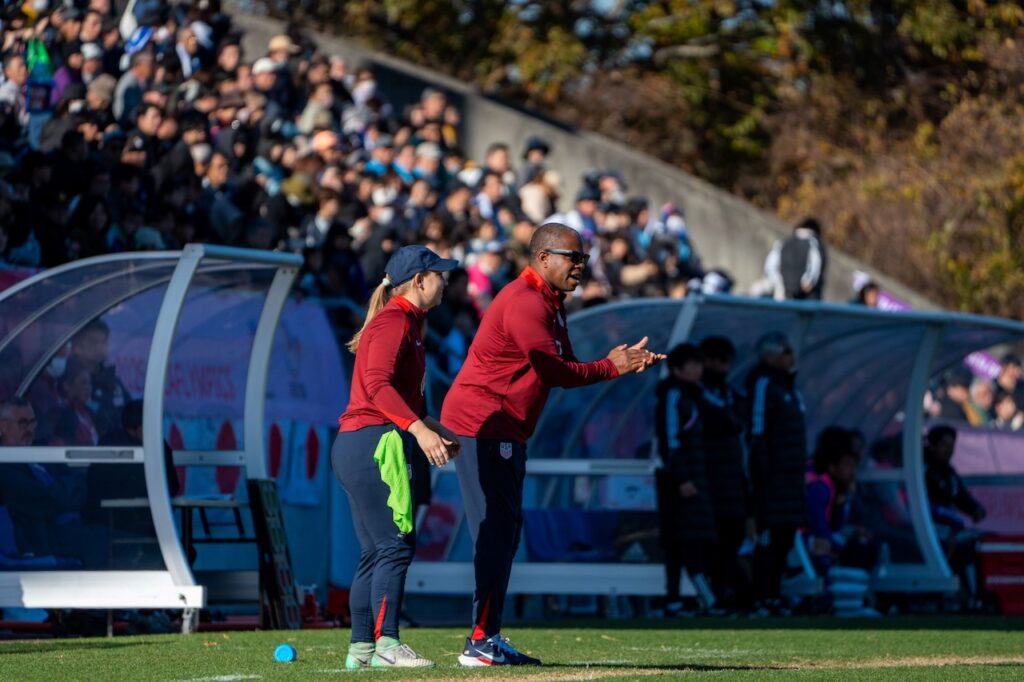
CLEVELAND, Ohio – When Everett Palache returns to Cleveland on Thanksgiving night after a three-week trip to Japan, he’ll do so knowing that his U.S. Men’s Deaf National Soccer Team made history by reaching the medal rounds in the Deaflympics. This marks the first time any U.S. deaf team has advanced to the semifinals, a milestone that fills him with pride.
“They made history making the medal rounds because no deaf U.S. team had made it to the semifinals prior to this occasion, so I’m really proud of the guys,” he said.
The U.S. Men’s Deaf National Soccer Team officially joined the U.S. Soccer National Team program in 2022 and stands as the only national deaf team in the United States. Competing in Japan was no easy task, as the team finished with a record of 2-3, placing fourth overall. They faced tough opponents, including the world’s No. 1 ranked team, Ukraine, losing to both them and France, while achieving victories against Korea and Brazil.
“No one expected us to even get to the medal rounds here in the Deaflympics,” said Palache, who also serves as the regional technical director for the Cleveland Force Soccer Club. “Both sides of the coin, I guess,” he added. “Made history going the furthest we have ever gone, but at the same time the losses sting a little bit.”
Palache's journey to coaching a national team stems from a diverse background. A graduate of Notre Dame Cathedral Latin High School and Philadelphia Textile (now Thomas Jefferson University), he initially worked in finance in Cleveland. However, his passion for soccer and nurturing young talent led him to coaching, which he describes as a “bucket list” achievement.
The team is part of the “extended” program of U.S. Soccer, allowing them access to the national team’s support staff, including doctors, trainers, and analysts. Operating out of Atlanta, the team comprises players aged 17 to 37 from across the country. They engage in four to five training camps each year, focusing on culture, leadership, tactics, and technical skills. Between camps, a “bridge program” supports players in sports-science initiatives to enhance their performance.
Palache took over coaching the team last year and has witnessed consistent improvement. Notably, the Deaflympics saw participants from over 80 countries, with 13 teams competing in Japan. Beyond the matches, players explored cultural sites, including shrines in Fukushima, noted for the severe nuclear accident caused by an earthquake and tsunami in 2011. They also planned to experience traditional sumo wrestling.
Fostering a sense of unity, Palache emphasizes the brotherhood among the players. “They are a brotherhood,” he said. “We’ve adopted a slogan – ‘band of brothers.’” Communication is key, and innovative coaching methods accommodate the players' needs. Most have hearing implants, and players must have a hearing loss of at least 55 decibels in their better ear to qualify for the team. Palache utilizes three interpreters for effective communication, one of whom acts as his “shadow” during sessions, aiding in real-time translations.
“We really leaned on that in this tournament,” he noted. Additionally, the team employs training vests—color-coded pinnies that signal different messages to players during drills: red for emergencies, yellow for strategy reminders, and green for maintaining the game plan.
Support has also come from local players like Michael Schmid from Oberlin, a veteran of international play who serves on the team’s leadership council. “Absolutely amazing guy,” Palache said. “Great leader, good person, hard-working. He’s actually one of our elder statesmen. We call him ‘dad’ on the team.”
As Palache prepares to return to his hometown, he reflects on the values he hopes to instill in his players. “I love Cleveland—Cleveland being hard-working, blue-collar, I try to take that into anything we do, in everything I teach,” he said, also crediting his wife, a fellow soccer coach, as a significant influence in his coaching career.
Looking ahead, Palache aims for the team to compete against a USL2 team around Memorial Day, continuing to build on their progress. “I’ve taken so much from learning how to coach better when they can’t hear you,” he stated. “You’ve got to be more detailed, you’ve got to be more precise, you’ve got to be more visual.” His experience underscores a poignant reality of soccer: “This sport’s a player’s game,” he said. “What I take away from the deaf environment, it really epitomizes that because once they are out there, there’s not much more you can do anymore.”
Florida's Shocking New Social Media Law Could Change Kids' Lives — Are You Prepared?

Ex-UFC Star Dan Henderson Makes Shocking Move: Why He's Backing Chad Bianco for Governor!

Nuvalent's Shocking Move at the 37th Annual Healthcare Conference: What You MUST Know Now!

Are We Too Late? Shocking AI Innovations in Climate Change That Could Save Us All!
How Greg Olson's Shocking Move Could Save the Raiders (Or Doom Them Forever!)
This Shocking College Football Playoff Bracket Will Leave You Speechless – Are Your Favorites in Danger?
You might also like: