
You Won't Believe What 7,000 Years of Lake Mud Reveals About Kangaroo Island’s Fiery Secrets!

During the summer of 2019–2020, half of Australia’s third-largest island, Kangaroo Island, was ravaged by wildfires. Known locally as Karta Pintingga or Karti, the island faced one of the worst impacts during the Black Summer fires, which claimed the lives of two people and incinerated nearly all of its remaining vegetation. The aftermath raised alarms for unique species native to the island, like the critically endangered dunnart, the green carpenter bee, and the Kangaroo Island micro-trapdoor spider.
This devastation was not an isolated event. Increasingly unstable climate conditions are heightening fire risks around the globe. Since those Black Summer fires, the world has witnessed a surge in megafires, with occurrences as far north as the Canadian Arctic. Each fire season in Australia continues to bring escalating destruction.
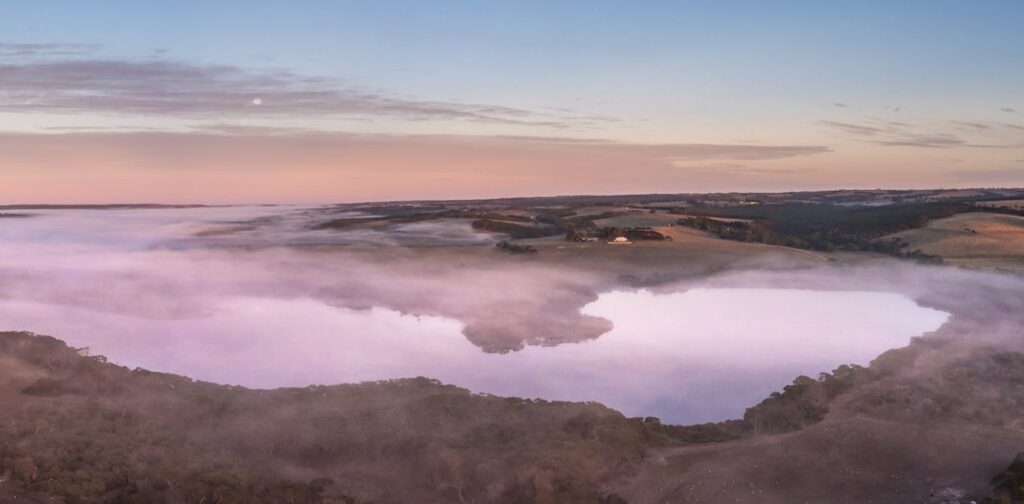
In the months following the 2020 fires, researchers turned their attention to Lashmars Lagoon on the Dudley Peninsula, eastern Kangaroo Island. There, trapped within the mud are thousands of charcoal fragments, remnants of ancient fires. By analyzing these fragments, scientists have started to reconstruct a valuable long-term context that sheds light on current environmental challenges, culminating in findings recently published in Global and Planetary Change.
A Rare Case Study
Understanding environmental change and how ecosystems respond to extreme events requires a perspective that extends beyond written records. Historical studies suggest that Indigenous land management practices effectively reduced fuel loads, leading to a notable decrease in the occurrence and intensity of bushfires. However, following European colonization, these sustainable practices largely ceased. The subsequent alteration of plant life, compounded by long-term fire suppression and climate change initiated by human activity, complicates the task of disentangling these factors' individual effects on fire regimes.
Kangaroo Island presents a unique opportunity to study fire history in an Australian environment that has not been managed by First Nations people in recent times. Early European settlers in the 1800s noted the island's dense scrub and absence of campfire smoke as indications of a lack of human habitation. Indigenous oral histories describe the departure of people from the island, likely due to its isolation from the mainland, with archaeological evidence supporting the notion that it remained uninhabited for thousands of years.
Known for its incredible biodiversity, Kangaroo Island is home to 45 plant species not found anywhere else. This raises an intriguing question: Have widespread wildfire events historically contributed to this high biodiversity, or are the more frequent fires now posing a threat to these unique ecosystems? This inquiry brings us back to the seven-meter-long sediment core collected after the 2020 fires.
Previous scientists, including Australian biologist Robin L. Clark, explored sediment from this area over 50 years ago. Clark established methodologies that remain significant in this field, employing charcoal fragments and pollen grains from Lashmars Lagoon to illustrate past fire and vegetation patterns. Using Clark’s techniques alongside advancements in sediment dating and analysis, current researchers re-evaluated her hypothesis regarding increased fire activity following human departure from the island.
After a thorough analysis of archaeological data, researchers determined that the last credible evidence of human presence on the island dates back between 5,000 to 6,000 years ago. After this departure, the island saw a shift toward denser, shrubbier vegetation. Despite this, fire activity remained relatively rare and subdued for an additional 3,000 years, owing to wetter climatic conditions. However, the last 2,000 years have seen a rise in fire activity, peaking between 700 and 900 years ago as climate became increasingly arid, potentially linked to shifts in the southern westerly winds.
Interestingly, this uptick in fire activity contrasts sharply with fire patterns observed in mainland Australia. Over the same 2,000-year period, southeastern Australia experienced lower fire activity, underscoring the critical role of Indigenous stewardship in mitigating bushfires, even amidst a progressively drying climate.
Ultimately, this study offers a glimmer of optimism. Biodiversity on Kangaroo Island has shown resilience in the face of significant climatic and fire-related changes throughout history. Nevertheless, major questions linger regarding whether this unique environment can continue to endure against dwindling water resources and the intensifying frequency of fires. As the climate rapidly changes, there’s a pressing need to integrate Indigenous knowledge, community involvement, and Western scientific research to preserve these unique ecosystems for future generations.
Is Vir Das' Shocking Election Post Exposing TMC's Dark Secrets? What You MUST Know Now!

Will This Shocking $96K Prediction Leave You in the Dust? The Squeeze Everyone's Talking About!

Former Governor vs. Ambitious Challenger: Will 2026 Change Everything? Discover the Shocking Truth!

Why Experts Warn You to NEVER Snack After 8 PM—The Shocking Reason Will Leave You Speechless!

11 Startups That Could Change Computing Forever - Are You Missing Out on the Next Big Thing?

You Won't Believe These 7 Shocking Exterior Design Secrets from James Hardie for Aussie Homes!
You might also like: