
Virginia's Democrats Gain Ground—But Are Voters About to Pay a Shocking Price? Find Out Now!

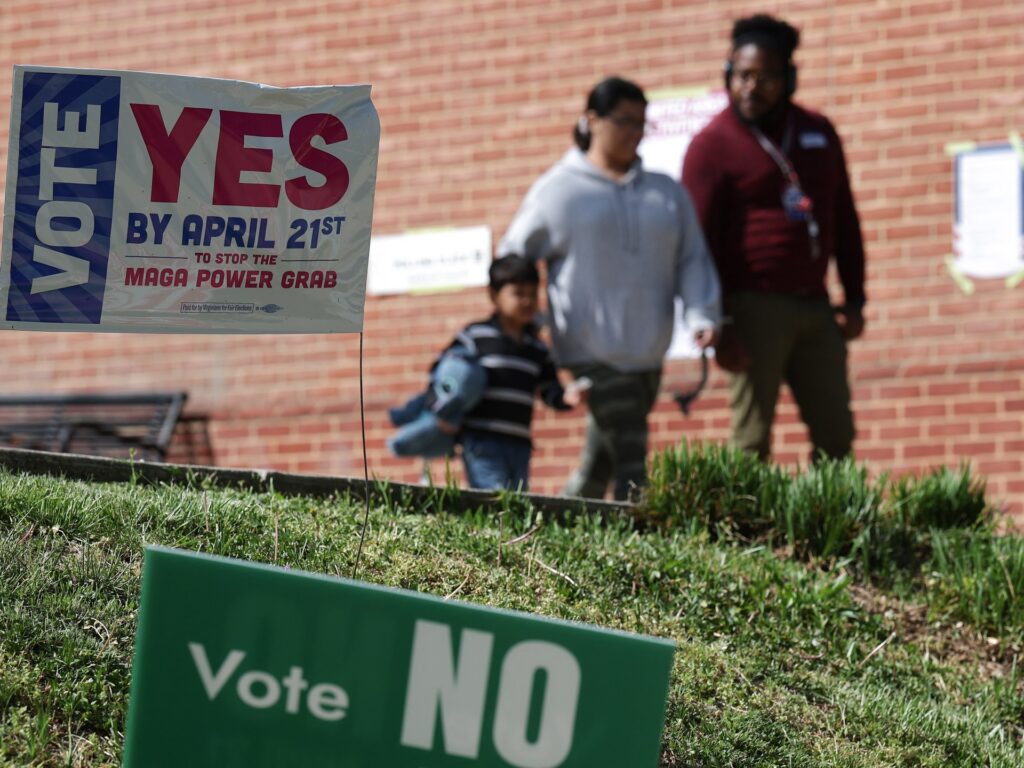
Washington, DC – In a significant move for the upcoming midterm elections, voters in Virginia have approved a referendum to redraw the state's electoral map. This decision is widely expected to bolster the Democratic Party's chances in their quest to regain control of the narrowly Republican-led U.S. House of Representatives in November.
The redistricting process, typically occurring every ten years post-Census, has seen unprecedented early action this election season. Prompted partly by Donald Trump's call for Republicans to adjust their maps in Texas, several states are moving swiftly to redraw their legislative boundaries. While Democrats currently hold the advantage in Virginia, potential challenges—such as ongoing redistricting efforts in Florida—could alter the political landscape significantly.
Experts caution that this wave of election-season redistricting could have lasting implications. Rina Shah, a political adviser and strategist, remarked, “Virginia’s unorthodox redistricting isn’t just a map redraw; it’s a mid-decade power play in a national arms race.” She added that “when one side bends the rules, the other follows, until courts or voters draw the final line.”
📰 Table of Contents
Democrats Gain – For Now
Former President Trump has been vocal about his desire to redraw state congressional maps in favor of the Republican Party. In July, he indicated that Texas would be a primary focus, stating to reporters, “Just a very simple redrawing, we pick up five seats.” Following his pronouncement, Texas’s Republican-controlled State House passed a new map that would add five seats to the GOP's representation in the U.S. House.
This shift in Texas has been mirrored in several other states. For example, new congressional maps in Missouri are expected to give Republicans an additional seat, while changes in North Carolina and Ohio could yield two to three more Republican-dominated districts. In response, Democrats in states like California and Utah have pushed through redistricting efforts that created around six new Democrat-leaning districts. Virginia’s recent referendum neutralizes some of these Republican gains, potentially adding two to four seats for Democrats, shifting Virginia’s balance from a current 6-5 split to as much as 10-1 in favor of Democrats.
These developments are crucial as Republicans brace for a challenging election season amid concerns regarding the U.S.-Israeli conflict and persistently high living costs. Democratic control of either congressional chamber would significantly curtail Trump's agenda during the final two years of his presidency. As of now, Sabato’s Crystal Ball, a midterm predictor from the University of Virginia’s Center for Politics, rates 217 Congressional districts as leaning Democratic, 205 as leaning Republican, and 13 as toss-ups.
Good for Democrats, ‘Terrible’ for Democracy
Though Democrats seem to be winning the redistricting battle in the short term, experts warn that this trend is detrimental to democracy. Samuel Wang, a professor at Princeton University and head of the Princeton Gerrymandering Project, stated, “From a non-partisan good government standpoint, it’s just a terrible event.” He described the current spate of mid-decade redistricting as a “complete busting of norms.”
Wang explained that rampant redistricting diminishes electoral competition, as gerrymandering effectively removes voters from the equation. Top Democrats argue that their redistricting efforts are a necessary response to Republican maneuvers rather than an opportunistic strategy. House Democratic leader Hakeem Jeffries emphasized, “When they go low, we hit back hard.” However, some Democrats, like Pennsylvania's John Fetterman, have expressed concern over the new precedent being set, noting that “whether it’s a red state or a blue state, our democracy is degraded.”
Despite the recent victories, the future of congressional maps remains uncertain. Following Virginia's vote, attention shifts to Florida, where Governor Ron DeSantis plans a special legislative session to discuss potential redistricting on April 28. A new map could add up to five Republican-dominated congressional districts, though state constitutional language may complicate this process. Jeffries has vowed to mobilize resources in Florida to challenge Republican incumbents if new maps are drawn, declaring, “Maximum warfare, everywhere, all the time.”
Legal challenges are also pending regarding Virginia’s redistricting ballot measure, which may impact the implementation of the new map. Trump has publicly criticized the Virginia vote, labeling it “rigged” without substantiating his claim. Meanwhile, a significant case before the U.S. Supreme Court, Louisiana v. Callais, may pave the way for further redistricting debates. The justices will determine if two Black-majority congressional districts align with the Voting Rights Act, potentially influencing redistricting efforts in various states.
Though a handful of states have established independent commissions to oversee redistricting, most rely on state legislatures, which often leads to partisan influence. Wang sees an opportunity for reform amid the current chaos. He suggests that Congress could create independent commissions to oversee redistricting, creating a pathway for bipartisan cooperation. “Now that mid-decade redistricting is backfiring on Republicans, it creates the possibility that both parties can see clearly that gerrymandering is a zero-sum game,” Wang concluded. This may open a pathway for meaningful reform in a political landscape increasingly defined by partisan maneuvering.
Las Vegas NBA Franchise Proposal: What Shocking Secrets About the Diamond Arena Are Experts Hiding?

ASUS Makes a Bold Move: Can Their New OLED Tablet Compete After Shocking Smartphone Exit?

US Drops Bombshell: No End in Sight for Iran Conflict! What Happens Next? Shocking Revelations Inside!

This Fitness Coach's 7-Week Plan Will Change Your Life—No Cardio or Fad Diets Allowed!

Is Your Late-Night Snacking Secretly Destroying Your Gut? 7 Shocking Facts You Can’t Ignore!

You Won't Believe What Happened in This Seaside Fitness Boot Camp for Metro Police Recruits!
You might also like: