
Kennedy's Shocking Confession: Did He Just Change the CDC's Stance on Vaccines Forever?

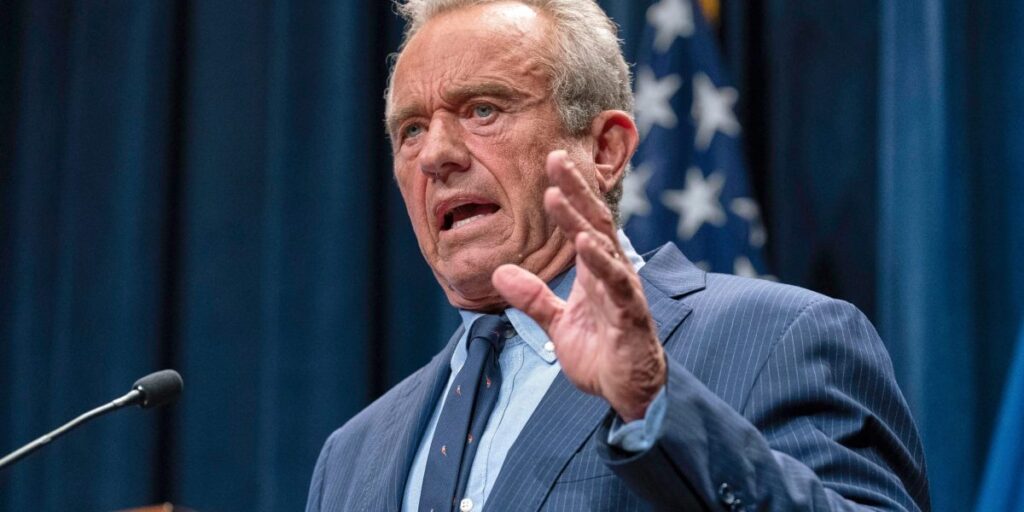
In a significant shift that has alarmed public health advocates, U.S. Health Secretary Robert F. Kennedy Jr. has personally directed the U.S. Centers for Disease Control and Prevention (CDC) to modify its website language regarding the safety of vaccines and their alleged link to autism. In an interview with The New York Times, Kennedy revealed that the CDC’s “vaccine safety” page now states that the assertion “vaccines do not cause autism” is not based on evidence, suggesting that the agency has overlooked studies indicating a potential connection.
This revelation comes after many current and former CDC staff expressed surprise over the new guidance, which contradicts a longstanding scientific consensus that vaccines are safe and do not cause autism. Kennedy, a prominent figure in the anti-vaccine movement, has had a tumultuous tenure at the agency, enacting policies that many in the medical community view as damaging to public health.
"The whole thing about ‘vaccines have been tested and there’s been this determination made,’ is just a lie,” Kennedy stated during the interview.
Public health researchers and advocates have sharply criticized the updated guidance, arguing that it misleads the public by exploiting the limitations of scientific inquiry. They emphasize that extensive research over decades has consistently shown no causal link between vaccines and autism. In a statement, the Autism Science Foundation highlighted that “no environmental factor has been better studied as a potential cause of autism than vaccines,” affirming that studies have ruled out vaccine ingredients and the immune response to vaccines as causes of the disorder.
Kennedy has acknowledged the existence of studies demonstrating no link between autism and thimerosal, a mercury-based preservative previously used in some vaccines, as well as the measles, mumps, and rubella (MMR) vaccine. However, he insists that gaps remain in our understanding of vaccine safety, calling for further research in the area.
The CDC's change has sparked disagreement between Kennedy and Senator Bill Cassidy, a Louisiana Republican and physician who chairs the Senate health committee. During Kennedy’s confirmation process, he assured Cassidy that he would retain the original statement about vaccines on the CDC website. While that statement remains, it now includes a disclaimer indicating that it was preserved as part of their agreement. Cassidy publicly disagreed with the modification, emphasizing the importance of reassuring parents about vaccine safety:
“What parents need to hear right now is vaccines for measles, polio, hepatitis B, and other childhood diseases are safe and effective and will not cause autism,” Cassidy posted on X on Thursday. “Any statement to the contrary is wrong, irresponsible, and actively makes Americans sicker.”
This updated guidance is not an isolated incident; Kennedy has implemented several controversial measures as Secretary of Health. He has withdrawn $500 million earmarked for vaccine development, replaced every member of a federal vaccine advisory committee, and indicated plans to revamp a federal program that compensates Americans injured by vaccines. Notably, he fired former CDC Director Susan Monarez shortly after her appointment due to disagreements over vaccine policy.
Dr. Sean O’Leary, chair of the infectious diseases committee at the American Academy of Pediatrics, criticized the CDC's updated website, calling it a perpetuation of misinformation. “This is madness,” he stated. “Vaccines do not cause autism, and unfortunately, we can no longer trust health-related information coming from our government.”
As public health experts grapple with Kennedy's recent actions, the Department of Health and Human Services has not provided additional comments regarding the situation. The implications of these changes are considerable, as they not only undermine established public health information but also fuel ongoing debates about vaccine safety and efficacy at a time when vaccine hesitancy poses a serious risk to community health across the United States.
You Won't Believe What These 5 Clinical Pharmacists Did to Save Lives—November Heroes Revealed!

Is the Houston Rockets' Shocking Statistical Success a Fluke? You Won't Believe the Numbers!

You Won't Believe How These Sisters Turned Their "Faith Fitness" Routine into a $100,000 Business!

Discover the Shocking List of 7 Rare Seeds That Could Transform Your Garden—Before They're Gone!

You Won't Believe Which Two Mean Moose Players Made All-State—Their Shocking Rivalry Ends Here!

My Daughter's Friends Smuggled This Shocking Device After We Took Her Phone—You Won't Believe What Happened Next!
You might also like: