
Is Your Job at Risk? Shocking Survey Reveals 20% of Workers Rely on AI—Find Out How!

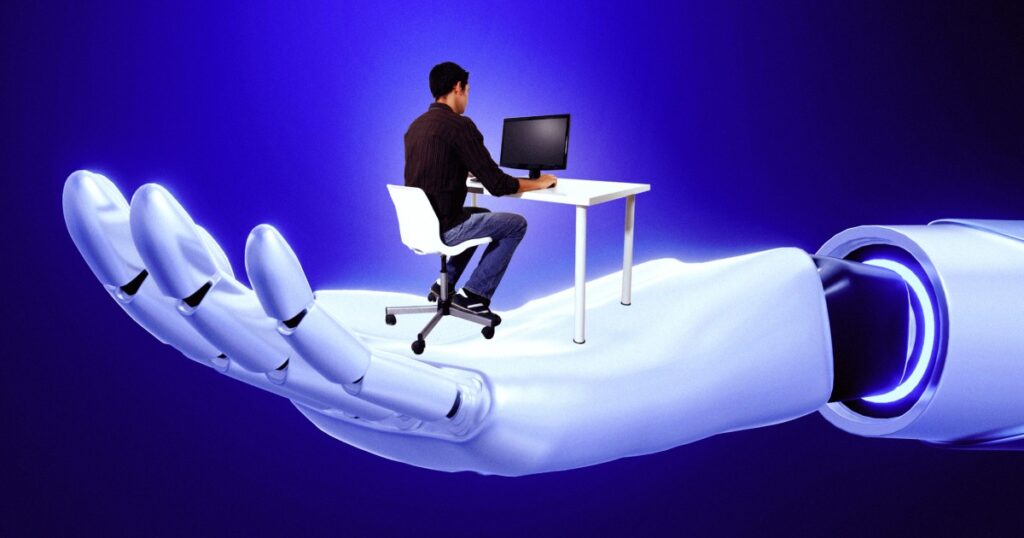
A recent survey conducted by the nonprofit AI research center Epoch AI in partnership with Ipsos reveals that a significant number of American adults are integrating artificial intelligence (AI) into their daily lives, whether for personal or professional purposes. The study, which surveyed 2,000 American adults, found that nearly half—50%—had used AI in the past week. Among full-time workers, 20% indicated that AI has taken over parts of their job.
Caroline Falkman Olsson, who led the research for Epoch AI, emphasized that the survey results affirm widespread assumptions about AI's growing influence in the workplace. "When we actually look at what people report for their AI usage, we do see augmentation and automation effects," she stated. However, she cautioned that further research is needed to understand the specific tasks being impacted by AI.
Epoch AI, founded in 2021, began as a volunteer effort to analyze trends in AI development. Since gaining traction in 2022 with its research on the computational power used by AI companies, it has expanded its focus to include the pricing of AI services, the construction of data centers, and the types of chips involved in AI model development.
The survey was conducted from March 3 to 5, 2023, using Ipsos’ online polling platform. Among those who used AI, nearly 50% reported utilizing AI between two and five days a week. Yet, a majority (62.5%) performed just 1 to 2 quick tasks on their most intensive day of AI usage, contrasting sharply with the roughly 6% who engaged in heavy use.
According to Nicholas Miailhe, an AI policy expert with the Global Partnership on Artificial Intelligence, these findings should serve as a wake-up call for both workers and policymakers. "When 1 in 5 workers say AI is already replacing parts of their job, we can start talking about labor market restructuring happening in real time," he noted. He further warned that the trend of replacement appears to outpace augmentation, indicating that "the policy window to shape how AI transforms work is probably closing faster than most governments realize."
The survey also uncovered that approximately half of American adults using AI for work relied on their personal subscriptions or free versions of AI services rather than those provided by their employers. This raises questions about the accessibility and integration of advanced AI tools in the workplace.
Interestingly, the survey addressed the growing phenomenon of AI agents—systems that can conduct independent tasks. While overall usage rates remain low, 8% of AI users reported engaging with an AI agent in the past week. In contrast, 49% utilized AI systems primarily for web searches. Renan Araujo, director of programs at the Institute for AI Policy and Strategy, highlighted the significance of these findings: "One in 12 Americans has used an autonomous AI agent, a software that not just answers questions but takes actions on your behalf. This capability was not available two years ago, and it’s striking to see its usage grow so quickly."
The survey also explored the various applications of AI among American adults. It found that 80% of those who used AI in the past week did so to look up information or recommendations, while 59% used it for writing or editing text, and 53% engaged with AI for brainstorming ideas. Among the services used, ChatGPT emerged as the most popular, utilized by 31% of respondents, followed by Google’s Gemini at 21% and Microsoft’s Copilot at 10.5%.
This survey follows recent reports from financial institutions like Goldman Sachs and Morgan Stanley, which highlight the significant impact of AI on the labor market. Goldman Sachs economists stated that AI could be eliminating around 16,000 jobs monthly due to both automation and augmentation effects. They previously estimated that AI could automate tasks consuming approximately 25% of all work hours.
As AI continues to evolve and integrate into everyday tasks, the implications for the workforce and workplace dynamics are becoming increasingly pronounced. The ability to adapt to these changes will be vital for workers and businesses alike as they navigate this rapidly transforming landscape.
Columbus Crew vs. Orlando City: Will This Match Decide the Future of U.S. Soccer? Shocking Stats Inside!

Unlock the Secret: These 3 Lifestyle Changes Could Add 10+ Years to Your Life—Are You Missing Out?
Unlock the Secret: How Farmley Transformed Healthy Snacking into a Must-Play Daily Game! Don’t Miss Out!

You Won't Believe What This Dog Found: Is Arugula the Secret to Unleashing Your Pet's Energy?

You Won't Believe How Trustonic Plans to Connect 100 Million Africans—This Could Change Everything!

XRP's Shocking Golden Cross: Is a Massive Price Drop Looming? You Won't Believe What Happens Next!
You might also like: