
Trump's Shocking Iran Threat Sends Stocks Plummeting—Is Your Portfolio Safe?

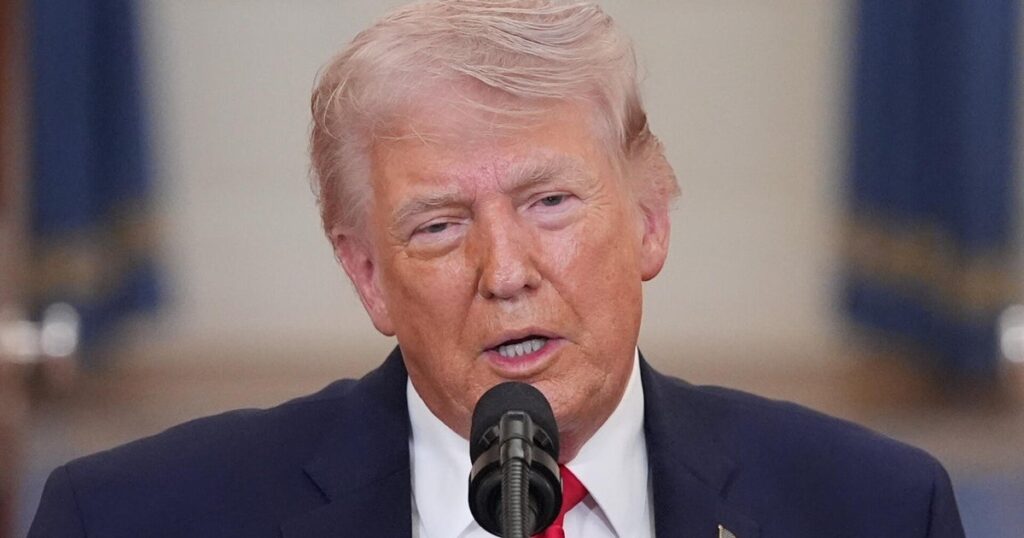
On Thursday, stocks are poised for a significant drop as oil prices soar, following President Trump's announcement regarding ongoing military actions against Iran. In his address, Trump failed to outline a clear strategy for reopening the crucial Strait of Hormuz, a key chokepoint for global oil transportation.
S&P 500 futures dropped 1.6% before the market opened at 9:30 a.m. EST, with Dow Jones Industrial Average futures indicating a 0.9% decline. This downturn comes after a recent rally, where the stock market surged 3.5% over the prior two trading days, fueled by investor optimism about a possible resolution to the conflict that would stabilize global energy markets.
Following Trump's remarks, oil prices jumped dramatically. Brent crude, the international benchmark, rose by 7.4% to $108.69 per barrel, while the benchmark U.S. crude increased by 7.1% to $107.24. The surge in oil prices reflects rising concerns over supply disruptions due to the ongoing conflict.
In his speech, Trump repeated claims that U.S. military objectives in the region are "nearly met," asserting that Iran's military capabilities have been "essentially decimated" after more than a month of engagement. However, his remarks did not provide any new strategies or timelines for reopening the Strait of Hormuz, which typically facilitates around 20% of the world’s oil and natural gas supply. The waterway remains effectively closed, and experts like Oxford Economics' global chief economist, Ryan Sweet, predict it could remain inaccessible to oil tankers until the end of April.
"Markets were beginning to price in more certainty, but this speech reintroduces more ambiguity," commented Nigel Green of the investment firm deVere Group. "Investors had anticipated a shorter, contained conflict. What they heard now is far less definitive, and that uncertainty is likely to drive volatility across various asset classes."
The longer the Strait of Hormuz remains closed, the greater the economic repercussions, according to Ryan Sweet. The Trump administration has been releasing oil from the Strategic Petroleum Reserves in an attempt to mitigate the impact of reduced oil supplies. However, this strategy may lose its effectiveness the longer the passage remains closed, which could lead to escalating oil prices. Sweet emphasized that scary scenarios regarding oil prices are "extremely plausible," warning that prices could potentially reach $150 or even $200 per barrel, as discussed by Nobel Prize-winning economist Paul Krugman during an interview with CBS News this week.
American consumers are already feeling the pinch at the pump, with gasoline prices, which are closely linked to global oil rates, continuing to rise. The average price for a gallon of gasoline reached $4.08 on Thursday, up from $4.06 the previous day, according to AAA data. Since the onset of hostilities on February 28, American drivers have collectively spent an additional $8.4 billion on gasoline, as calculated by Democrats on the Joint Economic Committee.
The ongoing crisis is not only affecting stock and oil markets; it has real consequences for everyday Americans. As the geopolitical situation evolves, consumers and investors alike are left grappling with uncertainty that threatens to impact both the economy and their wallets in the coming weeks.
You Won't Believe Who Just Invested $2.56 Million in Tokyo Lifestyle—Is Your City Next?

US Stock Market Meltdown: Here's Why the Dow Just Plunged 500 Points—Are Your Investments Safe?

You Won't Believe How Cheap Samsung’s Best 5G Phone is Right Now—Grab It Before It's Gone!

Cavaliers’ Secret Weapon: How $10,000 Dinners are Keeping Superstars from Leaving!

Is Your Real Estate Agent Hiding This Shocking Truth? Find Out Before You Sign!

Could This Shocking New Trend of 'Prescription Cocktails' in China Save Your Health? Find Out!
You might also like: