
Trump's Shocking Revelation: What’s Hidden Inside the New 'Massive Complex' Under the White House?

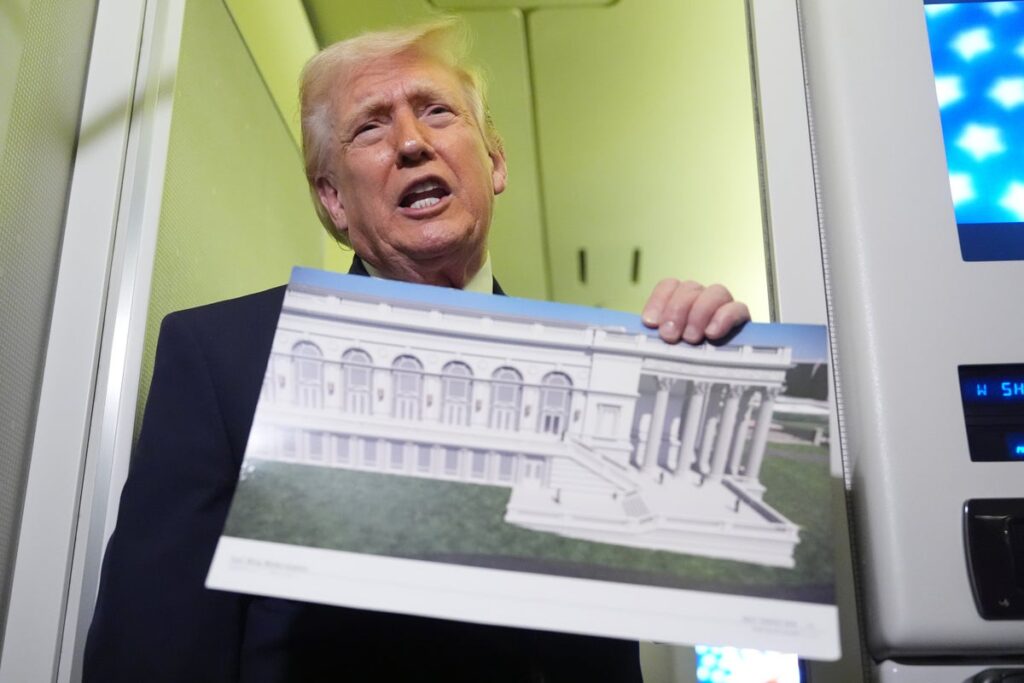
In a surprising announcement during a press briefing aboard Air Force One on March 29, 2026, President Donald Trump revealed that the U.S. military is constructing a “massive complex” beneath the White House ballroom. According to Trump, this facility, encompassing 90,000 square feet, is currently under construction and is expected to be completed ahead of schedule.
The ballroom, which Trump described as “essentially a shed” for the new bunker, has been a focal point since the East Wing was demolished last October to make way for the project. The president provided reporters with illustrations of the complex, highlighting its importance to national security. “The military is building a massive complex under the ballroom, and that’s under construction, and we’re doing very well, so we’re ahead of schedule,” Trump stated.
One of the key features of this facility is its drone-proof construction, designed to withstand potential aerial threats. The president emphasized that it will be fitted with “high-grade bulletproof glass,” underscoring the administration's focus on enhancing security measures in the wake of evolving threats. This move aligns with a broader trend among U.S. leadership to bolster protective measures around critical national assets.
The implications of this construction project extend beyond mere physical security. The development signals a heightened awareness of potential threats to national leadership and infrastructure. As geopolitical tensions continue to rise globally, the U.S. government's investment in such facilities indicates a proactive approach to safeguarding its highest officials and the operations of the executive branch.
Critics may argue that the resources allocated to this project could be better spent addressing pressing social issues, such as infrastructure repair, education, or healthcare. However, proponents of the initiative assert that national security should always be a top priority, especially in an era characterized by rapid technological advancements in warfare and surveillance.
As the construction continues, it will be interesting to see how this facility integrates into the broader security architecture of the White House and what additional measures might be enacted alongside it. The fact that Trump is taking such a visible role in promoting this project could also be seen as an attempt to emphasize his administration's commitment to national security ahead of upcoming elections.
In the context of U.S. history, the establishment of secure facilities like this one is not entirely unprecedented. Throughout different administrations, various security measures have been implemented to protect the president and key government sites, particularly following events that exposed vulnerabilities. Yet, the scale of this project, paired with the current political climate, raises questions about the balance between security and transparency in governance.
Ultimately, as the U.S. military progresses with the construction of this new complex beneath the White House ballroom, it serves as a reminder of the ongoing challenges the nation faces in safeguarding its leaders and critical infrastructure. This project will not only influence the immediate security landscape but also potentially reshape public perceptions of government priorities in an increasingly complex world.
$5.3M Retail Center in Central Florida Sells – What Shocking Secrets Did It Hide?
You Won't Believe What Experts Discovered Behind This Security Block—Is Your Data at Risk?

You Won't Believe Which City Boys Soccer Teams Are Dominating in 2026 – Shocking Stats Inside!

Are You Still Using Old Social Media Tools? Discover the Shocking Shift Small Businesses Are Making NOW!
New Hampshire's Shocking Move: Why Small Modular Reactors Could Change Everything—Are We Ready?

Why Boomers Waste $1,500 a Year on Lotto Tickets & Food They Toss—Is Your Wallet Next?
You might also like: