
Tulsa Teens' Shocking Health Tech Discovery: Will It Change Lives or Spark Controversy?

TULSA, Okla. - Three students from Booker T. Washington High School are preparing to showcase their innovative projects at the upcoming Oklahoma State Science and Engineering Fair in Stillwater. Yeriel Ko, Divya Ramnath, and Juliette Jackson have dedicated their research to health and science topics that they believe can have a real-world impact.
Yeriel Ko, a freshman, focused her project on how acetaminophen, the active ingredient found in Tylenol, affects individuals with low metabolism. This research was deeply personal for Ko, who was inspired by her childhood experience with jaundice. “I wanted to know how to treat patients with liver conditions with fever reducers,” Ko explained.
To test her hypothesis, Ko conducted a three-day experiment using pig liver she purchased from a grocery store. She exposed tissue samples to varying doses of acetaminophen, creating a model for patients whose bodies are unable to properly process the drug. “I did the experiment for three days, and I got my results, which showed that there was a really drastic decrease in the mass of each liver piece as the dose increased,” Ko noted. The results indicated that since the dead liver tissue had no metabolism, it mirrored the conditions of patients with significantly low metabolic rates. Her project earned second place at the regional competition, qualifying her for the state fair.
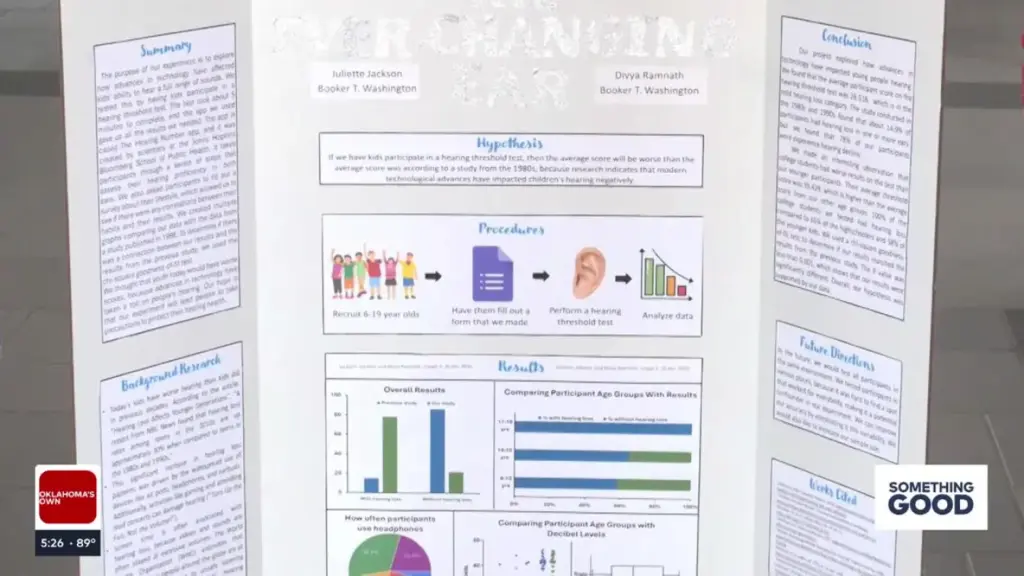
In another corner of the classroom, Divya Ramnath and Juliette Jackson tackled an issue that affects countless young people: hearing loss. Their project, titled “The Ever Changing Ear,” examined the connection between modern technology use—particularly headphone use—and declining hearing ability. The duo tested 50 participants aged 6 to 19, collecting data on their headphone habits and measuring their hearing levels.
“Something interesting that we found is that 100% of the college students had hearing loss,” Ramnath said. In their hearing tests, the average score for college students was around 40, whereas a score over 16 indicates hearing loss. Their findings align with earlier studies that suggest a troubling decline in hearing ability among young people over time. Their project took first place in its category at the regional competition.
Both Ramnath and Jackson expressed how their collaboration enhanced their learning experience. “I would say a lot of teamwork and collaboration,” Jackson reflected. “We have done so many personal projects over the years, but it’s just like a whole different thing, learning to work with someone who’s really different from you.”
The Oklahoma State Science and Engineering Fair is set to take place this Friday in Stillwater, where hundreds of students from across Oklahoma will present their work. Ko expressed excitement about the event and the opportunity to connect with peers who share her passion for science. “There’s so many people with a variety of interests in science,” she shared. “I’d like to know their projects and also share mine.”
All three students underscored the critical need for ongoing research, especially in fields like biochemistry and health sciences. “No matter what happens, we are always going to need more research on how to save lives,” Ko concluded. As they prepare for the fair, these young scientists are not only competing but also contributing to the larger dialogue on health issues that resonate within their communities and beyond.
Taylor Frankie Paul’s Shocking Third Domestic Violence Claim: What Did She Just Reveal? You Won’t Believe It!
Woman Sues Planet Fitness for $1M After Shocking Assault at West Ashley Gym - What Happened?

Copa90's Shocking New Deal with TikTok: What This Means for Soccer Fans! Don’t Miss Out!

Vitality's Shocking Move: How Acquiring Ramp Health Could Change Your Workplace Forever!

REMAX’s Shocking $10 Million Settlement: What It Means for Your Next Home Purchase!

Stakt's Shocking New Move: How 30% More Weight Vests Are Changing Fitness Forever!
You might also like: