
Trump’s Stunning Iran Move Could Skyrocket Bitcoin to $70K—Will You Be Left Behind?

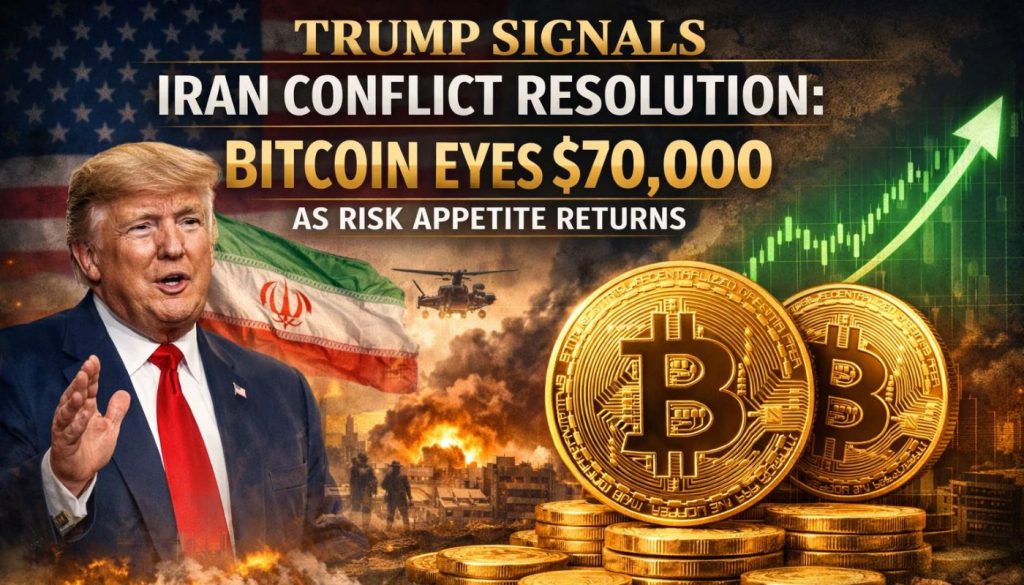
This week, global markets experienced significant shifts following President Donald Trump's remarks about potential de-escalation in the Middle East. Speaking at a news conference at the Doral resort, Trump suggested that the ongoing conflict with Iran could be resolved “very soon.” This statement ignited a recovery in riskier assets, particularly Bitcoin, which had seen a decline to the mid-$60,000 range after U.S.-Israeli strikes on February 28. As a result, Bitcoin quickly rebounded, nearing the critical $70,000 mark.
Bitcoin’s recent performance reflects its evolution as a high-risk asset, distinct from traditional safe havens like gold. While gold typically appreciates during tumultuous times, Bitcoin tends to follow the movements of global stocks, particularly when geopolitical tensions begin to subside. Many traders interpreted Trump's comments as a signal to re-enter growth investments, leading to a relief rally that also positively impacted other major cryptocurrencies, including Ethereum, XRP, and Solana.
📰 Table of Contents
Geopolitical De-escalation Fuels a Crypto Market Rebound
The rapid change in sentiment among cryptocurrency investors was palpable. As the likelihood of prolonged conflict diminished, many who had retreated to safer investments or stablecoins began reallocating funds back into the market. Ethereum surged to around $2,050, while Solana and XRP each gained approximately 1.4%. Analysts from NewsBTC and Saxo Bank attributed this shift to a decrease in “macro stress,” which had previously weighed heavily on large investors.
However, experts caution that the rally remains precarious. While Trump's optimism provided an initial boost, a formal ceasefire has not been established. Institutional traders are currently assessing whether this bullish trend is sustainable or merely a “bull trap” fueled by political rhetoric. Richard Galvin, co-founder of hedge fund DACM, warned that the market might be “misreading” the potential for a swift resolution, especially in light of Iran's continued assertions regarding regional energy security. For now, the $70,000 mark stands as a pivotal “line in the sand” for Bitcoin advocates.
Oil Volatility and the Historic 400 Million Barrel SPR Release
As the crypto market rallied, the energy sector faced its own set of challenges. Oil prices fluctuated significantly, soaring to $119.50 per barrel on Monday before plummeting to approximately $91 in response to easing tensions. In a historic move, the International Energy Agency (IEA) announced the release of 400 million barrels from strategic reserves, marking the largest emergency release in the agency's 50-year history. This amount is more than twice that released during the 2022 Russia-Ukraine crisis.
The U.S. is leading this initiative with a contribution of 172 million barrels, aimed at offsetting the “stranglehold” on the Strait of Hormuz, a crucial maritime chokepoint where Iran has reportedly intensified attacks on shipping traffic. Currently, oil and refined product movements through the strait are estimated to be less than 10% of pre-conflict levels. The IEA's intervention seeks to avert a “catastrophic” supply shock that could push oil prices toward the $200 mark, a scenario openly threatened by Iranian military spokespeople this week.
The Critical Link: How Energy Risk Dictates Crypto Pricing
The connection between the Strait of Hormuz and cryptocurrency prices is often overlooked. Rising oil prices can lead to increased global inflation, which may prompt the Federal Reserve to maintain high interest rates. Since Bitcoin performs best in environments with ample liquidity and low rates, escalating energy costs can hinder digital asset valuations. Additionally, higher electricity expenses can impact Bitcoin miners, potentially forcing those with higher operational costs to liquidate holdings to cover expenses.
- Risk-On Trigger: Trump's comments lowered the geopolitical risk premium.
- Energy Safety Net: The IEA’s 400-million-barrel release provides a temporary buffer against $200 oil.
- Strait of Hormuz Factor: 25% of global seaborne oil trade is currently at risk, contributing to ongoing volatility.
- Technical Levels: Bitcoin needs to break above $70,500 to confirm a new upward trend.
As the week progresses, the influence of Trump's statements will be scrutinized against new economic data. Investors are closely monitoring the upcoming U.S. Consumer Price Index (CPI) report to gauge whether the recent spike in energy prices is impacting overall inflation. Until a formal ceasefire is established, the cryptocurrency market is likely to remain sensitive to news developments, with Bitcoin serving as a primary indicator of global risk appetite.
Revealed: 10 Shocking Health Trends for 2026 That Could Change Your Life Forever!

You Won’t Believe How the Middle East Smartphone Market is Set to Explode by 20%—Here's What You Need to Know!

Whistleblower Doctor Faces Losing License—Shocking Truth About Vaccine Secrets Revealed!

Clemson's Shocking Upset: How They Stunned No. 19 UNC in a Nail-Biting 80-79 Finish!

This Startup's Bold Move: Will You Be Left Behind in the Quantum Race by 2025?
US Futures Surge: What Shocking Move Has Analysts on EDGE About the S&P 500 and Dow? Find Out NOW!
You might also like: