
Korean AI Chip Startups Are Hiring Like Crazy—Discover Which Giants Could Vanish!

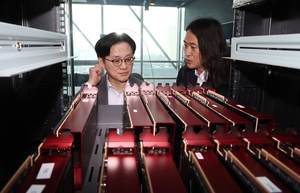
As South Korea's AI chip sector enters a pivotal stage of growth, several leading startups are ramping up their operations by significantly expanding their workforces. This strategic hiring comes as these companies, including Rebellions, DeepX, Mobilint, and FuriosaAI, work towards commercializing next-generation processors tailored for artificial intelligence applications.
According to industry sources and data from the Korean startup investment database TheVC, these four fabless firms, which design semiconductors but outsource manufacturing, are collectively enhancing their headcounts as they approach critical milestones in product development. The focus is on producing new neural processing units specifically designed for AI inference—where trained AI models are deployed to deliver real-time services, requiring chips that are optimized for low power consumption and cost-effective operation.
For instance, DeepX has nearly doubled its workforce from around 70 employees to over 140 within a year. Mobilint has also seen significant growth, bringing its staff count up to approximately 105 employees. Meanwhile, Rebellions has expanded its team from about 200 to nearly 300, and FuriosaAI aims to increase its personnel from 130 to 200 by the end of the year.
This hiring surge aligns with product launches and advancements. Rebellions recently commenced mass production of its second-generation AI processor, the REBEL-Quad, and is currently conducting proof-of-concept (PoC) testing with global partners. Proof-of-concept tests are essential for validating product performance with potential customers before wider deployment.
In January, FuriosaAI announced it received an initial batch of 4,000 units of its second-generation Renegade AI inference chip from its manufacturing partner, TSMC. These chips are being integrated into accelerator cards for enterprise systems. Mobilint is preparing to launch its Regulus chip into mass production after completing PoC with potential clients, while DeepX is already producing its first-generation DX-M1 chip and working on its next-generation DX-M2 processor.
The four firms are targeting different segments of the AI inference market. While Rebellions and FuriosaAI primarily focus on data center and enterprise workloads, DeepX and Mobilint are oriented towards edge and on-device AI applications. These include critical technologies like robotics, cameras, and vehicles, where energy efficiency and compact design play vital roles.
Monitoring their progress is essential, especially considering South Korea's established reputation in the memory semiconductor field through giants like Samsung Electronics and SK hynix. The country, however, has yet to cultivate competitive prowess in the realm of AI logic and accelerator chips—an area increasingly important as demand for AI technology rises globally.
Supporting this burgeoning sector, the South Korean government is also shifting its policy focus. In February, the Ministry of Trade, Industry and Energy announced it would invest 1 trillion won (approximately $678 million) over five years in a joint development program for on-device AI semiconductors. This initiative aims to accelerate commercialization efforts and promote the domestic adoption of these advanced technologies.
As these developments unfold, the implications for both South Korea's economy and the global AI landscape are significant. The expansion of these companies not only highlights the country's increasing commitment to innovation in AI technology but also sets the stage for South Korean firms to establish a more formidable presence in a competitive global market.
You Won't Believe What This College Athlete Did to Win a Record-Breaking 30 Games—Find Out How!

Unlock the Shocking Truth: How 80% of Predators Are Stopped by THIS One Early Conversation!

Lockheed Martin's Shocking New Defense Strategy: Are We Prepared for What’s Coming?

Stock Traders in NYC Sound Alarm: 330% Surge in Pump-and-Dump Schemes – Are You Next?

Is This the End? Shocking New Nipah Virus Vaccine Partnership Could Save Millions!

Shocking Secrets Revealed: What Fox News is Hiding in Their March 3-10 Newsletter!
You might also like: