
Discover What Ancient Arctic Sediments Reveal About Our Future Climate—You Won't Believe the Shocking Truth!

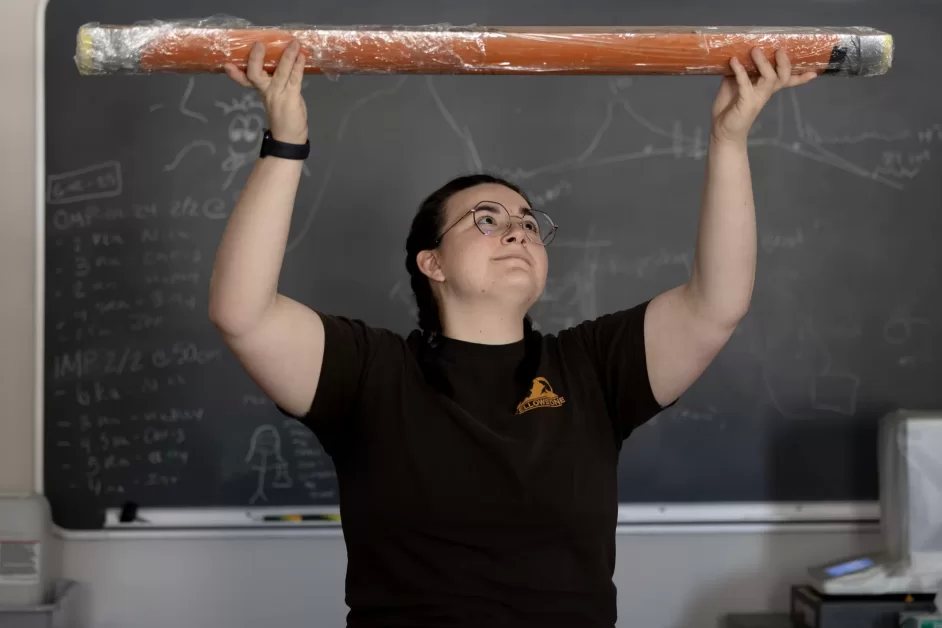
Hadley Blodgett, a sophomore at Bates College from Buckfield, Maine, is delving into the depths of time—7,000 years of it, to be precise. In Carnegie Science Hall, she’s conducting research for her senior thesis, analyzing a sediment core extracted from a lake in northern Greenland. As a double major in earth and climate sciences and music, with a minor in religious studies, Blodgett finds herself captivated by the intersections of her studies, particularly the immense history contained within the sediment sample. “How am I holding this?” she ponders, reflecting on the monumental span of history that lies before her.
But how did this sediment, buried beneath Arctic waters, make its way to her laboratory? The answer is a story woven through oceans and icebergs, all tied to Blodgett’s thesis advisor, Associate Professor of Earth and Climate Sciences, Nick Balascio.
Balascio, a paleoclimatologist, investigates how Earth's climate system has transformed over the millennia. He primarily analyzes lake sediment cores—layers of mud, dirt, and organic material that act as natural history books, recording environmental changes in and around the lake's watershed.
“Those lakes are natural history books that record what’s going on around the watershed of the lake as well as within the lake itself,” says Balascio.
In 2022, Balascio helped launch the Wandel Dal Project, a multi-national scientific initiative exploring ancient climate conditions in Greenland, supported by a National Science Foundation grant. This project focuses on Wandel Dal, an isolated Arctic desert valley located less than 500 miles from the North Pole in Greenland’s Peary Land. Beneath the ice lies a rich historical tapestry, as Peary Land was once home to the island's first inhabitants who migrated from northern Canada.
Over the last 4,500 years, Peary Land has been inhabited and abandoned by three different indigenous groups. Balascio and his team hypothesize that these migrations corresponded with climate fluctuations—people settled during warmer periods and departed as conditions became harsher.
“These are people with stone tool technology living in a pretty harsh and foreboding environment,” Balascio explains.
Understanding the historical climate context of Peary Land allows scientists to better grasp how changing conditions impact the Arctic, which is currently warming at a rate four times faster than the global average due to anthropogenic climate change. Balascio emphasizes the need for more research in the high Arctic, as it sits at the margins of the Greenland ice sheet, making it crucial to understand its sensitivity to climate changes.
In the summer of 2024, Balascio and colleagues traveled to Peary Land to collect sediment cores, embarking on a journey that included flights to Svalbard, Norway, and then to eastern Greenland, followed by a helicopter ride to their research site, where remnants of ancient human life dotted the landscape.
“Working in these extremely remote and remarkable landscapes is inspiring as an earth scientist,” Balascio remarked.
During this brief summer window, when the lakes of Wandel Dal are unfrozen, the team set up coring platforms to extract six-meter-long sediment samples from the depths of 200-foot-deep lakes. Several of these cores now reside in Bates’ core storage facility, offering invaluable resources for students like Blodgett, along with fellow researchers Fletcher Libre and Zach Van Dusen, who are using these samples for their own theses.
“I feel fortunate that we have those here at Bates and that Bates students can literally put their hands on these really remarkable records,” Balascio noted.
Although Blodgett has yet to visit the Wandel Dal region, she did journey to Greenland in November 2025 during Greenland Science Week, funded by Balascio’s NSF grant, which supports student research. She was thrilled by the opportunity and found it validating to present her findings at the conference and local outreach events, contributing to the broader scientific dialogue.
When she began her thesis research in the summer of 2025, Blodgett was struck by how clearly she could discern time from the sediment layers. The composition followed a consistent pattern—denser layers indicated warmer climate periods, while less dense layers reflected cooler periods. However, she noticed a significant change in the top four centimeters of the sample.
“Something in the climate is causing the environment to react in such a way that it makes this sediment deposit in a different way than it has for the entire rest of the record,” she said, hypothesizing that these layers reflect the effects of anthropogenic climate change.
Blodgett’s fascination with sediment cores grew as her research progressed, despite initially having little knowledge about them. Her academic journey at Bates has been marked by a willingness to explore new avenues; she began as a history major but found a calling in earth and climate sciences after taking a course on soil geography.
“I definitely have an appreciation for just how important [the land] can be culturally and the need to treat it with respect,” she said.
This respect for the land is a fundamental principle of the Wandel Dal Project, which is dedicated to honoring the cultural significance of Peary Land’s indigenous people. The project collaborates with the Greenland National Museum to rename the area from “Peary Land” to “Inutoqqat Nunaat,” or “land of the ancient people.” Archaeologists involved are also researching the human history of northern Greenland.
Balascio’s focus has gradually expanded from climate alone to include the human narrative intertwined with it. His collaborations with archaeologists have enriched his understanding of how climate history and human impact are deeply interconnected.
During Greenland Science Week, Blodgett recognized the importance of integrating human stories into climate science discussions. “You get so disconnected from the ‘people part’ sometimes in climate science, even though people are such an important part of it,” she reflected.
As Blodgett prepares for life after Bates, her trip to Nuuk not only deepened her research but also opened doors for mentorship and future opportunities. “No matter where I end up after May, I know for certain that the trajectory of my career has been changed because of the guidance shown to me by Professor Balascio and so many essential people in the Bates community,” she concluded.
This research is supported by the National Science Foundation under Award Numbers 2524995 to Bates College and 2126047 to the College of William & Mary. The views expressed do not necessarily reflect those of the NSF.
eXp's Shocking Move to Texas: What a Controversial Ruling Means for Agents!

Padilla Shocks Panel with Bold Questions: Is Trump Really Trying to Steal Our Elections? You Won't Believe the Responses!

Your Community's Future Hangs in the Balance: Don't Miss THIS Shocking Election Next Month!
You Won't Believe What Happens When Your Request Gets Denied – 7 Shocking Consequences!

Urgent Alert: 50 Measles Cases Linked to Major Airport - Are You at Risk?
AG Nessel's Bold Move: Is the Kennedy Vaccine Schedule About to Face a Game-Changing Attack?
You might also like: