
NIH Chief’s SHOCKING Claim: What He Just Revealed About Vaccines and Autism Will Change Everything!

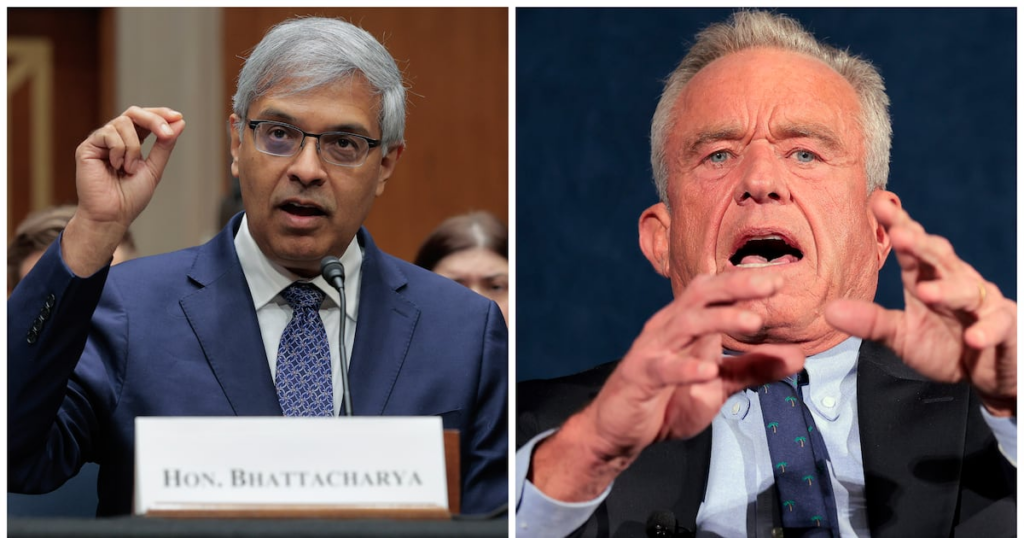
The debate over vaccines and their alleged link to autism resurfaced this week during a Senate hearing, where National Institutes of Health (NIH) Director Dr. Jay Bhattacharya reaffirmed his stance on the issue, asserting that he does not believe vaccines cause autism. This statement stands in stark contrast to the views of his superior, Health and Human Services (HHS) Secretary Robert F. Kennedy Jr., who has been vocal in promoting unproven theories regarding vaccines.
During a Senate Committee on Health, Education, Labor, and Pensions hearing on Tuesday, ranking member Bernie Sanders (I-VT) pressed Dr. Bhattacharya on the controversial topic, asking point-blank, “Do vaccines cause autism? Tell that to the American people: Yes or no?” After a brief hesitation, Dr. Bhattacharya stated, “I have not seen a study that suggests any single vaccine causes autism,” effectively aligning himself with the consensus of the scientific community.
This exchange is particularly significant given the current climate surrounding vaccine skepticism, largely fueled by figures like Kennedy. Over his first year at the HHS, Kennedy has focused heavily on autism, often linking it to vaccines. Critics, including Alison Singer, head of the Autism Science Foundation, argue that Kennedy’s efforts are rooted in anti-vaccine conspiracies rather than the established science surrounding autism. Last week, Kennedy overhauled the Interagency Autism Coordinating Committee, filling it with vaccination skeptics, which has raised concerns about the integrity of federal autism research.
Kennedy’s recent comments have included claims that circumcision and Tylenol may also contribute to autism, further entrenching him within the realm of vaccine skepticism. His critics assert that his focus on autism lacks a scientific basis and is more about promoting his own agenda than addressing the actual needs of families affected by autism.
In contrast, Dr. Bhattacharya has remained a proponent of vaccination as a critical public health measure. Commenting on the ongoing measles outbreaks in the U.S., particularly in states with low vaccination rates, he stated, “I am absolutely convinced that the measles epidemic that we are seeing currently is best solved by parents vaccinating their children for measles.” In March 2025, Kennedy criticized the effectiveness of the Measles, Mumps, and Rubella (MMR) vaccine, claiming its efficacy “wanes” over time and asserting that it is responsible for “all cases” of the illness. He even went so far as to direct the Centers for Disease Control and Prevention (CDC) to investigate the potential use of vitamin A as a treatment for measles, despite medical advice indicating that vitamin A should only serve as a supplement, not a cure.
Dr. Bhattacharya, who rose to prominence among conservative circles for his criticisms of COVID-19 protocols, has consistently emphasized the importance of vaccines in maintaining public health. His previous comments supporting the rollback of COVID vaccine guidelines for healthy children and pregnant women reflect a broader tendency toward vaccine skepticism that has permeated certain political factions.
Kennedy's tenure at HHS has also been marked by significant personnel changes. He has purged agencies of medical professionals opposing his views, including the entire Advisory Committee for Immunization Practices, which advises the CDC on vaccine effectiveness, replacing them with individuals who share his anti-vaccine stance. The recent dismissal of CDC head Susan Monarez for resisting Kennedy's policies illustrates the extent to which he is willing to go to enforce his controversial beliefs.
This ongoing struggle between established scientific consensus and vocal skepticism surrounding vaccines emphasizes the need for clear communication and education regarding public health measures. As the U.S. grapples with measles outbreaks, the implications of this debate extend beyond mere opinions; they impact the health and safety of children and communities across the nation.
As the conversation continues, it remains crucial for public health officials, scientists, and government leaders to advocate for vaccination as a means of preventing disease. The challenges posed by misinformation in the age of social media highlight the necessity for evidence-based approaches to health policy.
Bay Area Gutters Are Collapsing—Is Your Home Next? Shocking Climate Facts Revealed!
Breakthrough Alert: First-Ever SARS Vaccine Human Trials Could Change Everything—Are You Prepared?

College Football Playoff Dates Revealed: Will Your Team Survive the Shocking Quarterfinals?

Why February 2026 Was a Game-Changer for Sports Law: Shocking Deals & Controversies You Won't Believe!

You Won't Believe How X's New Poll Feature Could Change Your Online Experience Forever!

Congress Shockingly Ends Shutdown—But What’s the Hidden Cyber Strategy That Could Change Everything?
You might also like: