
China’s Property Crisis: Could This $300 Billion Collapse Drag Down the Global Economy?

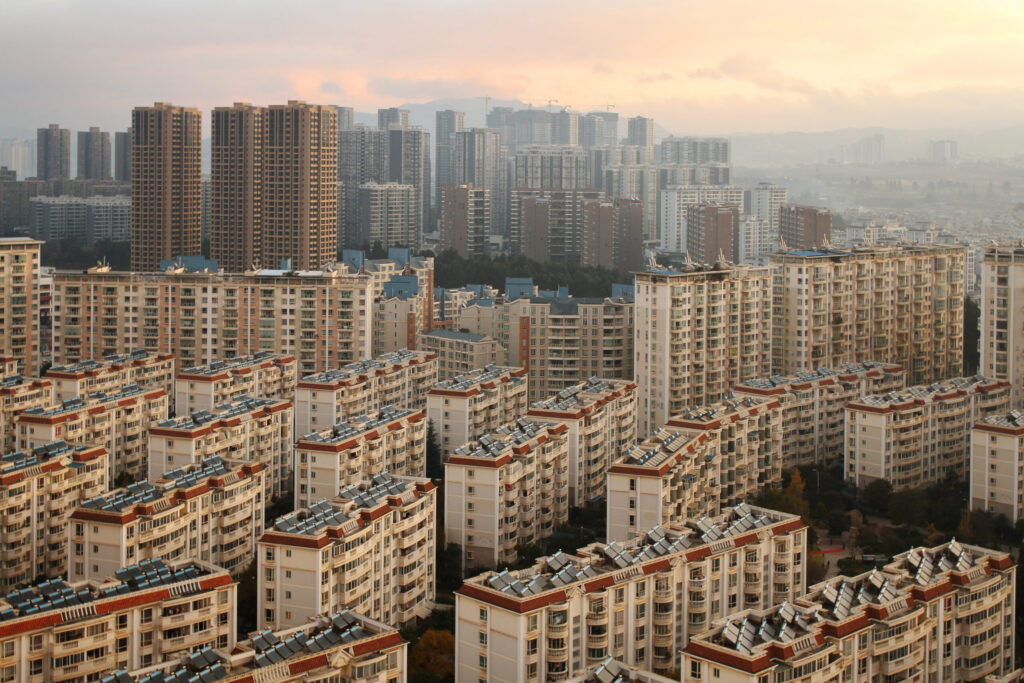
China’s real estate market, once a cornerstone of its economy, is now facing an unprecedented crisis in its fifth consecutive year of decline. Key indicators such as sales, prices, and construction activity are plummeting, with an estimated 80 million unsold or vacant homes saturating the market. Major developers are struggling, with many defaulting on debts and one of the largest state-backed firms, China Vanke Co., fighting to avoid a similar fate. A Chinese economist predicts that as many as 80 percent of developers and construction companies may “exit the market” in the coming years, indicating a significant contraction in the industry.
In response to this ongoing crisis, Chinese leaders have begun moving away from their previous regulatory and fiscal efforts to stabilize the market. Beijing has acknowledged that the “traditional real estate model” characterized by “high debt, high leverage, high turnover” has reached its conclusion. Instead, authorities are pushing for a “new model of real estate development,” which focuses on “affordable housing,” enhanced services, and “basically stable prices.” This marks a stark departure from an industry that previously accounted for about 25 percent of China’s gross domestic product and employed roughly 15 percent of the nonfarm workforce.
📰 Table of Contents
The Disconnect: Government Plans vs. Market Realities
However, a critical issue with this new paradigm is its apparent disregard for the market forces at play. Real estate has served as a primary repository for the life savings of hundreds of millions of Chinese households. Yet, according to Macquarie Group, approximately 85 percent of the price gains that fueled this wealth have vanished since 2021, following the government’s clumsy imposition of credit restrictions aimed at cooling a previously tolerated bubble.
The repercussions of this collapse are substantial. Weak retail spending, low consumer and business confidence, dwindling investment, and falling prices plague the economy. Without at least a partial recovery in the real estate sector, the government will struggle to achieve its stated goal of boosting domestic demand, as evidenced by the poor growth numbers for the fourth quarter of 2025, which reveal weak consumer demand continuing to hinder economic performance.
Zombie Companies and Banking Risks
The financial implications of the real estate crisis extend deeply into China’s banking system. While major banks have, so far, weathered the fallout from defaults among prominent private developers, a broader issue looms. Over 60 developers have defaulted on offshore debt or are in restructuring negotiations, but this focus on high-profile cases masks a more pervasive problem involving lower-tier developers in smaller urban centers. Many of these firms are unable to service their debts, posing increasing risks to banks and shadow lenders alike.
A recent estimation by researchers at the Dallas Federal Reserve Bank indicates that in 2024, approximately 40 percent of bank loans to the real estate sector were to companies whose operating earnings could not cover their interest obligations, a significant increase from just 6 percent in 2018. This trend has effectively turned many borrowers into “zombie” companies. Across the broader economy, the share of such firms has risen to 16 percent in 2024, up from 5 percent in 2018.
Moreover, many of the loans burdening banks are tied to local government debt, compelling the central government to provide around $1.4 trillion in refinancing over the past year. The intricate ties among financial institutions, the real estate sector, and local and central governments create a precarious environment. As warned by AXA Investment, even a minor disturbance could trigger a chain reaction destabilizing the entire banking system.
While China’s six largest state-owned banks are generally regarded as financially sound, concerns are emerging around the health of regional banks and smaller rural institutions, which have extensive ties to local government financing vehicles (LGFVs). These LGFVs, established to generate revenue for local authorities, have become entrenched in real estate, often purchasing properties at government land auctions as private demand dwindled.
Despite the government’s assurances that banking risks are under control, the opacity surrounding the financial system complicates matters. The International Monetary Fund (IMF) noted that systemic analyses of risks in small banks are hampered by a lack of publicly available data. Recent restrictions on the release of real estate market statistics only add to the uncertainty, with reports indicating the largest decline in home sales in eighteen months.
While officials maintain that the situation is manageable, the reality is that the crisis presents profound challenges. The recent government plans acknowledge the potential for developer bankruptcies, yet they largely omit how to confront the extensive household and institutional property losses. Economic experts liken China’s predicament to Japan’s real estate-driven debt crisis of the 1990s, suggesting that the prolonged rolling over of bad loans could stifle productivity and stymie any recovery.
In conclusion, rebuilding after the collapse of China’s property bubble will be a daunting task. It requires not just revitalizing a crucial economic segment but also restoring the financial security of countless homeowners who have seen their wealth evaporate. The road ahead is fraught with challenges, and without significant changes, the repercussions may linger for years to come.
MCSD's Shocking Tech Transformation: 5 Innovations You Won't Believe Are Coming!

You Won't Believe What Just Happened at Hacker Murphy—John F. Harwick's Shocking New Role!

Unlock Google's Secret: 7 Shocking Tricks to Bypass Fake News & Find Trusted Sources Fast!

College Football Playoff Shockingly Hires Golden Knights Exec—What This Means for Your Team!

Is Donald Trump on the Brink? Shocking Minnesota ICE Shootings Spark National Crisis!

Browns Shock NFL with Monken Hire: What This MEANS for Their 2026 Playoff Chances!
You might also like: