
Why Tigers and Koalas Are Forever Separated by a Mysterious Line—The Shocking Truth Revealed!

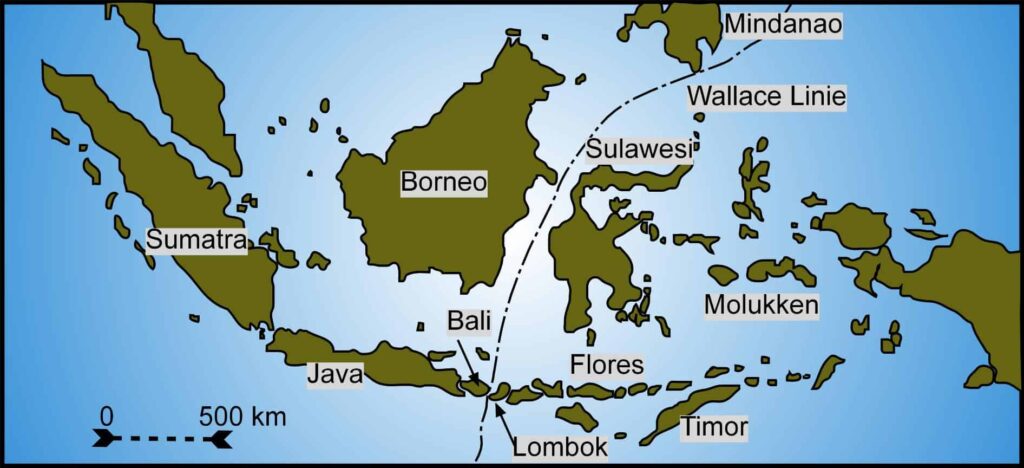
In the 19th century, the naturalist Alfred Russel Wallace embarked on an extraordinary journey through the Malay Archipelago, armed with nothing more than a butterfly net and a keen curiosity about the natural world. Wallace, renowned for independently developing a theory of evolution by natural selection—alongside Charles Darwin—found himself captivated by a biological enigma that scientists would later name the Wallace Line. This line serves as an invisible boundary dividing two distinct biological realms, with one side teeming with Asian species and the other with Australian fauna.
During his exploration, Wallace noted a striking shift while crossing from the island of Bali to the nearby island of Lombok. On Bali, he observed familiar animals—monkeys, wild boars, and woodpeckers. Yet, upon arriving in Lombok, he found himself surrounded by an entirely different ecosystem, one populated by honeyeaters, cockatoos, and tree-climbing marsupials. This abrupt ecological transition led Wallace to propose that a significant barrier prevented species from crossing between these regions, effectively creating a natural division.
The Origins of the Wallace Line
Wallace’s groundbreaking work spanned eight years and over 14,000 miles, culminating in the collection of 125,660 specimens, many of which were previously unknown to Western science. His observations laid the foundation for biogeography, the study of how species are distributed across geographical areas. Supported by a network of local assistants, particularly a Malay youth named Ali, Wallace documented the diverse life forms he encountered, revealing that the distribution of species was not random but intricately linked to geological history.
For over 160 years, the Wallace Line remained a scientific mystery. However, recent studies have provided clarity. Researchers from the Australian National University and ETH Zurich utilized a sophisticated computer model to analyze the forces shaping this boundary, revealing that it was created by high-speed continental collisions and significant climate changes approximately 35 million years ago. This newfound understanding of the Wallace Line highlights the impact of tectonic activity on biodiversity.
Australia’s northward drift, after separating from Antarctica, resulted in the formation of the Indonesian archipelago. This geological process created a series of stepping stones that allowed some species to migrate. Yet, deep ocean trenches and persistent marine barriers, particularly in the Wallacea region, stymied the movement of many terrestrial vertebrates. The convergence of the Australian and Eurasian plates dramatically altered the climate, leading to global cooling that would ultimately affect species survival and distribution.
Interestingly, the species exchange across the Wallace Line is asymmetric; biologists found that species migrated from Asia to Australia at rates at least twice as high as the reverse. This pattern can be attributed to the evolving climatic conditions affecting species on both sides of the line. Asian species, adapted to humid tropical climates, thrived when they moved into the richer environments of New Guinea and Australia. In contrast, Australian species, which evolved in drier conditions, struggled to adapt to the lush tropical forests of the Indonesian islands.
Recent findings from the study, led by Dr. Alex Skeels from ANU, underscore that precipitation tolerance played a crucial role in determining which species could successfully migrate across the line. “If you travel to Borneo, you won’t see any marsupial mammals, but if you go to the neighboring island of Sulawesi, you will,” Skeels explained. The research emphasizes that the climate on the newly formed islands was conducive to life, unlike the harsher environments faced by some Australian species.
As climate change accelerates at an unprecedented rate, understanding the Wallace Line offers valuable insights into species adaptation and survival amid environmental shifts. The ability to learn from past climate changes could aid in predicting how current species might respond to future challenges. The Wallace Line stands as a testament to the profound effects of geology and climate on biodiversity, inviting further exploration into other significant biogeographical boundaries, such as Weber’s Line and Lydekker’s Line.
Ultimately, the findings, published in the journal Science, highlight the importance of understanding the intricate relationships between geology, climate, and biodiversity. As we confront the challenges posed by climate change, recognition of these historical patterns can inform conservation efforts and enhance our understanding of the natural world around us.
Could This Week's Big Tech Earnings Send Dow, S&P 500, and Nasdaq Plummeting? Find Out Now!

France's Shocking Social Media Ban for Minors: What Parents MUST Know to Protect Their Kids!

Supreme Court's Shocking Decision: Could Brazil's Crypto Ban Spark Election Chaos? Find Out!

Is 2028 the Deadline for Humanity? Shocking New Report Reveals What’s at Stake!

2026 Election Shockers: Who Will Lead Duplin County? You Won't Believe Their Controversial Plans!

Measles Makes a Comeback: Are YOU and Your Kids at Risk? Shocking Numbers Inside!
You might also like: