
US Families on the Brink: Will Freezing Childcare Funding Leave 3 Million Kids in Crisis?

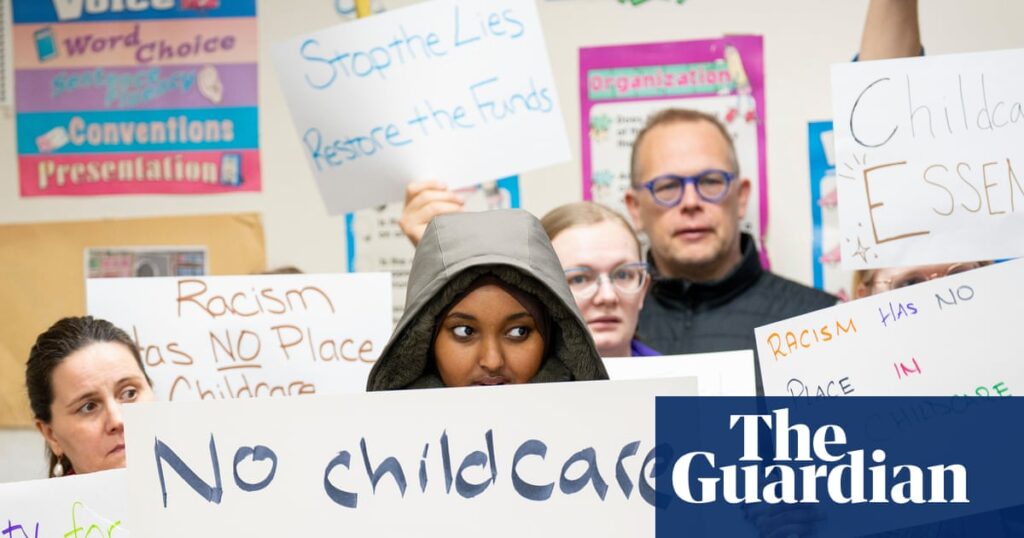
American families are facing what many describe as “impossible choices” as the Trump administration moves to freeze federal funds for childcare and family assistance in five states—Minnesota, New York, California, Illinois, and Colorado—over allegations of potential fraud and misuse of taxpayer money. Billions of dollars are at stake, with nearly $2.4 billion through the Child Care and Development Fund (CCDF), $7.35 billion through the Temporary Assistance for Needy Families (TANF), and $869 million through the Social Services Block Grant (SSBG) poised to be affected.
Alice Dryden, a childcare worker in Chicago, voiced her concerns to the Guardian, stating that freezing these funds would be a “disaster” for families reliant on them. “If we had to close our doors or close some classrooms, these families would be faced with impossible choices,” she explained. “This is a support network for the entire community. Our workforce allows the rest of the workforce in the city and the state to function.”
These sweeping claims of fraud originated from a viral video released by a conservative influencer, who collaborated with Minnesota Republicans to allege fraud at a Somali daycare center. However, multiple media outlets have debunked these claims, finding no evidence of misuse of federal funds at the childcare centers in question. The controversy has gained traction due to a 2021 COVID-19 fraud investigation involving a meals program called Feeding Our Future, which did uncover significant fraud. This scandal led to the prosecution and conviction of dozens of Somali-Americans, but it does not appear to be connected to the alleged fraud in childcare programs.
Lily Crooks, a childcare worker in Minneapolis, expressed her frustration with the government's response. “A lot of this reaction about fraud is actually about the Feeding Our Future scandal, which has already been widely covered, and having it brought up more broadly as fraud in childcare centers is extraordinarily misleading,” she said. Crooks emphasized that this narrative unfairly characterizes childcare providers as criminals, when in fact the funds are essential for families. “It’s actually cutting off childcare funds to families, not to childcare centers,” she added. “We’re just fighting to not be seen as criminals.”
As many working parents rely on these funds, Crooks warned that the freeze would also hinder their ability to work, creating ripple effects throughout local economies. “It’s already extremely difficult for families to receive childcare assistance, and to have it have yet another hurdle is going to drive people out of the workforce,” she stated.
Despite the severity of the situation, the federal government has not provided a timeline or details for the freeze. The funds will remain frozen until the Department of Health and Human Services (HHS) completes a review and confirms that the states are in compliance with federal requirements. Francis Ramirez, a childcare worker in Lancaster, California, expressed her shock at the freeze, noting, “I was in shock. It’s my only income. I’m a single mom.” For many families, the fear of losing childcare assistance is compounded by the uncertainty surrounding immigration enforcement. “There are families that are not being approved by the program, and some of them are afraid of what’s going on right now with ICE,” she said.
Claudia Alvarado, another childcare worker in California, criticized the administration's actions, calling them an attack on a crucial support system. “Childcare is not a partisan issue,” she asserted. Pam Frank, a childcare worker in Springfield, Illinois, pointed out that the U.S. is already facing a shortage of childcare providers, with many workers underpaid. “Most of the workers that work in the field already qualify for additional services. So it’ll be devastating, because parents won’t have anywhere to take their children,” she said.
The average annual cost of childcare in the U.S. is around $13,000, and these costs have been rising faster than inflation in nearly every state. Additionally, 45 states currently have fewer childcare providers than they did before the pandemic. “We already have a shortage,” Frank noted, highlighting the critical role that these providers play in supporting families.
In response to the freeze, the impacted states are suing the Trump administration. They successfully secured a court order to temporarily block the freezing of funds on January 9 and are currently seeking a longer-term injunction as a federal court hears the case. Meanwhile, the White House has not responded to multiple requests for comment, but a spokesperson from HHS described the lawsuit as a “partisan political stunt” against the freeze. “Waste, fraud, and abuse will not be tolerated in the Trump administration,” stated HHS general counsel Mike Stuart.
The attorneys general from the five states argue that the administration has failed to provide evidence of fraud or justification for the freezing of funds, claiming that these actions violate both the law and the U.S. Constitution. As the debate continues, families who rely on these services face an uncertain future, struggling to navigate a landscape of conflicting narratives and mounting pressures.
You Won't Believe Who Just Took Charge at Cyber AB—The Shocking Changes That Could Impact You!
Why Stock Futures Are Plummeting: Shocking Political Risks and Earnings Secrets Revealed!

You Won't Believe How Kalshi Lets You Bet on 50+ Soccer & Basketball Leagues—Are You Missing Out?

Is Roy Cooper the Secret Weapon for Democrats? Shocking Poll Results Inside!

You Won't Believe What Panthers CB Mike Jackson Achieved That Even All-Pro Devon Witherspoon Couldn't!

Nasscom's Shock Proposal: Could New Tax Rules Kill 2026 Startups? Find Out Now!
You might also like: