
Houston Startup Shocks Industry: Maersk's $20 Million Bet on Battery Power Could Change Everything!

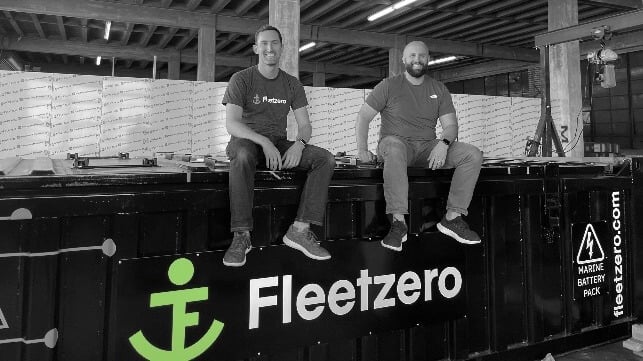
In recent years, the shipping industry has faced increasing pressure to adopt more sustainable practices, with many analysts skeptical about the feasibility of hybrid or battery-electric propulsion for long-distance ocean routes. This skepticism stems from concerns about the low energy density of lithium-ion batteries compared to more traditional power storage methods. While the batteries are often perceived as heavy and bulky, which could limit a ship's cargo capacity, a new player in the market, Fleetzero, is challenging this narrative and believes it can make hybrid technology commercially viable.
Fleetzero recently announced a successful Series A financing round, raising an impressive $43 million from notable investors, including Bill Gates' Breakthrough Energy Ventures, Maersk Growth, Obvious Ventures (co-founded by Evan Williams of Twitter fame), 8090 Industries, and Y Combinator, among others. This backing highlights the potential confidence in Fleetzero's vision to revolutionize maritime transportation.
"Fleetzero is making robotic ships a reality today. The team is moving us from dirty, dangerous, and expensive to clean, safe, and cost-effective. It's like watching the future today,"
said Andrew Beebe, Managing Director at Obvious Ventures. He emphasized that Fleetzero's team comprises experienced mariners and engineers who deeply understand the industry.
The goal of this financing round is to expand the manufacturing of Fleetzero's innovative hybrid and electric powerplants, which are currently in the rollout phase for commercial ships worldwide. The company plans to establish a new manufacturing hub in Houston, leveraging the city's abundant industrial expertise. The initial manufacturing capacity is set to be 300 MWh per year, with projections to increase tenfold within five years.
According to Steven Henderson, co-founder and CEO of Fleetzero, the hybrid and electric options are not only more environmentally friendly but also "simply cheaper" than conventional powerplants. He believes that the transition to electrification is "inevitable," as it can significantly lower total cost of ownership (TCO) by requiring less maintenance. Additionally, the company aims to integrate high levels of automation and autonomy into its operations.
This ambitious vision has attracted significant attention from well-capitalized backers in the maritime industry. For instance, MOL Plus, the venture capital arm of Mitsui O.S.K. Lines, has invested in Fleetzero, while AET, a leading tanker company, is exploring retrofitting one of its Lightering Support Vessels (LSV) with a plug-in hybrid-electric system. The recent investment by Maersk further solidifies the potential of Fleetzero's technology.
"We believe that electrification will be an important part of the mix on our journey to reach net-zero,"
said Morten Bo Christiansen, Head of Energy Transition at A.P. Moller-Maersk. He expressed confidence in Fleetzero's ambitions, noting their plans extend from battery technology to broader infrastructure.
Fleetzero is collaborating with the American Bureau of Shipping (ABS) to define the technical requirements necessary for containerized batteries. This partnership includes establishing design parameters, testing methods, and quality control procedures, all crucial safety items required for class approval. However, the challenge of energy density remains a significant hurdle, as both ABS and industry experts acknowledge.
"The next step is overcoming key barriers to deployment, most notably the constraints of energy density compared to conventional fuels and the associated safety challenges. We are proud to join Fleetzero in this effort to explore new approaches with safety as our guiding principle,"
stated Michael Kei, ABS Vice President of Technology. This acknowledgment underscores the complexities involved in transitioning the maritime industry toward more electric solutions.
The road ahead for Fleetzero is filled with potential yet fraught with challenges. As the global shipping industry grapples with the pressing need for sustainability, the success of Fleetzero could herald a significant shift in maritime transportation. If effective, hybrid and electric propulsion could reshape the industry, reducing its carbon footprint and paving the way for a greener future on the high seas.
You Won't Believe What Maine's Governor Just Declared for 2026—Is This the Year Women Farmers Rise?
You Won't Believe How Many People Lost Everything in THIS Shocking Financial Crisis! Are You Next?

Is Your Teen's Social Media Habit Leading Them to a Shocking 40% Increase in Crime? Find Out Now!

2026 College Football Champion Predicted! You Won't Believe Who's Taking the Title—Find Out Now!

You Won't Believe Paul Scholes' Shocking Net Worth: What Claire Froggatt Knows That Could Change Everything!

White House's Shocking Threat: What CBS News Didn't Want You to See in Trump Interview!
You might also like: